Yoga & health

Why Do Restorative Yoga Poses Make You Cry? A Neuro-Somatic Explanation
Crying in restorative yoga is not a sign that something is wrong; it’s a physiological signal that your body has finally achieved a state of profound safety, allowing accumulated stress and emotion to be processed and released. Your nervous system…
Lire la suite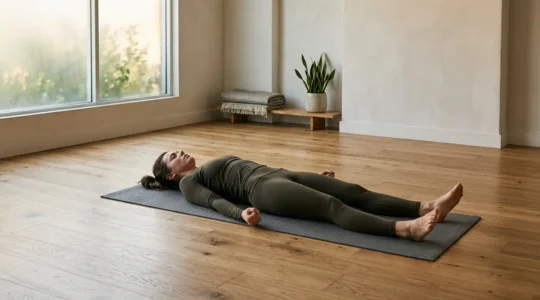
Why Does Your Relaxation Savasana Feel More Anxious Than Your Morning Commute?
Contrary to popular belief, the inability to relax isn’t a mental failure but a physiological signal that your nervous system is stuck in a state of high alert. The « wired but tired » feeling is a real biological state caused by…
Lire la suite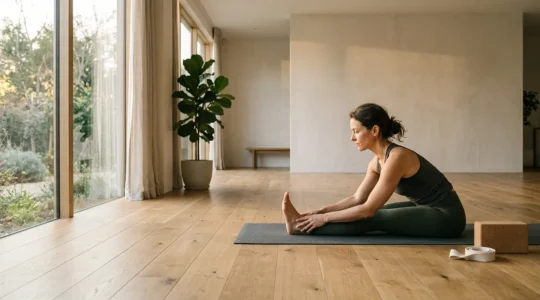
How to Safely Return to Yoga 6 Weeks After a Hamstring Strain?
The biggest mistake in yoga injury recovery is returning to your mat when your muscle *feels* ready, not when it’s *biologically healed*—a gap that causes most re-injuries. Complete rest can delay recovery; controlled, early movement (optimal loading) is key for…
Lire la suite
Why Does Your Shoulder Lose Mobility After 50 Even Without Injury?
The gradual loss of mobility after 50 is not an inevitable sentence of ‘wear and tear’, but a result of reversible changes in your connective tissues and nervous system. Stiffness often comes from the dehydration and thickening of fascia and…
Lire la suite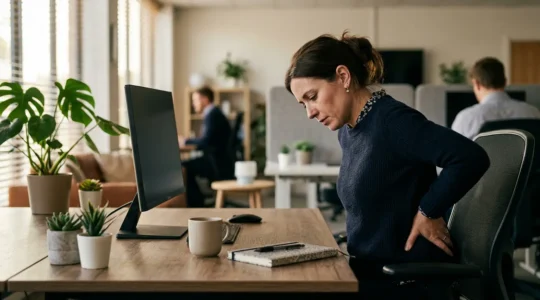
Why Does Your Posture Collapse by 3pm Despite a £400 Ergonomic Chair?
It’s the all-too-familiar story for the modern desk professional. You’ve invested in a top-of-the-line ergonomic chair, a marvel of engineering with lumbar support, adjustable armrests, and a price tag to match. You start your day sitting tall, feeling focused and…
Lire la suite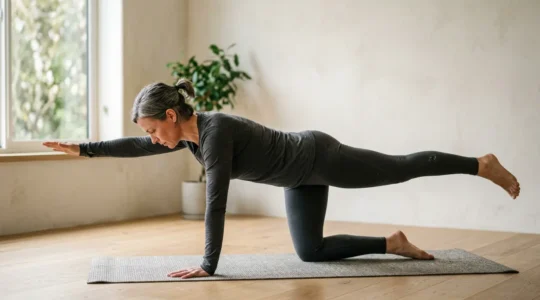
Why Crunches Won’t Fix Your Back Pain After 40—And What Actually Works
The endless crunches you’re doing to fix your back pain are likely making the problem worse. Crunches target superficial « mirror muscles, » not the deep core system that actually stabilises your spine. This neglect forces other muscles, like your hip flexors…
Lire la suite
How to Choose Between Sports Massage and Deep Tissue When You Have Chronic Back Pain?
For chronic back pain, the choice is not between « sports » or « deep tissue » massage; it’s about finding a qualified UK therapist who can accurately diagnose the source of your pain—be it muscle, fascia, or nerve. The title « Massage Therapist » is…
Lire la suite