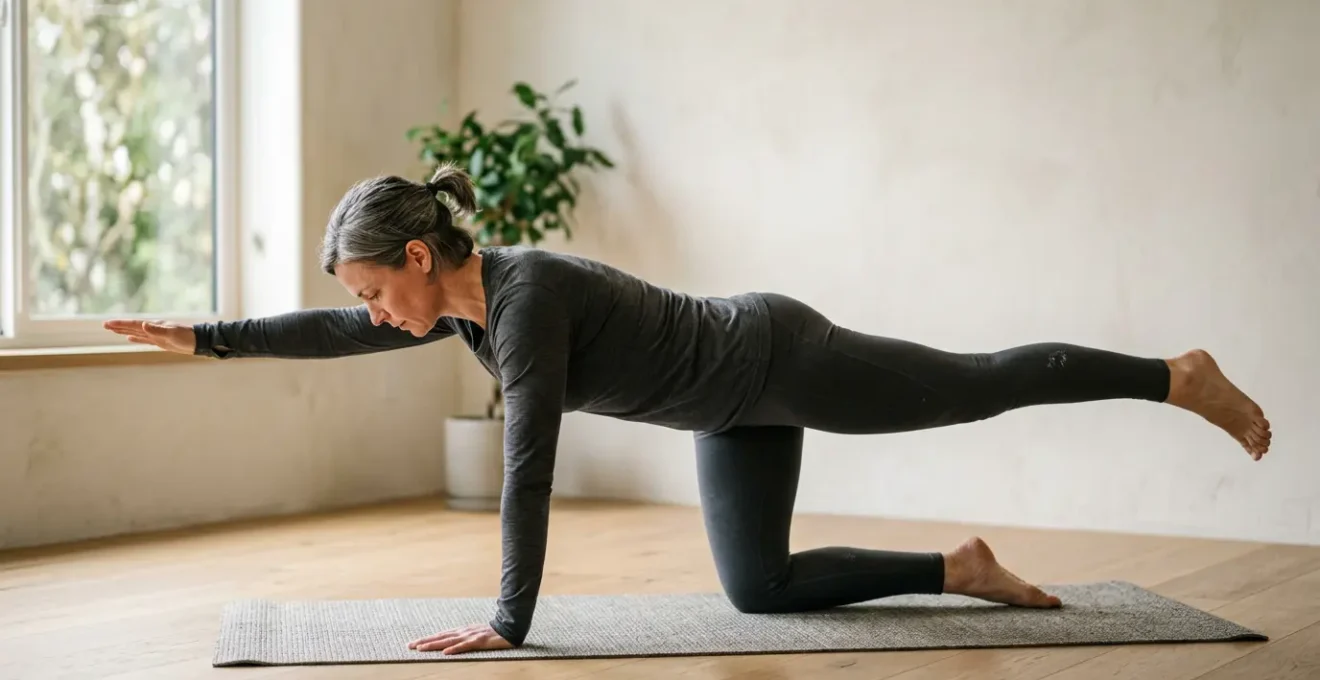
The endless crunches you’re doing to fix your back pain are likely making the problem worse.
- Crunches target superficial « mirror muscles, » not the deep core system that actually stabilises your spine.
- This neglect forces other muscles, like your hip flexors and lower back, to overwork, increasing strain and perpetuating the pain cycle.
Recommendation: Shift your focus from isolated ab exercises to integrated movements that awaken your body’s natural, 360-degree support system for lasting relief.
If you’re over 40 and dealing with that nagging, persistent lower back ache, you’ve probably found yourself on the floor, dutifully performing set after set of crunches. It’s the classic advice we’ve all heard: « Your back hurts? You need to strengthen your core. » For decades, a « strong core » has been marketed as a chiselled six-pack, the visual hallmark of fitness. So you crunch, you plank, and you feel the burn in your abs, yet the dull ache in your lumbar spine returns, sometimes even worse after a workout. This frustrating cycle leaves many feeling defeated, believing their back is simply « bad » or that this is an unavoidable part of ageing.
The frustration is understandable, but it’s based on a fundamental misunderstanding. The issue isn’t your effort; it’s your focus. The common approach to core training confuses the muscles you see in the mirror with the muscles that truly matter for spinal health. This is where the myth-busting begins. What if the key to a pain-free back has almost nothing to do with your rectus abdominis (the six-pack muscle) and everything to do with a deeper, more intelligent system you’ve likely never been taught to use? This is the concept of the « functional core, » a pressurised container of muscle that provides 360-degree support to your spine.
In this guide, we’ll dismantle the outdated ideas about core strength. As a physiotherapist, I’m here to empower you with knowledge that goes beyond aesthetics. We will explore the critical difference between superficial abs and the deep stabilising system, show you how to activate it unconsciously in daily life, and provide a clear roadmap to building strength you can actually use—the kind that lets you lift your grandchild or enjoy a round of golf without a second thought. It’s time to stop punishing your back and start training it with intelligence.
This article will guide you through the essential shifts in mindset and exercise needed to build a truly resilient and pain-free back. The following sections break down the science and practical steps to reclaim your functional strength.
Summary: The Physiotherapist’s Guide to a Resilient Back After 40
- What Is the Difference Between Your Six-Pack Muscles and the Core That Protects Your Spine?
- How to Engage Your Deep Core When Lifting Your Toddler Without Thinking About It?
- Planks or Dead Bugs: Which Exercise Actually Stabilises Your Spine for Golf?
- The Overlooked Mistake of Core Obsession That Creates Hip Flexor Tightness
- When Is It Safe to Progress Beyond Basic Core Exercises After a C-Section?
- Why Does Pilates Focus on Muscles You Cannot See Rather Than Your Six-Pack?
- What Is the Difference Between Gym Strength and Strength You Can Actually Use?
- Why Does Your Lower Back Hurt After Pilates When It Is Supposed to Help Your Back?
What Is the Difference Between Your Six-Pack Muscles and the Core That Protects Your Spine?
The most significant misconception in fitness is that the « core » is synonymous with the six-pack. This belief is the root cause of much chronic back pain, especially as we age. For people over 45, back pain becomes incredibly common; CDC data shows that back pain prevalence affects 44.3% of adults aged 45-64. The muscles you see, the rectus abdominis, are « mirror muscles. » Their primary job is to flex the spine forward—the exact movement of a crunch. While they look impressive, they offer very little in terms of deep spinal stabilisation. They are the flashy exterior of a building, not the foundational structure holding it up.
The true, protective core is a sophisticated system often called the « core canister. » Imagine a cylinder deep within your torso. The top is your diaphragm (your breathing muscle), the bottom is your pelvic floor, and the walls are formed by the deep transversus abdominis (TVA) wrapping around you like a corset, supported by the small multifidus muscles running along your spine. When these muscles work in harmony, they create intra-abdominal pressure. This pressure acts like a natural, internal weight belt, stiffening the spine and protecting it from excessive or uncontrolled movement. Crunches completely bypass this system.
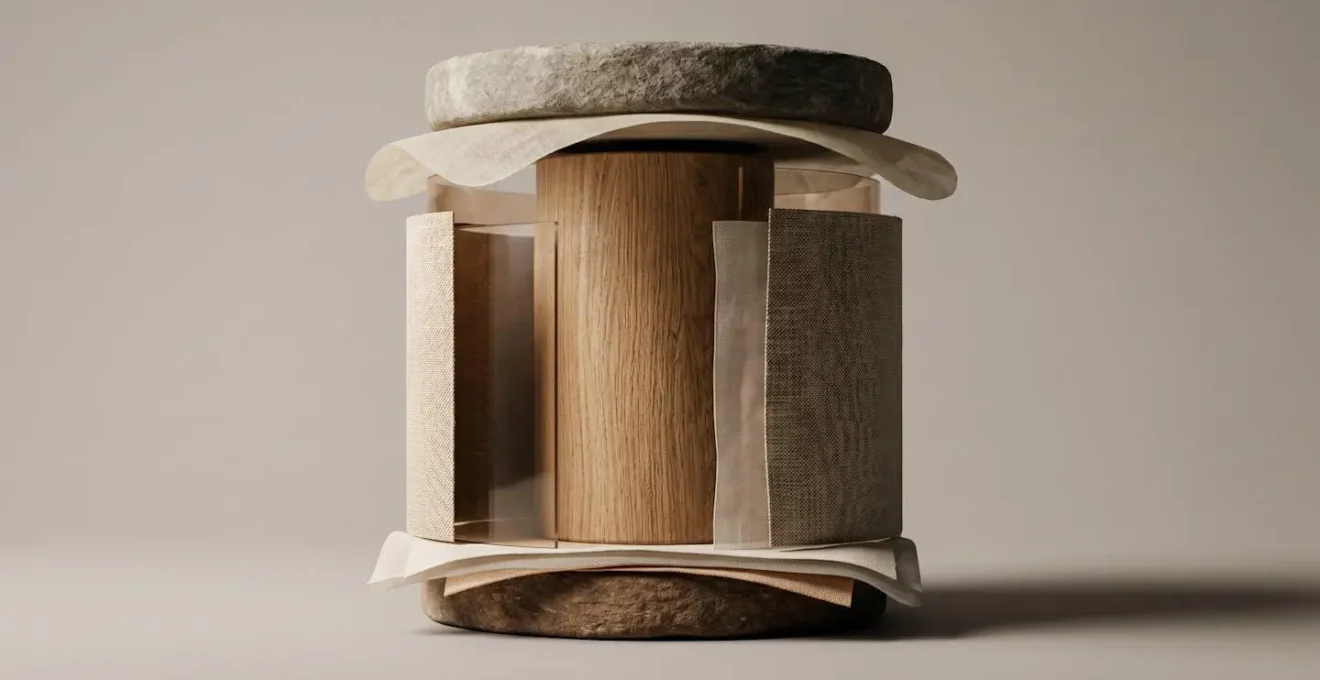
As the illustration symbolises, this system provides 360-degree stability. It doesn’t just prevent your spine from flexing forward; it controls rotation, side-bending, and extension. When this canister is dysfunctional—often due to sedentary lifestyles, poor breathing patterns, or a history of back pain—the body develops what can be called neuromuscular amnesia. It forgets how to activate this system. Instead, it relies on the superficial muscles (like the six-pack and lower back extensors) and other compensators (like hip flexors) to do a job they weren’t designed for. This is the pathway to strain, compression, and chronic pain. The solution isn’t more crunches; it’s re-learning how to pressurise your canister.
How to Engage Your Deep Core When Lifting Your Toddler Without Thinking About It?
The ultimate goal of effective core training isn’t to consciously « brace » for every single movement. It’s to retrain your body so that deep core activation becomes a subconscious, protective reflex. This is what we call reflexive stability. In a healthy, well-functioning system, these deep stabilisers fire automatically milliseconds before you even move a limb. As researchers from Strathcona Physical Therapy note, this anticipatory contraction is your body’s innate way of preparing the spine for a load, whether you’re reaching for a mug or lifting a child. The problem is that after years of poor habits or injury, this reflex can become dormant. Our job is to wake it up.
Rebuilding this automatic response requires a process of motor learning, moving from conscious, controlled practice to unconscious, real-world application. It’s like learning to drive a car; at first, every action is deliberate and mentally taxing, but eventually, it becomes second nature. You don’t « think » about pressing the brake in an emergency; you just do it. We need to create that same automatic response for your spine. This involves starting with simple exercises in a safe position to re-establish the brain-muscle connection, then gradually adding complexity and load until the pattern is ingrained.
The key is consistency and progression. You are not just building muscle; you are rewriting a neural pathway that has been neglected. The following plan outlines a proven protocol to move from basic activation to automatic, functional stability that protects you during unpredictable daily tasks.
Your Action Plan: Rebuilding Automatic Core Activation
- Isolate and Feel: Lie on your back with knees bent. Practice the abdominal drawing-in maneuver: exhale gently and draw your belly button toward your spine without holding your breath or moving your pelvis. Use your hands on your lower abdomen to feel the deep tension, imagining a corset tightening 360 degrees around you.
- Add Sensory Cues: Continue the drawing-in maneuver, but now focus on the exhale-on-exertion technique. As you exhale and engage, imagine you’re about to be lightly pushed, creating a firm but not rigid « brace. » This builds the connection between breath and stability.
- Introduce Light Load: Progress to functional movements while maintaining the core connection. Practice this exhale-and-engage technique while performing a simple bodyweight squat or lifting a very light kettlebell. The goal is to build the neural pathway under a manageable load.
- Master the Hip Hinge: The hip hinge is the foundation of safe lifting. Practice hinging at your hips (pushing your bum back) with a neutral spine, ensuring your hips and powerful leg muscles do the lifting while your « core canister » simply stabilises your torso.
- Integrate into Daily Life: Gradually apply this pattern to real-world tasks. Start by consciously engaging your core before picking up a bag of groceries. With repetition, this conscious step will fade away, and the deep core activation will become the automatic and protective reflex it’s meant to be.
Planks or Dead Bugs: Which Exercise Actually Stabilises Your Spine for Golf?
When it comes to functional activities like a golf swing, the question is no longer just « is my core strong? » but « is my core doing the right job at the right time? » The golf swing is a dynamic, high-velocity rotational movement. It requires a core that can resist unwanted twisting, transfer power efficiently from the ground up through the hips to the shoulders, and maintain a stable spinal position throughout. This is where the debate between exercises like planks and dead bugs becomes critical. Both are superior to crunches, but they serve different purposes in building a golf-ready core.
A plank is an excellent exercise for building static anti-extension strength. It teaches your core to resist the pull of gravity and prevent your lower back from arching. This has its place, particularly in maintaining a stable posture at address. However, the golf swing is not static. Your arms and legs are moving powerfully around a stable torso. This is where the dead bug excels. It challenges dynamic anti-extension by forcing you to maintain a neutral spine while your opposite arm and leg are in motion. It more closely mimics the challenge of keeping your centre stable while your extremities are creating force.
But for a truly rotational sport like golf, even dead bugs are just one piece of the puzzle. The most sport-specific core training involves resisting and controlling rotation. A comprehensive analysis, like one featured by experts in golf fitness, shows that anti-rotation and controlled rotation exercises are paramount.
| Exercise Type | Stability Quality | Golf Swing Relevance | Primary Benefit |
|---|---|---|---|
| Planks | Static anti-extension | Moderate – builds endurance | Spinal stability during address position |
| Dead Bugs | Dynamic anti-extension with limb movement | Good – adds movement complexity | Maintains neutral spine while extremities move |
| Pallof Press | Anti-rotation under load | Excellent – mimics swing mechanics | Resists twisting forces, transfers power from hips to shoulders |
| Cable Wood Chops | Controlled rotational power | Excellent – sport-specific | Trains diagonal power transfer essential for swing |
As the table demonstrates, a truly functional core program for a golfer must progress beyond simple static holds. While planks and dead bugs build the foundation, exercises like the Pallof Press (resisting a rotational pull) and Cable Wood Chops (controlling a rotational movement) directly train the « diagonal slings » of the body responsible for transferring power. This is how you build a core that not only prevents injury but actively enhances performance on the course.
The Overlooked Mistake of Core Obsession That Creates Hip Flexor Tightness
In the relentless pursuit of a « strong core » through endless crunches, sit-ups, and leg raises, many people inadvertently create a new problem: chronically tight and overactive hip flexors. This is one of the most common, yet overlooked, drivers of lower back pain. When the deep core stabilisers are weak or not firing correctly—a state of neuromuscular amnesia—the body is incredibly resourceful. It will find another muscle group to take over the job of stabilising the pelvis and spine. The primary recruits for this task are the hip flexors, particularly the psoas and iliacus.
This compensatory pattern is a recipe for dysfunction. The hip flexors are designed for movement (lifting the leg), not for prolonged stabilisation. When forced into this role, they become chronically overworked, shortened, and stiff. This is where the biomechanical cascade begins. As outlined in research from institutions like the Hospital for Special Surgery, this overactivity has a direct effect on your posture and spinal health.
The Biomechanical Cascade of Hip Flexor Compensation
When deep core and glute muscles are weak, the hip flexors are forced to take over the job of stabilizing the spine and pelvis. This leads to chronic overwork and stiffness. These tight hip flexors then pull the pelvis forward into an anterior pelvic tilt. This tilt increases the natural curve in the lower back (lumbar lordosis), which in turn compresses the facet joints of the spine. The result is joint irritation, muscle spasm in the lower back, and a feeling of constant tightness. The solution isn’t just to stretch the hip flexors; it’s a dual approach of releasing this tightness while simultaneously strengthening the deep core and, crucially, the glutes to restore proper muscle balance and break the compensatory cycle.
The solution, therefore, isn’t to do more sit-ups, which only shorten the hip flexors further. It’s a two-pronged attack: first, release the overactive hip flexors through targeted stretching. Second, and more importantly, strengthen the muscles that *should* have been doing the job in the first place—the deep core canister and the powerful gluteal muscles. By strengthening the glutes, you provide a counterbalance to the pull of the hip flexors, helping to restore the pelvis to a neutral position and decompressing the lower back.
When Is It Safe to Progress Beyond Basic Core Exercises After a C-Section?
Recovering from a C-section is a unique journey that requires patience, respect for the body’s healing process, and a highly specific approach to core rehabilitation. A Caesarean is major abdominal surgery that disrupts several layers of tissue, including the transversus abdominis (TVA)—the cornerstone of your deep core canister. The common desire to « get your body back » can lead to progressing too quickly, which can hinder recovery, worsen diastasis recti (abdominal separation), and lead to pain or dysfunction down the line. The question of « when is it safe? » has less to do with a specific timeline and more to do with meeting functional milestones.
The first step is always to get clearance from your doctor or a specialised pelvic health physiotherapist, typically around 6-8 weeks postpartum. The initial phase of rehab should focus exclusively on re-establishing the mind-body connection with the deep core and pelvic floor. This involves gentle breathwork (diaphragmatic breathing) and very low-level TVA activations, like the abdominal drawing-in maneuver described earlier. The key is to work at a level where you can maintain control without any « coning » or « doming » of the abdomen, which is a sign that the pressure is too great for the healing tissues to manage.
The power of this targeted, gentle approach is validated by science. A correctly implemented core stability program can make a clinically significant difference in muscle function post-surgery. As one authoritative study found:
Those in the exercise group increased transverse abdominis activation and improved timing compared to the control group, with strong effect sizes indicating clinical differences beyond measurement variability.
– Transversus Abdominis Research Team, Transversus Abdominis Activation and Timing Following Core Stability Training
Progressing beyond these basics is safe when you can perform foundational exercises (like heel slides, bent knee fallouts, and glute bridges) with perfect form, consistent deep core engagement, and no abdominal bulging. Only then is it appropriate to gradually introduce more challenging movements like dead bugs, modified planks, and eventually, full-body functional exercises. Rushing this process is counterproductive; a slow, steady, and intelligent progression builds a far stronger and more resilient foundation for life.
Why Does Pilates Focus on Muscles You Cannot See Rather Than Your Six-Pack?
Pilates has a reputation for creating long, lean muscles and a strong core, yet its methodology can seem counterintuitive to those raised on traditional gym workouts. The practice places immense emphasis on subtle movements, precise control, and activating muscles you can’t even see, like the transversus abdominis (TVA) and pelvic floor. This is a deliberate choice, rooted in the understanding that true strength—the kind that supports your joints and allows for graceful, efficient movement—is built from the inside out. It prioritises function over aesthetics, stability over superficial definition.
The six-pack muscles (rectus abdominis) are « fast-twitch » dominant. They are designed for powerful, short-burst contractions, like flexing the spine in a crunch. In contrast, the deep core muscles that Pilates targets have a different architecture. The TVA, for instance, is primarily composed of slow-twitch muscle fibres. This is the entire key to its function. As one physiotherapy group explains, these fibres allow it to maintain a low-level, gentle contraction for long periods, often without conscious thought. It’s designed to be an endurance muscle, silently humming away all day to provide constant, subtle support to your back and pelvis. Pilates is essentially a training system for these endurance-based stabilisers.

This focus on the « unseen » muscles is why Pilates can feel so challenging in a different way. It demands immense concentration and control to bypass the large, dominant « mirror muscles » and isolate the deep, subtle stabilisers. It’s not about how *much* you can lift or how *hard* you can contract; it’s about the quality and precision of the movement. By training this deep internal support system, you are building the very foundation of your body’s structure. A strong, responsive TVA and pelvic floor create the stable base from which all other movement can occur safely and efficiently. The visible toning is simply a happy by-product of a well-functioning, deeply supported system.
What Is the Difference Between Gym Strength and Strength You Can Actually Use?
There’s a significant and often misunderstood gap between « gym strength » and « functional strength. » Gym strength is what you build with isolated exercises in a controlled environment. It’s the ability to bench press a heavy barbell, perform a perfect bicep curl, or leg press an impressive weight. These feats are measurable and can be ego-boosting, but they don’t always translate to the chaotic, unpredictable demands of real life. This is why a person who can deadlift 200kg might still throw their back out picking up a wriggling toddler from an awkward angle.
Functional strength, on the other hand, is the ability to manage your own bodyweight and external loads through multiple planes of motion, in real-world situations. It’s integrated, not isolated. It’s the strength used by a furniture mover who can navigate a heavy sofa down a spiral staircase, or a gardener who spends hours bending, twisting, and lifting. This strength relies on the entire kinetic chain working together: your brain’s ability to anticipate a load, your deep core’s capacity to provide reflexive stability, and your larger muscles’ power to produce force in a coordinated fashion. It’s about synergy, timing, and control, not just raw power.
Traditional gym routines often break the body down into parts—chest day, leg day, back day. This can build impressive-looking muscle, but it fails to train the neuromuscular « software » that orchestrates movement between these parts. Functional training, by contrast, focuses on fundamental movement patterns: squatting, hinging, pushing, pulling, twisting, and carrying. These are the patterns of life. By training these movements, you are building a body that is not just strong in the gym, but resilient and capable everywhere else. You’re preparing it for the unexpected shift in a grocery bag or the sudden need to catch your balance on an icy pavement. This is the strength that truly matters for long-term health and a pain-free life after 40.
Key Takeaways
- Your true, protective core is a 360-degree « canister » of deep muscles, not the superficial six-pack targeted by crunches.
- Chronic back pain is often caused by compensation, where tight hip flexors and back muscles take over the job of a dormant deep core.
- The goal of effective training is « reflexive stability »—making deep core activation an automatic, subconscious reflex that protects you in daily life.
Why Does Your Lower Back Hurt After Pilates When It Is Supposed to Help Your Back?
It’s a frustrating paradox: you start Pilates, an exercise system lauded for its back-strengthening benefits, only to finish a class with a sore or aching lower back. This experience is surprisingly common and is almost always a sign that you are unintentionally reinforcing poor movement patterns rather than correcting them. While Pilates is an outstanding tool for building deep core strength, it is only effective if performed with correct form and an awareness of common compensations. When pain occurs, it’s a signal that something is off in the execution.
The most frequent culprit is overpowering the movement with the wrong muscles. If your deep core stabilisers (the TVA) are weak or you haven’t learned to engage them properly, your body will default to its old habits. During an exercise like the « Hundred » or « Roll Up, » instead of using your deep abdominals to support the movement, you might be gripping with your hip flexors or bracing with your superficial six-pack muscles. As we’ve discussed, this not only fails to strengthen the stabilisers but it also pulls on the pelvis and can compress the lumbar spine. Similarly, you might be using your back extensor muscles to force a movement, leading to muscle fatigue and soreness.
Another common issue is progressing too quickly. Pilates is a system built on foundational principles. Attempting advanced exercises before you have mastered the basics of pelvic stability and deep core engagement is a recipe for strain. Your instructor should be guiding you, but it’s also your responsibility to listen to your body and choose modifications. Feeling a « deep, low ab connection » is the goal; feeling a sharp grip in your hips or a pinch in your back is a red flag. The pain isn’t a failure of Pilates, but rather a valuable piece of feedback telling you to regress, refocus on the quality of the contraction, and truly master the fundamentals before moving on. A pain-free practice is a successful one.
Start building a body that supports you from the inside out. The path to a pain-free back begins not with more reps, but with smarter, more intentional movement. For personalised guidance, seeking an assessment from a qualified physiotherapist is the most effective next step to tailor these principles to your unique body and history.