Yoga & spirituality
For many modern practitioners, the journey into yoga begins on a rectangular mat, focusing entirely on physical shapes and flexibility. However, as the initial novelty of achieving complex postures fades, a profound realization often emerges: the physical practice is merely the gateway to a much deeper internal landscape. Exploring the intersection of yoga and spirituality reveals a rich tapestry of somatic awareness, ancient philosophy, deep meditation, and energetic subtle anatomy.
Understanding this broader spectrum is essential when your practice begins to feel empty, or when you realise that simply mastering a pose does not automatically grant inner peace. Bridging the gap between the physical movements of Hatha yoga and the profound realisations of traditional spiritual paths requires unlearning purely aesthetic goals and embracing a holistic approach to the mind-body connection. This exploration serves as your foundation for navigating the layers of practice that lie beyond the physical postures.
Reconnecting With the Physical Body: Beyond Perfect Postures
A common paradox in modern yoga spaces is the feeling of being entirely disconnected from your body, even while engaged in a demanding physical practice. When practice becomes highly aesthetic or performative, the internal experience is often sacrificed for external alignment.
The Trap of Perfectionist Adjustments
Focusing obsessively on micro-adjustments to achieve the ‘perfect’ shape can inadvertently create more physical tension and mental anxiety than it resolves. Treating the body like a mechanical object to be fixed rather than a living landscape to be experienced leads to a hollow practice. When you constantly analyse whether your hips are perfectly square or your heels are touching the floor, you override your nervous system’s subtle cues. True somatic awareness requires shifting the focus from how a pose looks to how it intrinsically feels.
Somatic Exploration and Nervous System Regulation
Developing genuine body awareness often requires stepping outside traditional linear movements. Practices like the Feldenkrais Method or mindful body scanning can reveal pockets of held tension that traditional stretching might bypass. To truly reconnect, consider these principles:
- Sensory curiosity: Notice temperature, weight, and subtle vibrations rather than just muscle stretch.
- Autonomic responses: Pay attention to your breath’s texture; a held breath is a clear indicator of nervous system stress.
- Restorative challenges: Acknowledge that your mind may race more in still, restorative poses than in active flow, as stillness removes the distraction of intense movement, forcing you to face internal mental chatter.
Demystifying Yoga Philosophy for the Modern Sceptic
While yoga is widely secularised today, ignoring its philosophical roots deprives the practitioner of the tools needed to navigate daily life off the mat. You do not need to adopt a new religion to benefit from these ancient psychological frameworks.
Applying the Eight Limbs in Daily Life
Most Western classes focus almost exclusively on Asana (postures) and Pranayama (breathwork), leaving the other limbs unexplored. The Yamas (ethical disciplines) and Niyamas (personal observances) offer a powerful, non-religious ethical compass. For instance, practising Ahimsa (non-violence) extends beyond physical harm; it includes the way you speak to yourself when your body feels stiff or tired. However, practitioners must be wary of spiritual bypassing—the tendency to use concepts like ‘everything happens for a reason’ to avoid dealing with genuine psychological wounds or systemic injustices. True spirituality demands engaging with reality, not escaping it.
Decoding Patanjali’s Yoga Sutras
The Yoga Sutras of Patanjali remain the definitive text on the mechanics of the mind. For a modern student, navigating the various translations can be daunting, as different scholars interpret the Sanskrit terms through distinct cultural lenses. To truly integrate the Sutras into your life rather than merely intellectualising them, a structured approach is highly recommended:
- Select a translation suited to your background (some are academic, others are deeply psychological).
- Study just one Sutra per week, allowing its meaning to percolate during your physical practice.
- Observe how the core tenet of the Sutra manifests in your daily interactions and stress triggers.
- Reflect on these observations in a journal to track your psychological evolution over a year.
The Science and Reality of Deep Meditation
Meditation is often marketed as a quick fix for productivity or stress, but traditional systems view it as a profound vehicle for altering baseline consciousness.
Transcendental Practices vs. Mindfulness Apps
The meditation landscape is vast, ranging from silent Vipassana to mantra-based Transcendental Meditation (TM) and guided mindfulness apps. While apps are excellent for initial nervous system regulation and building a daily habit, heavily guided sessions can sometimes keep the mind engaged in listening rather than allowing it to drop into profound stillness. Whether you invest in formal training or cultivate a silent home practice, lasting state changes in the brain require sustained, daily commitment over an extended period. Furthermore, for those who find sitting still excruciating, walking meditation or movement traditions often provide a more accessible gateway to deep states by giving the restless mind a rhythmic anchor.
Building a Sustainable Daily Habit
A common frustration is committing to a daily home practice, only to watch it collapse after two weeks. Relying solely on motivation guarantees eventual failure, as motivation is an emotional state that fluctuates. When you inevitably miss a week, returning to the mat without shame is crucial. A mature practice adapts to your current life season—sometimes demanding rigorous movement, and other times requiring nothing more than ten minutes of conscious breathing.
Navigating Energetics, Deep Rest, and Advanced States
As the body opens and the mind settles, practitioners often encounter phenomena that sound mystical but have profound physiological and psychological correlates.
Chakras, Energy, and Physical Fatigue
For the rationally minded sceptic, concepts like Chakras and energy channels can seem alienating. However, viewing them as ancient maps of the nervous system—corresponding to major nerve plexuses and endocrine glands—demystifies the experience. Often, what we perceive as profound physical fatigue is actually energetic depletion from chronic overstimulation. Learning to ground yourself after a practice that leaves you feeling ‘too wired’ is essential. Sensations of buzzing energy are signposts of an awakening nervous system, but becoming addicted to seeking these sensations can distract from genuine inner progress.
Conscious Sleep: The Power of Yoga Nidra
Yoga Nidra is not merely a guided relaxation; it is a systematic method of inducing complete physical, mental, and emotional relaxation while maintaining awareness. The goal is to traverse specific brain wave states (from Beta down to Theta and Delta) without falling asleep. This state of conscious deep sleep is highly effective for trauma recovery, with different schools (like iRest or the Bihar School) offering varied approaches. Integrating a powerful Sankalpa—a deep, affirmative resolve—during these receptive states plants seeds for psychological transformation far deeper than standard conscious willpower.
The Pursuit of Samadhi and Non-Duality
At the pinnacle of classical yoga lies Samadhi, a state of profound absorption and union. Modern classes rarely mention it, often confusing it with the zoned-out feeling after deep relaxation. Genuine Samadhi involves different progressive levels of cognitive absorption. However, pursuing it can sometimes morph into another form of achievement addiction. When yoga teachings state that ‘you are already one with everything’, they are pointing toward a direct, experiential shift in consciousness rather than a mere philosophical belief. Cultivating this universal connection does not negate the importance of individual suffering; rather, it fosters a profound, unconditional compassion for the human experience, bridging the gap between the ascetic monk and the modern householder.

Why Do Different Translations of the Yoga Sutras Seem to Say Completely Different Things?
You’re in a yoga class, and the teacher quotes a beautiful, inspiring line from Patanjali’s Yoga Sutras. It resonates deeply. Later, curious to learn more, you pick up a different translation of the same text, find the same sutra, and…
Lire la suite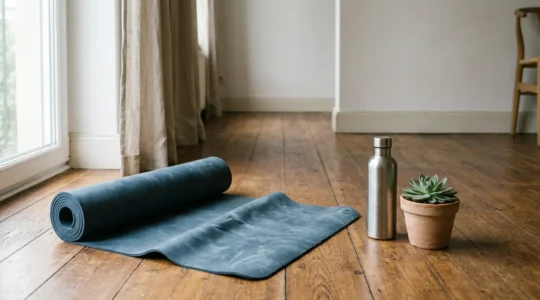
Why Does Your Home Practice Collapse After 2 Weeks Every Time You Commit?
Your spiritual practice doesn’t collapse because you lack discipline; it collapses because it’s built on the unreliable foundation of motivation. Motivation is neurologically designed to fade with familiarity, making it a poor long-term fuel for any habit. Lasting practice is…
Lire la suite
Why Does Walking Meditation Feel Awkward When Sitting Meditation Feels Natural to You?
If walking meditation feels awkward, you’re not failing at mindfulness; you’re experiencing valuable bio-feedback. This discomfort often stems from a ‘stillness bias’ where the mind expects the calm of sitting, clashing with the body’s complex sensory input during movement. The…
Lire la suite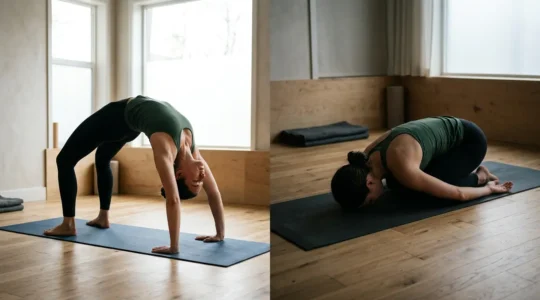
Why Do Some Yoga Classes Leave You Buzzing While Others Leave You Flat?
Contrary to popular belief, the goal of yoga isn’t to always feel a blissful « buzz »; it’s about learning to intelligently manage your nervous system. The energetic « high » or « crash » you feel is a direct reflection of whether a practice has…
Lire la suite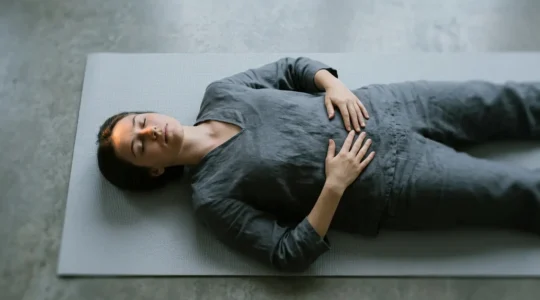
Why Do You Fall Asleep Every Time You Try Yoga Nidra Instead of Staying Aware?
If you constantly fall asleep during Yoga Nidra, it’s not a personal failure but a common neurological signal of nervous system fatigue. The practice aims for the « hypnagogic » state, a delicate threshold between Theta (creativity, light rest) and Delta (deep…
Lire la suite
What Does Yoga Mean by Saying You Are Already One with Everything?
The yogic idea of « oneness » isn’t a mystical belief but a tangible, neurological state you can cultivate. It’s about learning to quiet the brain’s « separateness-generator »—the part that creates a strong sense of « me »—through specific practices. This shift allows you to…
Lire la suite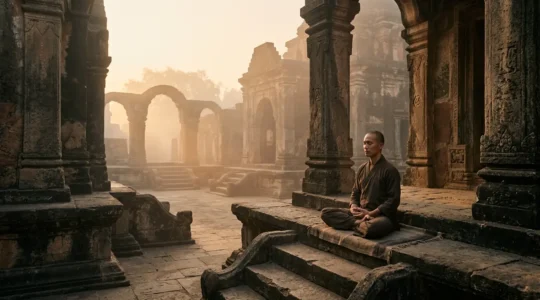
What Is Samadhi and Why Do Most Modern Yoga Classes Never Mention It?
Many practitioners believe Samadhi is an unattainable state of bliss reserved for monks. This guide reveals it as a trainable state of lucid awareness, accessible through systematic practice, and explains how understanding it is crucial to avoiding the traps of…
Lire la suite
What Actually Happens During Transcendental Meditation That Makes People Pay £500 for Training?
Contrary to popular belief, Transcendental Meditation’s high cost isn’t just for a secret mantra; it’s an entry fee to a training system designed to induce a specific and measurable state of ‘restful alertness’ that most free apps cannot replicate. Scientific…
Lire la suite
Why Does Your Yoga Practice Feel Empty Even When Your Poses Are Perfect?
The emptiness you feel in a technically perfect yoga practice is not a sign of failure, but a profound invitation to explore the 99% of yoga that exists beyond the mat. Most Western yoga focuses on Asana (poses), just one…
Lire la suite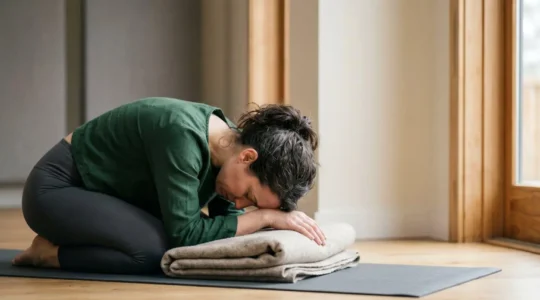
Why Do You Feel Disconnected from Your Body Even During Yoga Practice?
Feeling disconnected in yoga doesn’t mean you’re ‘bad’ at it; it’s a neurological habit of the nervous system operating on autopilot. The solution isn’t to ‘try harder’ to feel, but to gently re-educate your brain’s sensory channels—interoception and proprioception. Numbness…
Lire la suite