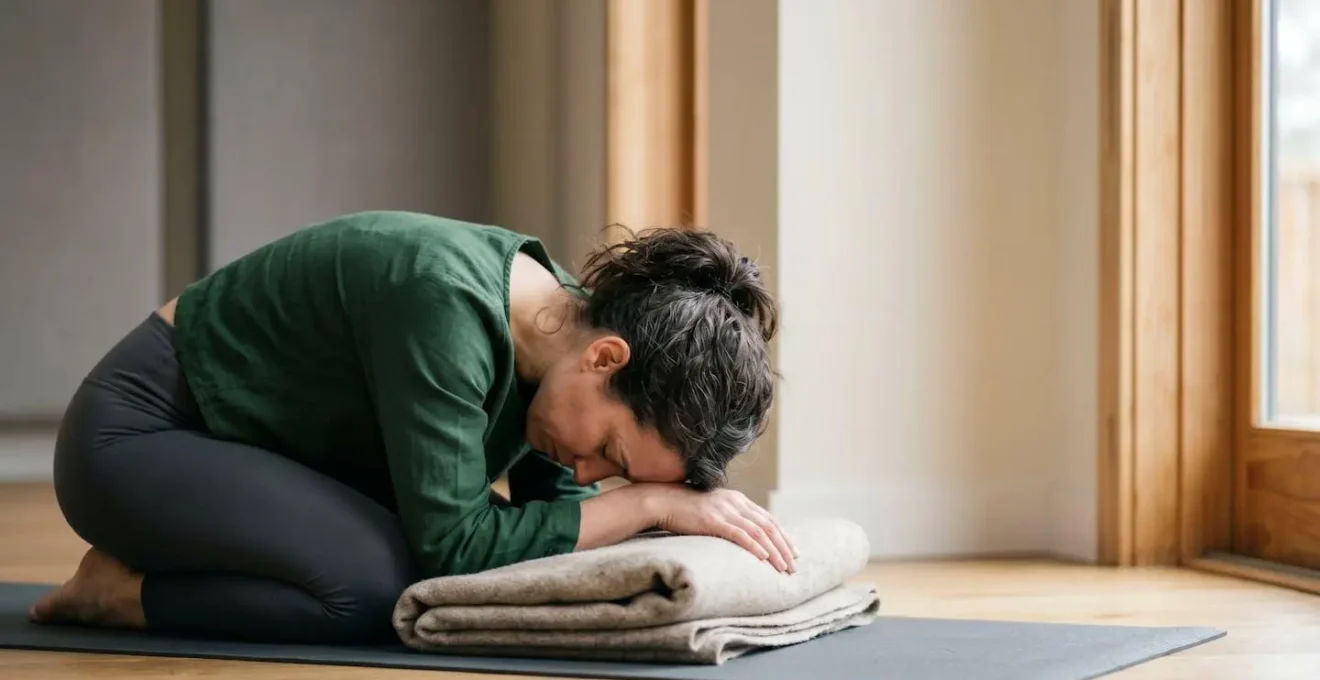
Feeling disconnected in yoga doesn’t mean you’re ‘bad’ at it; it’s a neurological habit of the nervous system operating on autopilot.
- The solution isn’t to ‘try harder’ to feel, but to gently re-educate your brain’s sensory channels—interoception and proprioception.
- Numbness or a blank feeling is often a sign of ‘Sensory-Motor Amnesia,’ where chronic tension drops out of conscious awareness.
Recommendation: Start with small, simple ‘contrast’ exercises to give your brain novel sensations, which is the first step to bringing awareness back online.
You move through a yoga sequence, your body making the familiar shapes of Downward Dog and Warrior II. The teacher cues you to « feel the stretch in your hamstrings » or « notice the sensation of breath, » but when you turn your attention inward, you’re met with a quiet hum, a vague numbness, or maybe just… nothing. You’re going through the motions, but you feel profoundly disconnected from the very body you’re trying to connect with. This experience is incredibly common and can be a source of deep frustration, making you feel like you are failing at the core purpose of the practice.
The typical advice is to « be more mindful » or « focus harder, » but this often creates more tension. It frames the problem as a lack of effort, when the reality is far more nuanced and gentle. This isn’t a personal failing. The feeling of disconnection is often a protective strategy of a nervous system that has learned to tune out certain signals. The path to reconnection isn’t about forcing a feeling; it’s about creating the conditions for sensation to be heard again. It’s about understanding the language of your body, which is spoken through subtle systems of internal and external sensing.
Instead of trying to break down a door that seems locked, what if we could find the key? This guide will explore that key. We will move beyond the platitudes and delve into the somatic principles of interoception and proprioception. We will explore why your body might go numb, why ‘forcing’ relaxation can backfire, and offer gentle, practical ways to invite sensation back into your practice and your life. This is an invitation to shift from ‘doing’ yoga to truly ‘being’ in your body.
To guide you on this journey of inner exploration, this article is structured to build your understanding step-by-step. Below is a summary of the key areas we will explore to help you rebuild that essential mind-body connection.
Summary: A Guide to Reconnecting with Your Body
- What Does « Feeling Your Body » Actually Mean When You Feel Nothing Specific?
- How to Body Scan in a Way That Reveals Held Tension You Didn’t Know Existed?
- Yoga or Feldenkrais: Which Practice Develops Body Awareness Faster for Beginners?
- Why Your Body Goes Numb During Certain Yoga Poses and What It Might Mean
- How to Add Pause Points for Internal Sensing Without Disrupting Your Vinyasa Flow?
- Why Forcing Yourself to Relax Can Backfire and Keep You Stuck in Stress
- How to Retrain Your Body to Notice Slumping Before Pain Starts?
- Why Does Your Relaxation Savasana Feel More Anxious Than Your Morning Commute?
What Does « Feeling Your Body » Actually Mean When You Feel Nothing Specific?
The instruction to « feel your body » can feel impossibly vague when your internal landscape seems blank. But « feeling nothing » is itself a piece of information. Feeling is not just about noticing big, obvious stretches or muscle burn. According to yoga and body awareness researchers, embodiment is a rich tapestry woven from three distinct sensory systems: exteroception (sensing the outside world, like the mat under your feet), proprioception (sensing your body’s position in space), and interoception (sensing your internal state, like your heartbeat, breath, or the subtle stirrings of emotion).
When you feel « nothing, » it often means your awareness is not yet tuned to the subtler frequencies of interoception. This is not a defect; it’s a common state in a world that trains us to live from the neck up. In fact, emerging research has shown that anxiety and depression correlate with difficulties in interoceptive processing. The first step, then, is to reframe the goal. Instead of searching for a specific, dramatic sensation, the invitation is to simply notice the quiet, neutral baseline. Is there coolness? Warmth? A subtle pressure? Or just a sense of space? All of it is valid sensory data.

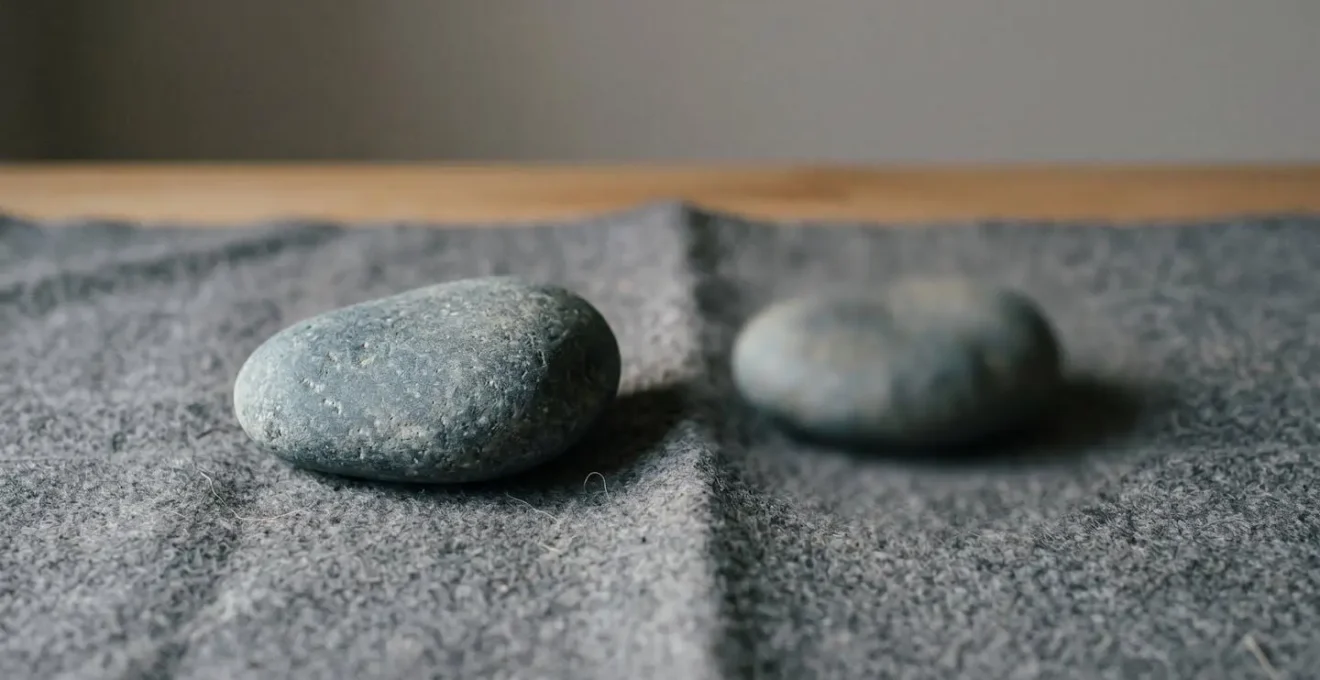
This image of a calm, neutral texture represents the « interoceptive baseline. » It’s the quiet state you can learn to tune into. Noticing this stillness is the foundation. From this place of neutral observation, without the pressure to feel something « more, » the more subtle sensations can begin to emerge. It’s about cultivating curiosity about your inner world, exactly as it is in this moment.
How to Body Scan in a Way That Reveals Held Tension You Didn’t Know Existed?
A traditional body scan, where you passively move your attention from head to toe, can sometimes amplify the feeling of « nothingness. » If a part of your body has chronic, low-grade tension, your brain may have already learned to tune it out. As experts at YogaUOnline note, a key benefit of interoceptive practices is that they « help to dissipate unconscious muscular tension—holding patterns you may not even know that you have! » To reveal these patterns, we need to give the brain something it can’t ignore: contrast.
Instead of just passively observing, you can use a technique of gentle, intentional tensing and releasing. This creates a clear « before and after » sensation that highlights the baseline level of tension that was previously invisible. It’s like turning on a light in a dim room; suddenly you can see what was there all along. This active approach provides your nervous system with novel data, waking it up from autopilot.
Action Plan: Revealing Hidden Tension with Contrast Scanning
- Choose a Target Area: Select one small, specific muscle group, such as your jaw, your right shoulder, or the space between your eyebrows.
- Introduce Gentle Tension: Consciously and gently contract that area—just enough to feel it working—for about 3 seconds. Avoid straining.
- Release and Observe: Completely let go of the contraction and bring your full attention to the area for the next 10-15 seconds.
- Notice the Afterglow: Pay close attention to the sensations that follow the release. You might notice warmth, tingling, softness, or a sense of spaciousness. This « afterglow » is the contrast to your hidden holding pattern.
- Integrate the Awareness: As you feel this new state of release, you are actively teaching your brain what « letting go » feels like in this specific area, making it easier to notice and release tension in the future.
By using this method, you are not just scanning; you are entering into a direct dialogue with your nervous system. You are providing it with the clear, comparative information it needs to update its internal map and release patterns of tension that no longer serve you.
Yoga or Feldenkrais: Which Practice Develops Body Awareness Faster for Beginners?
While yoga is a powerful path to body awareness, it’s not the only one. For practitioners who feel « stuck » or disconnected, exploring a different modality like the Feldenkrais Method can be transformative. The question isn’t which is « better, » but how their different approaches can serve your goal. Yoga often involves holding static postures or flowing through sequences, focusing on alignment and breath. Feldenkrais, on the other hand, is a process of direct sensory-motor learning that uses small, gentle, and often unusual movements to communicate directly with the nervous system.
The core of Feldenkrais is neuroplasticity—the brain’s ability to reorganize itself by forming new neural connections. As researcher L.K. Myers explains, this principle is « fundamental to the Feldenkrais Method » for modifying « maladaptive, pain-perpetuating and inefficient movement patterns. » Instead of stretching a « tight » muscle, a Feldenkrais lesson might guide you through a novel movement that helps the brain « remember » how to release that muscle voluntarily. It prioritizes the quality of movement and attention over achieving a specific shape. This focus on process over outcome has shown remarkable results, and research on neuroplasticity interventions reveals that it can be effective even in clinical populations, such as improving ataxia in MS patients.
For a beginner struggling with disconnection, Feldenkrais can sometimes feel more accessible. Its emphasis on novelty, slowness, and ease provides the nervous system with the safety and new information it needs to learn. It bypasses the feeling of « failing » at a pose and instead fosters a sense of curiosity and discovery. You might find that practicing Feldenkrais for a time dramatically deepens your yoga practice, as you bring a more refined sensory awareness back to the mat.
Why Your Body Goes Numb During Certain Yoga Poses and What It Might Mean
Feeling a specific area « go numb » or completely blank during a yoga pose can be unsettling. You might be in a deep hip opener and feel sensation everywhere *but* the targeted hip. This isn’t just a lack of flexibility; it’s often a neurological phenomenon. The late somatic pioneer Thomas Hanna coined a term for this: Sensory-Motor Amnesia (SMA). It describes a state where inefficient patterns of muscular activation become so habitual that the brain literally loses its ability to sense and voluntarily control them.
Sensory Motor Amnesia describes inefficient patterns of muscular activation that are so habitual you can’t sense or control them.
– Thomas Hanna, Better Movement
This « amnesia » is a functional memory loss in the nervous system, not a problem with the muscle tissue itself. Your brain has essentially put a chronically tight area on « ignore » to conserve energy, recruiting other muscles to compensate. When a yoga pose challenges this forgotten area, your brain has no clear sensory map to refer to, and the result is a feeling of numbness or disconnection.
Case Study: The Brain’s Forgotten Movement Patterns
In his work, Thomas Hanna described how Sensory-Motor Amnesia (SMA) leads to a loss of sensation and motor control when muscular patterns become deeply automated. This is not a structural issue but a neurological one where chronically tense areas literally drop out of conscious awareness. The brain adapts by using other tissues to compensate, which creates inefficient movement and the very sensation of numbness or disconnection you might feel during a pose that specifically asks that « forgotten » area to participate. The path to resolving SMA isn’t forceful stretching, but gentle, mindful movements that re-educate the brain and remind it that it has control over these muscles.
Understanding this concept is empowering. The numbness isn’t a sign that you are broken; it’s a signpost pointing to an area where your brain needs a gentle re-introduction. The contrast techniques and novel movements discussed earlier are direct remedies for SMA, helping to bring these sensory « dead zones » back to life.
How to Add Pause Points for Internal Sensing Without Disrupting Your Vinyasa Flow?
For those who love the rhythm and heat of a Vinyasa practice, the idea of slowing down for internal sensing can feel like it would ruin the flow. But embodiment isn’t at odds with dynamic movement. The key is to strategically weave « pause points » into your practice, creating small islands of interoceptive awareness in the river of your flow. As occupational therapist Kelly Mahler suggests, « Shifting from a focus of assuming the pose to a focus on noticing the way your body feels during that pose, makes it more of an explicit interoception learning activity. »
You don’t need to pause for minutes at a time. A structured, three-breath rhythm in a few key poses can be incredibly effective. This creates a predictable pattern that your mind and body can learn, allowing you to drop into sensing mode quickly and efficiently without losing momentum. Choose 3-5 poses in your practice (like Warrior II, Triangle, or a lunge) to apply this technique.
A simple yet powerful framework for this is the « 3-Breath Rule for Interoceptive Practice »:
- Breath One (Structural): As you arrive in the pose, use the first full breath cycle to establish your physical alignment. Check your foundation, the stacking of your joints, and the overall safety of the form. This is the « doing » part.
- Breath Two (Sensory): For the second full breath, shift your attention entirely to a single, specific internal sensation. It could be the pressure of your front foot on the mat, the feeling of stretch in your inner thigh, or the expansion of your ribcage. Notice it without judgment.
- Breath Three (Emotional): On the third breath, observe the emotional « flavor » of the pose. Does it feel empowering? Constricting? Agitating? Joyful? Simply notice the quality that arises without needing to change it. Then, flow to your next position.
This structured approach transforms a simple hold into a rich, multi-layered experience. It trains your brain to quickly shift between structural awareness, sensory detail, and emotional quality, deepening your practice from the inside out without ever coming to a full stop.
Why Forcing Yourself to Relax Can Backfire and Keep You Stuck in Stress
« Just relax! » is perhaps one of the most common and least helpful pieces of advice given. When you are feeling stressed or anxious, this command can paradoxically increase your internal stress. The attempt to force relaxation creates an inner conflict that keeps your nervous system on high alert. This is because the part of your brain that « tries » and « does » (the prefrontal cortex) is different from the part that « feels » (the limbic system). When the « doer » commands the « feeler » to relax, it often perceives this as a performance demand, leading to more stress if it « fails. »
The Paradox: Interoceptive Attention and Psychological Distress
Contemplative research highlights a critical paradox. As individuals pay closer attention to their internal sensations (interoception), they may discover significant levels of tension and psychological distress that were previously out of their awareness. The command to « relax » activates the executive « doer » part of the brain, which often works in opposition to the feeling, limbic system. This internal battle can actually increase sympathetic nervous system arousal—the very stress response you’re trying to reduce. A more effective therapeutic approach is what can be called ‘permission to not relax.’ By actively giving yourself permission to feel anxious, tense, or distracted, you reduce the secondary stress caused by ‘failing to relax,’ which paradoxically creates space for genuine relaxation to arise on its own.
Instead of demanding relaxation, a more somatic and effective approach is to offer yourself permission. Give yourself permission to be exactly as you are. Permission to feel anxious. Permission for your mind to race. Permission for your jaw to be tight. By removing the judgment and the fight, you stop adding a second layer of stress (stress about being stressed). In this space of gentle acceptance, the nervous system no longer feels under threat from your own self-criticism, and it can begin to down-regulate naturally.
How to Retrain Your Body to Notice Slumping Before Pain Starts?
Poor posture, like slumping at a desk, is another form of Sensory-Motor Amnesia. By the time you feel back pain, the slumping pattern is already deeply ingrained. The key to breaking this cycle is to retrain your proprioception—your sense of your body’s position—so that you notice the *shift* toward slumping long before it becomes painful. As with interoception, the brain is far more sensitive to contrast and change than it is to a static state. We can use this to our advantage.
The goal is to create a sharp sensory contrast between aligned posture and slumped posture. By intentionally moving between the two extremes, you are amplifying the sensory signals sent to your brain, making the difference between them impossible to ignore. This exaggerates the feedback loop, effectively recalibrating your body’s internal GPS.
You can do this anywhere with a simple « Proprioceptive Contrast Training » exercise:
- Find Your Ideal Posture: First, stand or sit in what you perceive as your best, most aligned posture. Hold it for 10 seconds. Don’t focus on how it looks, but on how it *feels* internally—the lift in your chest, the length in your spine, the balance in your feet.
- Embrace the Slump: Now, deliberately adopt your worst, most habitual slumped posture. Exaggerate it slightly for 10 seconds. Really notice the sensations: the compression in your lower back, the heaviness in your shoulders, the restriction in your breathing.
- Return and Notice the Contrast: Shift back to your ideal posture. Feel the immediate difference? That feeling of lightness, space, and ease is the contrast. This heightened awareness is what you are training.
- Repeat for Reinforcement: Cycling between these two states 3-5 times, a few times a day, trains your proprioceptive system to send out an « early warning signal » the moment you begin to drift toward a slump.
Yoga practice is an excellent environment for this kind of training. As body awareness specialists note, « Yoga helps to optimize proprioception because you get to practice all sorts of different ways to stay upright, balanced, and safe in lots of different positions, fast or slow. » Every pose is an opportunity to feel your body in space and refine that internal map.
Key Takeaways
- Sensation is a Skill: Feeling your body is not a given; it’s a skill built on three systems: interoception, proprioception, and exteroception. Disconnection is often a sign these systems need gentle retraining.
- Contrast is the Key: The brain learns through difference. Using techniques that contrast tension and release, or good posture and bad posture, is the fastest way to wake up sensory awareness.
- Permission, Not Perfection: Forcing relaxation or trying harder to « feel » often backfires. Giving yourself permission to be where you are reduces nervous system threat and creates space for genuine change.
Why Does Your Relaxation Savasana Feel More Anxious Than Your Morning Commute?
You’ve made it through an entire yoga class. You lie down for Savasana, the final relaxation, and instead of peace, your heart starts to pound. Your mind races, and you feel more anxious than you did during your hectic morning commute. This experience is deeply confusing, especially when scientific studies demonstrate that Savasana is designed to decrease cortisol and activate the rest-and-digest nervous system. The truth is, for a chronically stressed nervous system, stillness is not always perceived as safe.
A nervous system that is constantly « on » is always scanning the environment for threats. During a busy day, it has plenty of external stimuli to focus on: emails, traffic, conversations. This external focus keeps the underlying hum of anxiety at bay. When you lie down in a quiet room for Savasana, all of that external noise is suddenly removed. As nervous system researchers explain, for a chronically stressed system, « a sudden lack of external stimuli can be interpreted as a threat, causing the brain to scan for danger and producing anxiety instead of relaxation. »
Your brain, finding no external threats to latch onto, turns its hyper-vigilant scanner inward. It magnifies every subtle internal sensation—a heartbeat, a twitch, a thought—and interprets it as a potential problem. This is not a conscious choice; it’s a deeply ingrained survival reflex. To make Savasana feel safer, you may need to give your scanning mind a gentle, soothing anchor. Instead of an empty space, provide a simple focus: the weight of a blanket on your body, the feeling of the floor supporting you, or the sound of your own quiet breath. These are simple exteroceptive and interoceptive anchors that tell your nervous system, « You are here. You are supported. You are safe. »
This journey back into your body is not about achieving a perfect state of blissful awareness. It is a gentle, compassionate process of listening, learning, and re-establishing trust. By understanding these somatic principles, you can begin to transform your yoga practice from a series of empty shapes into a rich, living conversation with yourself. To begin this dialogue, simply choose one technique from this guide and apply it with curiosity and without expectation.