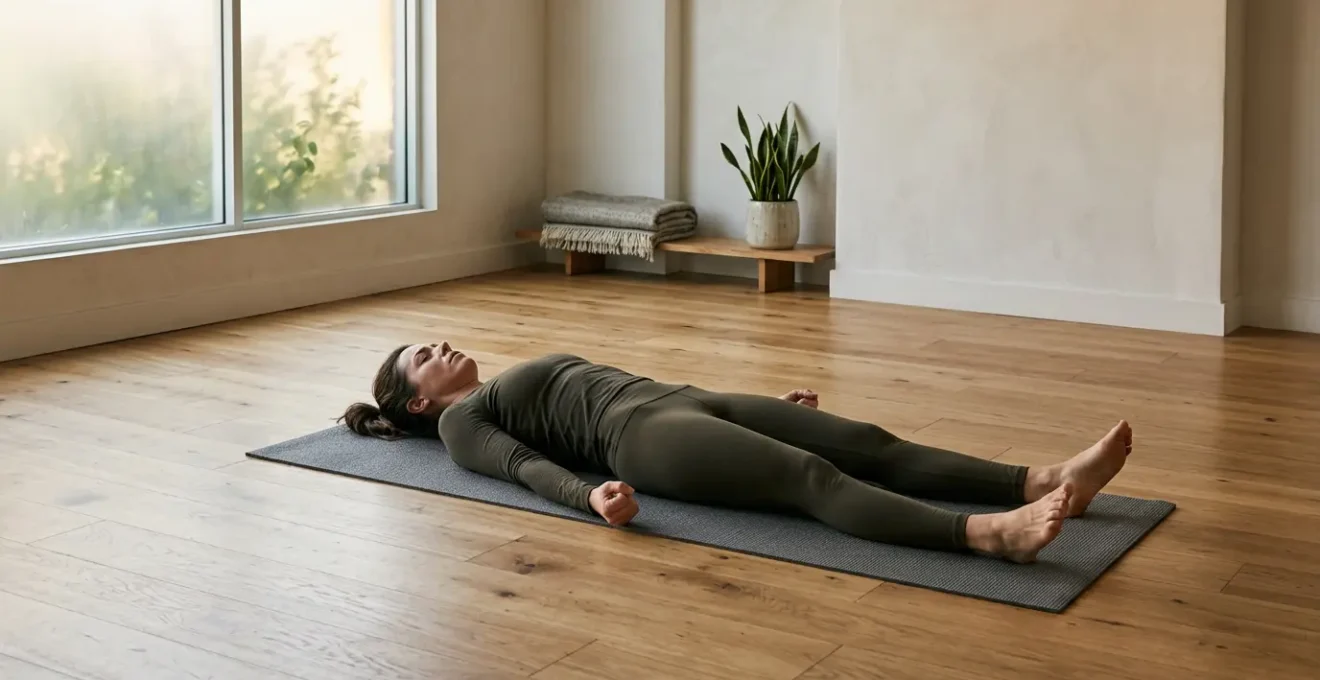
Contrary to popular belief, the inability to relax isn’t a mental failure but a physiological signal that your nervous system is stuck in a state of high alert.
- The « wired but tired » feeling is a real biological state caused by hormonal dysregulation from chronic stress.
- Forcing slow breathing can increase anxiety; specific exhale-focused techniques like the « physiological sigh » are scientifically proven to be more effective for a highly activated system.
Recommendation: Shift your focus from forcing your mind to be calm to giving your body the specific signals it needs to feel safe, starting with a five-minute daily breathing practice.
If you’ve ever laid down for Savasana (corpse pose) at the end of a yoga class, desperate for a moment of peace, only to find your heart racing and your mind more cluttered than before, you are not alone. This paradox is deeply frustrating. You’re given the time, space, and permission to rest, yet your body seems to revolt, flooding you with more anxiety than your morning commute. The typical advice to « just let go » or « breathe deeper » often feels like adding insult to injury, increasing the sense of failure.
The common understanding of relaxation is flawed. We treat it as a mental switch we should be able to flip. But what if the problem isn’t your willpower? What if it’s a profound misunderstanding of your own biology? The key to unlocking genuine rest lies not in trying harder to be calm, but in understanding the language of your nervous system. This isn’t about a lack of discipline; it’s about a mismatch between your physiological state and the tools you’re using.
This article will demystify this experience from a nervous system perspective. We will explore the real biological mechanisms that make relaxation feel impossible, introduce scientifically-backed techniques that work *with* your physiology instead of against it, and reframe your relationship with rest. You will learn why your body sometimes rejects calm and how to send it clear, effective signals of safety to finally move from a state of high-strung stress to deep, restorative peace.
To guide you through this process, we will explore the science behind your body’s stress response and provide practical, accessible tools to help you navigate it. Here is a breakdown of the key areas we will cover.
Summary: Unlocking the Paradox of Stressful Relaxation
- What Is Actually Happening in Your Body When You Feel Wired but Tired?
- Which Breathing Technique Works When You Are Already Too Activated to Breathe Slowly?
- Restorative Yoga or Breathwork: Which Calms Your Nervous System Faster After Work?
- Why Forcing Yourself to Relax Can Backfire and Keep You Stuck in Stress
- How to Build a 5-Minute Daily Practice That Prevents Stress from Accumulating?
- Why Your Body Goes Numb During Certain Yoga Poses and What It Might Mean
- What Makes Burnout Different from Regular Exhaustion and Why Normal Rest Doesn’t Fix It?
- Why Can’t You Relax Even When You Finally Have Time Off?
What Is Actually Happening in Your Body When You Feel Wired but Tired?
That feeling of being simultaneously exhausted and buzzing with an anxious energy is a hallmark of a dysregulated nervous system. It’s not just « in your head »; it’s a tangible, physiological state driven by your body’s hormonal stress response. This mechanism, known as the Hypothalamic-Pituitary-Adrenal (HPA) axis, is designed for short-term survival. When faced with a threat, it releases cortisol, the primary stress hormone, to give you a burst of energy to fight or flee.
In a healthy cycle, cortisol levels are highest in the morning to wake you up and gradually decrease throughout the day. However, chronic stress—from work deadlines, personal worries, or constant digital stimulation—keeps this system activated. Your body is perpetually flooded with cortisol, never getting the signal that the « threat » is over. Over time, this leads to HPA axis dysregulation. The system becomes less sensitive, and your natural cortisol rhythm is disrupted.
This creates the « wired but tired » paradox. Your body is physically exhausted from the constant state of high alert, but the elevated cortisol levels prevent your nervous system from shifting into its « rest-and-digest » (parasympathetic) mode. Instead, you’re stuck in a low-grade « fight-or-flight » (sympathetic) state. According to researchers, this chronic activation has significant consequences. As they explain, « Chronic stress leads to HPA axis dysregulation that causes sustained cortisol production. Consequently, this dysfunction leads to neurobiological changes, including neuroinflammation, oxidative stress, and structural alterations in critical brain regions like the hippocampus, » as detailed in a study on stress-associated depressive disorders.
This biological reality is confirmed by clinical data. A 2025 cross-sectional study on HPA axis function found that individuals with chronic stress show a significantly flattened diurnal cortisol slope. Specifically, the study noted that participants with chronic stress exhibited a flattened diurnal cortisol slope of -0.18 ± 0.03 compared to healthy controls, along with much lower cortisol levels in the morning. This hormonal flatlining is the biological signature of being wired, tired, and stuck.
Which Breathing Technique Works When You Are Already Too Activated to Breathe Slowly?
When you’re already in a state of high activation, the common advice to « take a slow, deep breath » can feel impossible and even counterproductive. Trying to force a slow rhythm when your sympathetic nervous system is screaming « danger! » can create more internal conflict and anxiety. Your body needs a different kind of signal—one that works *with* its current state to gently guide it back toward equilibrium. The most effective technique in this scenario is not about slowness, but about the exhale.
Enter the physiological sigh. This is an innate breathing pattern that humans and animals naturally use to de-stress and reset. You’ve done it unknowingly after a good cry or when falling into a deep sleep. It involves a double inhale through the nose followed by a long, extended exhale through the mouth. The mechanism is purely mechanical and brilliant: the first inhale fills the lungs, but the second, smaller inhale pops open the tiny air sacs (alveoli) that may have collapsed due to stress. This maximizes the surface area for gas exchange, allowing you to offload carbon dioxide more efficiently on the extended exhale. This rapid expulsion of CO2 is a powerful, direct signal to the brainstem to slow the heart rate and switch off the stress response.
The effectiveness of this technique is not just anecdotal; it’s backed by robust science. A landmark randomized controlled trial from Stanford University compared the effects of five minutes of daily practice of cyclic sighing, box breathing, and mindfulness meditation. The results were clear: the cyclic sighing group showed the most significant improvement in mood and the most substantial reduction in respiratory rate, a key indicator of nervous system calming.
The study found that while all practices were beneficial, the physiological sigh was uniquely effective at producing a rapid down-regulation. This is because, unlike passive meditation, it’s an active, physiological intervention. You are not trying to convince your mind to be calm; you are using the mechanics of your lungs to tell your brainstem that it’s safe to stand down. It’s a bottom-up approach that bypasses the frantic, analytical mind and speaks directly to the ancient, regulatory parts of your brain.
Restorative Yoga or Breathwork: Which Calms Your Nervous System Faster After Work?
After a stressful workday, the goal is to shift your nervous system out of a high-alert, sympathetic state and into a restorative, parasympathetic one. Both restorative yoga and focused breathwork are excellent tools for this, but they work through different mechanisms and on different timelines. The « faster » choice depends on your specific state of activation.
Breathwork, particularly exhale-focused techniques like the physiological sigh, offers the most rapid intervention. As we’ve seen, it acts like a direct physiological « off-switch » for the stress response. Its power lies in its ability to quickly alter your biochemistry and signal to your brainstem that the immediate threat has passed. If you come home feeling acutely agitated, jittery, or overwhelmed, a five-minute breathwork session is likely your most effective first-aid. It cuts through the mental noise and provides an immediate, palpable shift in your physical state.
Restorative yoga, on the other hand, works more slowly but perhaps more deeply. Its primary mechanism is not active intervention but the creation of an environment of profound safety and support. The practice uses an abundance of props—bolsters, blankets, blocks—to hold the body completely, removing any need for muscular effort. This is where the concept of neuroception comes into play: your nervous system’s subconscious ability to scan for cues of safety or danger. By being completely supported, warm, and still, you are sending your body powerful, non-verbal cues of safety. This is not about forcing relaxation; it’s about creating the conditions where the nervous system *chooses* to relax because it perceives no threat.
This visual of complete support is central to understanding the practice. The body, cocooned and held, can finally let go of the subtle, chronic tension it maintains in readiness for a threat.
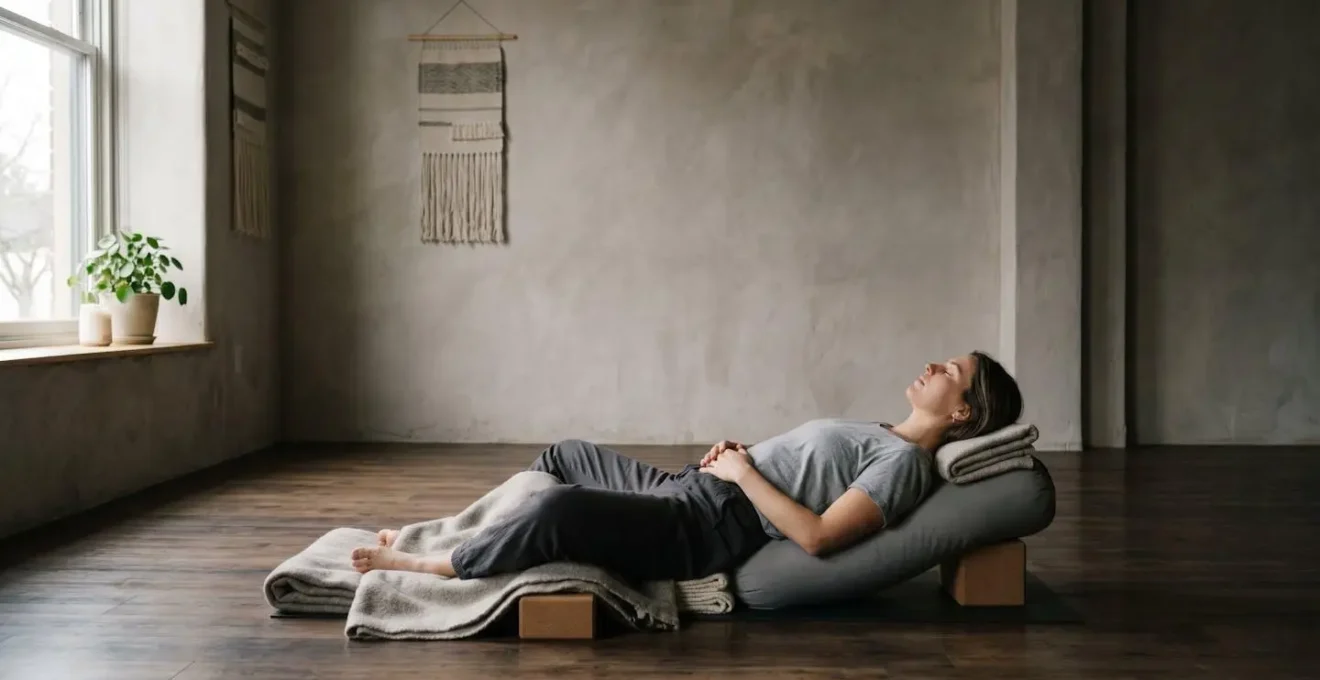
As the image suggests, restorative yoga is less about doing and more about being. The props do the work, allowing your nervous system to slowly unwind over a period of 10 to 20 minutes in a single pose. While breathwork is the fast-acting tool for acute stress, restorative yoga is the deep conditioning for a chronically stressed system. It teaches your body, over time, what it feels like to be truly safe and at rest. So, which is faster? Breathwork for immediate relief, restorative yoga for sustained, deep nervous system re-education.
Why Forcing Yourself to Relax Can Backfire and Keep You Stuck in Stress
If you’ve ever felt a surge of panic while meditating or a wave of anxiety during Savasana, you’ve experienced a scientifically recognized phenomenon called Relaxation-Induced Anxiety (RIA). This counterintuitive response is the ultimate proof that you cannot bully your nervous system into a state of calm. Trying to force relaxation when your body is in a state of high alert is like flooring the accelerator and the brake at the same time. The result isn’t stillness; it’s a lurching, jarring conflict that can be more distressing than the initial stress itself.
This backfire effect happens for a few key physiological reasons. First, for a chronically stressed person, the state of high alert feels « normal » or even safe. The sudden absence of that familiar tension can be interpreted by your nervous system’s threat-detection system (neuroception) as something being wrong. The quiet can feel deafening and unsafe, paradoxically triggering a new wave of adrenaline and cortisol to bring you back to your baseline of hypervigilance.
Second, when you finally stop moving and distracting yourself, you are left alone with the very physical sensations you’ve been running from all day: a racing heart, shallow breathing, a knot in your stomach. Without the buffer of activity, these sensations come to the forefront of your awareness. If you interpret these signals as dangerous or as proof that you are « failing to relax, » it will only amplify the feedback loop of stress, confirming your body’s belief that it is, in fact, in danger.
This isn’t a rare occurrence. Research is beginning to validate this experience, showing it’s a common issue, especially for those with a history of anxiety. In fact, a study published in BMC Complementary Medicine and Therapies investigated this very issue. The findings revealed that approximately 15% of individuals reported experiencing Relaxation-Induced Anxiety, with this being significantly more likely in those with generalized anxiety disorder. This validates that the feeling of anxiety during relaxation is not a personal failing but a predictable physiological response in a sensitized nervous system.
How to Build a 5-Minute Daily Practice That Prevents Stress from Accumulating?
Preventing stress from accumulating is far more effective than trying to discharge it after it has reached a critical level. The key is consistency and creating a small, manageable daily habit that reinforces a sense of safety within your nervous system. A five-minute practice is perfect because it’s too small to fail. It doesn’t require a special location, equipment, or a significant time commitment, making it easy to integrate into your life.
The most effective five-minute practice for nervous system regulation is the daily use of the physiological sigh. Committing to this technique for just five minutes a day, especially at consistent times, begins to retrain your HPA axis and build what is known as « vagal tone »—the health and responsiveness of your vagus nerve, the primary driver of your parasympathetic « rest-and-digest » system. A higher vagal tone means your body becomes more efficient at shifting out of stress and back into a state of calm and social engagement.
Practicing at a transitional moment of your day—such as right after you finish work, before you interact with your family, or just before bed—can be particularly powerful. It creates a clear boundary, helping you to consciously « complete the stress cycle » from your workday instead of carrying that activation into your personal life. This small daily deposit into your « nervous system bank account » builds resilience over time. It teaches your body, through repetition, that it has a reliable tool to manage arousal. This creates a powerful, positive feedback loop: the more you practice, the safer and more capable your body feels, which in turn reduces your baseline level of anxiety.
This isn’t about achieving a blissful, stress-free state in five minutes. It’s about a consistent, mechanical intervention that, over weeks and months, fundamentally changes your physiological baseline and your capacity to handle stress without becoming overwhelmed.
Your Action Plan: 5-Minute Daily Cyclic Sighing Protocol
- Find a comfortable position, either seated with a straight back or lying down. Relax your shoulders.
- Take a deep, full breath in through your nose, filling your lungs almost to capacity.
- Without exhaling, take another short, sharp inhale through your nose to maximally inflate the lungs.
- Exhale slowly and completely through your mouth, ensuring the exhalation is noticeably longer than the two inhalations combined.
- Repeat this cycle continuously for five minutes. Set a timer so you don’t have to watch the clock and can focus on the sensations.
Why Your Body Goes Numb During Certain Yoga Poses and What It Might Mean
Experiencing numbness or a sense of dissociation during a yoga pose, especially a long-held passive stretch or during Savasana, can be unsettling. It’s often mistaken for simply « zoning out » or the limb « falling asleep » due to physical pressure on a nerve. While mechanical pressure can be a factor, this sensation often has a much deeper root in your nervous system’s survival mechanisms. This numbness can be a protective state known as a dorsal vagal shutdown.
This concept comes from Polyvagal Theory, which describes a hierarchy of responses in our autonomic nervous system. Our most evolved state is the ventral vagal pathway, associated with safety and social connection. When we detect a threat, we first mobilize into the sympathetic fight-or-flight response. But what happens when the threat is perceived as inescapable, or the activation becomes too overwhelming to bear? The nervous system has an ancient, last-resort strategy: it hits the emergency brake.
This is the dorsal vagal response—a state of freeze, shutdown, and dissociation. It’s a conservation strategy, numbing us physically and emotionally to survive an experience that is too much. In the context of a yoga class, a long-held hip opener might release a torrent of stored emotional energy, or the stillness of Savasana might feel so foreign and unsafe to a hypervigilant system that it interprets the lack of threat as a threat itself. In these moments, numbness is not a failure; it’s a brilliant, protective shield.
When a pose or the emotions it brings up become overwhelming, the nervous system can hit the emergency brake, leading to a ‘freeze’ or shutdown response. This numbness is a protective dissociative state, not just ‘falling asleep.’ The nervous system moves into dorsal vagal activation—a phylogenetically ancient response to inescapable threat.
– Polyvagal Theory researchers, Trauma and the Nervous System: A Polyvagal Perspective
Understanding this re-frames the experience entirely. Instead of pushing through the numbness or judging yourself for not being « present, » you can see it as a valuable message. Your body is telling you, « This is too much, too fast. » The invitation then becomes one of profound self-compassion: to back off, perhaps by reducing the intensity of the stretch, adding more props for support, or gently wiggling your fingers and toes to bring sensation back in a slow, safe, and gentle way.
What Makes Burnout Different from Regular Exhaustion and Why Normal Rest Doesn’t Fix It?
We often use the terms exhaustion and burnout interchangeably, but they are fundamentally different physiological states. Exhaustion is a temporary state of depletion that can be resolved with rest, sleep, or a break. It’s the feeling you have after a long hike or a demanding project—you rest, and you recover. Burnout is a chronic state of nervous system dysregulation where rest is no longer restorative. You can take a week off work and still feel bone-tired, emotionally numb, and cynical.
The reason normal rest doesn’t fix burnout is because burnout isn’t just about being tired; it’s about being stuck. As authors Emily and Amelia Nagoski explain in their groundbreaking book, « Burnout, » the condition is the result of accumulated, incomplete stress cycles. When you encounter a stressor, your body’s HPA axis floods you with stress hormones to prepare you to act. The stress cycle is only « complete » when your body gets a clear signal that the threat is over and it’s safe to stand down. In the modern world, our stressors are often abstract and chronic (like an overflowing inbox), and we rarely give our bodies the signal of completion.
Exhaustion is a state; burnout is the accumulation of incomplete stress cycles. Normal rest doesn’t work because the stress-activated chemistry is still trapped in the body. You must actively discharge it through movement, creative expression, or deep connection.
– Emily Nagoski and Amelia Nagoski, Burnout: The Secret to Unlocking the Stress Cycle
This « stuckness » has a clear biological marker. While acute stress causes a spike in cortisol, chronic burnout often leads to a blunted, dysfunctional HPA axis. A 2015 study published in BioMed Research International found that burnout patients showed significantly reduced cortisol reactivity to stressors compared to healthy controls. Their bodies were no longer mounting a healthy stress response; the system was, in effect, broken. This is why you feel flat, unmotivated, and detached—your body has downregulated its ability to mobilize energy in response to a demand.
Fixing burnout, therefore, requires more than passive rest. It requires actively completing the stress cycles. This can be done through physical activity (which tells your body you’ve « survived » the threat), breathwork (like the physiological sigh), creative expression, or deep, meaningful social connection. You have to actively signal safety to your body; simply removing the stressor isn’t enough once burnout has set in.
Key Takeaways
- The « wired but tired » feeling is a real physiological state called HPA axis dysregulation, caused by chronic stress.
- Forcing slow breathing can increase anxiety; the « physiological sigh » (double inhale, long exhale) is a scientifically proven way to quickly calm an activated nervous system.
- Burnout isn’t just exhaustion; it’s the result of incomplete stress cycles, which is why passive rest alone doesn’t work and active discharge is needed.
Why Can’t You Relax Even When You Finally Have Time Off?
You’ve finally made it. The out-of-office is on, the deadlines are behind you, and you have a stretch of time with nothing on the agenda but to rest. Yet, as you sit down, a familiar agitation creeps in. Your mind races, your body feels tense, and the promised relief of vacation feels more like a new form of torture. This experience is the culminating symptom of everything we have discussed: a nervous system that has forgotten how to feel safe in the absence of a problem to solve.
The reason you can’t relax on vacation is because your HPA axis is still dysregulated. Your body has been trained by months or years of chronic stress to maintain a high level of vigilance. Its baseline is « on alert. » When the external stressors are suddenly removed, your nervous system’s threat-detection mechanism (neuroception) doesn’t automatically stand down. Instead, it can perceive the sudden quiet and lack of structure as a threat in itself, a void that must be filled with worry or planning. The « problem » to solve becomes the very act of relaxing.
Furthermore, your body is still swimming in the chemical residue of dozens of incomplete stress cycles. The cortisol and adrenaline that powered you through the last quarter didn’t just vanish when you logged off. They remain in your system, needing to be processed and discharged. Without an active strategy to signal completion—like the physiological sigh, gentle movement, or restorative practices—your body remains stuck in a low-grade fight-or-flight mode, even as you lie by a pool.
The path forward is to stop seeing relaxation as a passive activity or something you’ve « earned » and start treating it as a gentle, active practice of signaling safety. It’s about shifting your intention from « I must relax now » to « I will offer my body a moment of safety. » This means using the tools we’ve explored: five minutes of physiological sighing in the morning, choosing a restorative yoga pose over scrolling on your phone, or simply noticing your feet on the ground to bring your awareness back to the present moment. It’s in these small, consistent, and compassionate acts that you retrain your nervous system and reclaim your innate capacity for true, restorative rest.
Begin today by choosing one small, five-minute practice. Instead of demanding relaxation from your body, offer it a consistent signal of safety and observe, with curiosity and compassion, how it responds over time.