Accessories & equipment
Stepping onto the mat is a journey inward, but the physical reality of our bodies often requires external support to reach that state of flow. Whether you are a complete beginner wondering if you really need all those props, or an intermediate practitioner looking to upgrade your setup, understanding yoga accessories and equipment is pivotal. The right gear does not just add clutter to your space; it functions as an extension of your body, bridging the gap between your current range of motion and safe, optimal alignment.
Navigating the market can be overwhelming. From the chemistry of mat materials to the density of meditation cushions, the choices you make impact your joint health, your stability, and even your ability to relax. This comprehensive guide demystifies the essential tools of the trade, helping you distinguish between clever marketing and genuine utility, ensuring every investment you make serves your practice for years to come.
The Foundation of Practice: Choosing the Right Yoga Mat
Your yoga mat is your island. It is where you sweat, struggle, and find stillness. However, not all mats are created equal. A common frustration for many practitioners is buying a budget-friendly option, only to find it flaking, smelling of chemicals, or becoming dangerously slippery within months. Understanding the mechanics of grip and durability is essential for safety.
Material Matters: PVC, TPE, or Natural Rubber?
The material of your mat dictates its lifespan and performance. Natural rubber is often preferred for its superior grip and eco-friendly properties, making it excellent for vigorous styles where traction is key. However, it requires specific care to prevent degradation from sunlight. On the other hand, TPE (Thermoplastic Elastomer) offers a lightweight, hypoallergenic alternative that is often recyclable. Understanding these differences helps explain why hot yoga studios often require specific mat types that can handle high humidity without becoming bacterial colonies.
Thickness and Stability
Comfort is subjective, but biomechanics are not. The debate between a 4mm and a 6mm mat is about more than just cushioning; it is about the trade-off between joint protection and balance. A thicker mat protects sensitive knees during kneeling poses but can make standing balances feel wobbly as your foot sinks into the foam. Finding the middle ground depends on your personal anatomy and the style of yoga you practice most frequently.
The Economy of Longevity
It is tempting to opt for the cheapest option, but the true cost of ownership tells a different story. Buying a low-quality mat every year often costs significantly more in the long run than investing in a high-quality mat that lasts five years or more. Furthermore, high-performance mats are designed to withstand the rigorous cleaning required to keep them hygienic, whereas cheaper materials often degrade when scrubbed effectively.
Props for Alignment: Blocks, Straps, and Mechanics
There is a lingering misconception that using props is a sign of weakness or inflexibility. In reality, advanced practitioners and styles like Iyengar Yoga use props extensively to deepen the experience of a pose. Blocks and straps are not crutches; they are tools for anatomical intelligence, allowing you to prioritize spinal integrity over touching your toes.
Cork vs. Foam Blocks: Which Do You Need?
The material of your block changes the feedback your body receives. Cork blocks are heavy, sturdy, and sustainable. They provide the unwavering support needed for balancing poses or when you need to put your full weight on the prop. Conversely, foam blocks are lighter and softer, making them ideal for restorative support under the head or back where cork might feel too aggressive. Understanding sustainable harvesting is also crucial when choosing cork to ensure your eco-claims are genuine.
Strap Mechanics and Shoulder Health
Tight shoulders are a common ailment in modern life. A yoga strap acts as an arm extender, allowing you to bind hands or hold feet without compromising the position of your shoulder girdle. Knowing how to choose between a block, a strap, or a blanket for shoulder work can transform a painful struggle into a therapeutic release.
Restorative Gear: Bolsters, Blankets, and Deep Rest
In a world that glorifies busy-ness, restorative yoga is a radical act of slowing down. However, true relaxation is physical, not just mental. If the body is not fully supported, the nervous system cannot switch off. This is where the geometry of bolsters and the strategic use of blankets become essential skills.
Bolster Shapes and Densities
The choice between a round and rectangular bolster affects how your spine is supported. Rectangular bolsters are generally flatter and more stable, providing a broad base for the back in reclined poses. Round bolsters offer a deeper arch, which can be opening for the chest but potentially intense for the lower back. Furthermore, knowing whether you need a firmer or softer filling ensures that the prop supports you, rather than you having to work to stay on the prop.
The Art of the Blanket
A yoga blanket is perhaps the most versatile tool. It can be a seat, a knee pad, a neck roll, or a weight for grounding. Learning how to position bolsters and blankets correctly is the secret to stopping the « work » in restorative poses. If you find yourself falling asleep or, conversely, feeling agitated during Yoga Nidra, the arrangement of your practice space and your props is often the culprit.
Meditation Essentials: Sitting with Ease
Many people give up on meditation not because their mind is too busy, but because their body hurts. Back ache after ten minutes is usually a sign of poor pelvic positioning, not a lack of spiritual discipline. The right cushion elevates the hips, allowing the knees to drop below the hip crease, which naturally lengthens the spine.
- Zafu (Round Cushion): Traditional choice, lifts the hips high. Filling matters deeply here; buckwheat hulls shift to mold to your anatomy, while kapok is firmer and bouncier.
- Zabuton (Floor Mat): Cushions the ankles and knees against the hard floor. Do you need both? For longer sessions, the combination is often necessary to prevent limbs from falling asleep.
- Height Adjustment: Knowing if your cushion is too high or too low is vital. Too high, and you pitch forward; too low, and your lower back rounds.
Activewear: Fabric, Fit, and Ethics
Clothing is your second skin during practice. It should handle sweat, stretch without restricting circulation, and align with your values. The industry is rife with greenwashing, so learning to identify if recycled polyester is actually sustainable or just a marketing buzzword is an important skill for the conscious consumer.
Breathability vs. Moisture-Wicking
There is a distinct difference between a cotton t-shirt that feels soaked and heavy after twenty minutes and technical fabric that wicks moisture away. Moisture-wicking pulls sweat to the surface to evaporate, essential for vigorous flows. Breathable fabrics allow air to circulate. Understanding which property you need prevents the discomfort of overheating or chilling during the cool-down phase.
The Transparency Problem
Few things are as distracting as worrying if your leggings have become see-through in a forward fold. This issue, often found in cheaper garments, stems from poor fabric density and over-stretching. Investing in quality opaque fabrics ensures you can move with confidence. We explore the essential pieces you actually need for year-round practice, moving away from fast fashion towards a functional, durable capsule wardrobe.
Ultimately, your equipment should serve a single purpose: to remove obstacles between you and your practice. By choosing tools that respect your anatomy, your budget, and the planet, you create a container for movement that is safe, sustainable, and deeply supportive.
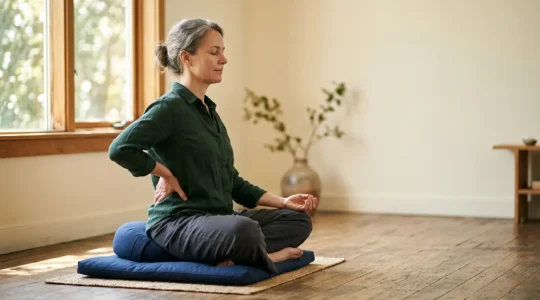
Why Does Your Back Ache After 10 Minutes of Meditation Despite Sitting on a Cushion?
Back pain during meditation isn’t a sign you’re « doing it wrong »; it’s a sign your cushion is calibrated incorrectly for your specific biomechanics. Your cushion’s primary job is to create a precise forward pelvic tilt, not just to elevate you…
Lire la suite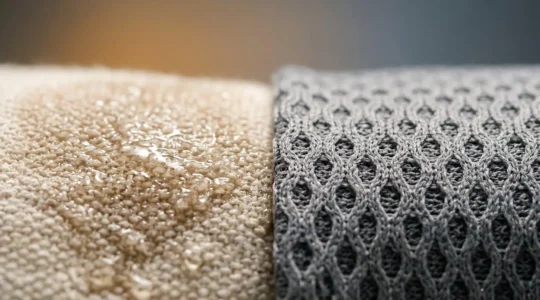
Why Does Your Cotton T-Shirt Feel Soaked After 20 Minutes While Others Stay Comfortable?
The discomfort you feel in your yoga practice is not a lack of fitness, but a failure of material science. Cotton acts like a sponge, absorbing sweat and becoming heavy, while performance fabrics are engineered to move moisture away from…
Lire la suite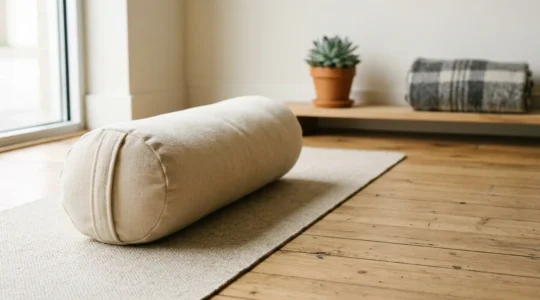
Why Do Restorative Teachers Insist on Bolsters When a Rolled Blanket Seems to Work?
The belief that a rolled blanket can replace a yoga bolster stems from a misunderstanding of its purpose: the goal isn’t softness, but unwavering structural integrity that signals safety to your nervous system. A bolster’s non-compressible density provides clear proprioceptive…
Lire la suite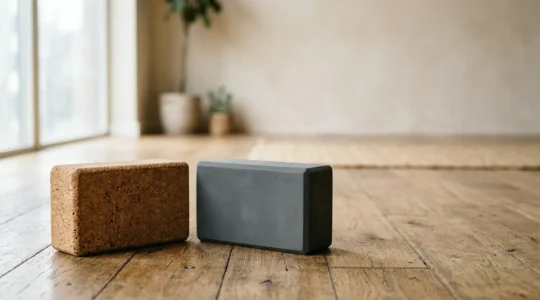
Why Are Cork Blocks Better Than Foam for Some Poses but Worse for Others?
The choice between cork and foam is not about which is ‘better,’ but about understanding the specific physical feedback each material provides for your alignment goal. Cork redirects force, acting as a stable extension of the floor for building strength…
Lire la suite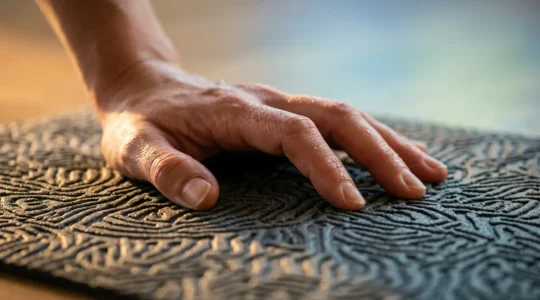
Why Does Your Mat Work Fine in Winter but Become Slippery Every Summer?
Your mat’s seasonal slipperiness is not a sign of wear but a predictable outcome of material science reacting to heat and humidity. Closed-cell materials (like cheap PVC) create a dangerous « hydroplaning » effect with sweat, while open-cell materials (like PU or…
Lire la suite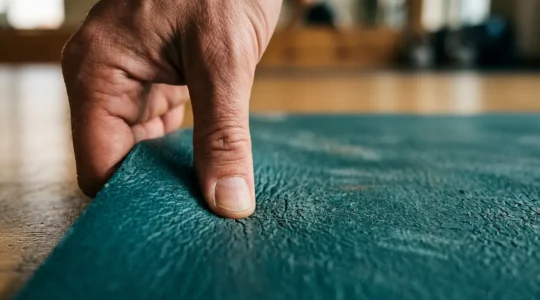
Why Does Your Cheap Yoga Mat Smell Toxic and Slip When You Sweat?
The chemical smell and slipperiness of your cheap mat are not just annoyances; they are symptoms of poor material science and hidden costs that compromise your practice and health. Low-cost mats, often made of PVC, degrade quickly, lack grip in…
Lire la suite