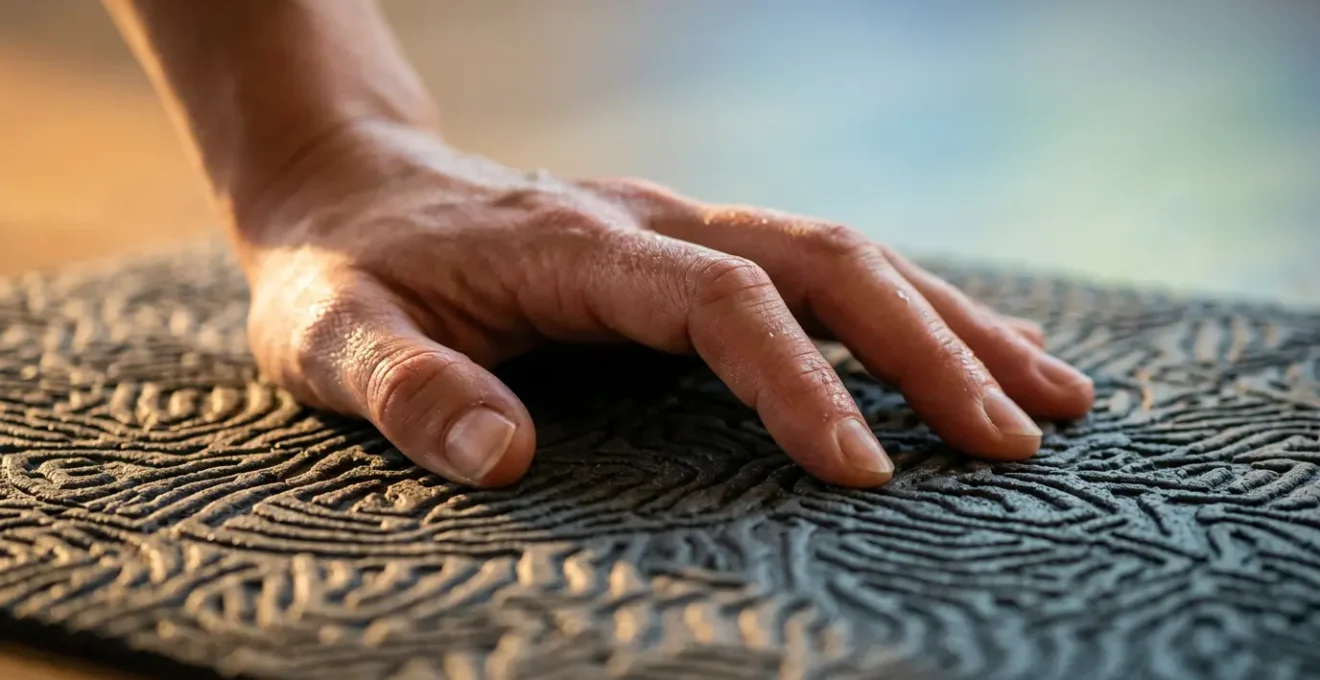
Your mat’s seasonal slipperiness is not a sign of wear but a predictable outcome of material science reacting to heat and humidity.
- Closed-cell materials (like cheap PVC) create a dangerous « hydroplaning » effect with sweat, while open-cell materials (like PU or rubber) use moisture to increase their grip.
- Stability in balance poses comes from a mat’s density, not its thickness; a thick, low-density mat can be more unstable than a thin, dense one.
Recommendation: Stop blaming your sweat and start evaluating your mat’s material composition. For a safe, all-season practice, invest in a high-density, open-cell mat made of polyurethane (PU) or natural rubber.
There’s a frustratingly common experience for many yoga practitioners. The mat that provided a rock-solid foundation throughout the cool, dry months of winter suddenly turns into a slip-n-slide the moment summer humidity and a more intense practice set in. You find your hands sliding in Downward Dog and your standing leg trembling in Tree Pose. The typical advice is to « get a towel » or « break it in, » but these are temporary fixes that ignore the root of the problem. This seasonal failure isn’t a random event or a fault in your practice; it’s a direct result of the mat’s material science interacting with a changing environment.
Understanding why your mat fails is the first step toward finding a solution that doesn’t involve compromising your practice with a bunched-up towel. The difference between a reliable, all-season performance mat and a cheap, slippery one lies in its core composition—specifically, its material porosity, surface texture, and density. This isn’t just about comfort; it’s a critical safety issue. A mat that loses its grip when wet is a liability, increasing the risk of strains and falls. To truly solve this problem, we must stop thinking of a mat as a simple accessory and start treating it as a piece of technical equipment governed by the laws of physics and material engineering.
This guide will deconstruct the science behind mat performance. We will explore the physics of friction, dissect the differences between materials like PVC, TPE, and natural rubber, and explain why concepts like « open-cell » and « closed-cell » are the most important factors for your safety. By the end, you will be equipped with the technical knowledge to diagnose your current mat’s failings and confidently select a new one that provides a safe and stable foundation, no matter the season or the intensity of your practice.
To navigate this technical deep-dive, we’ve structured the article to build your expertise from the ground up, moving from foundational science to practical application. The following summary outlines the key areas we will cover.
Summary: Why Does Your Mat Work Fine in Winter but Become Slippery Every Summer?
- What Actually Makes a Mat Grip Better and Why Do Some Fail When Wet?
- 4mm or 6mm Mat: Which Thickness Protects Your Knees Without Making Balances Wobbly?
- Why Do Hot Yoga Studios Require Specific Mat Types That Regular Studios Don’t?
- Why Your Brand New Grippy Mat Feels Slippery and How to Fix It?
- How to Test a Yoga Mat’s Grip in a Shop Before Committing to Purchase?
- Natural Rubber or TPE Mat: Which Is Better for Hot Yoga Practice in the UK?
- How to Progress from Standing on One Leg to Eyes-Closed Balance in 8 Weeks?
- Why Does Your Cheap Yoga Mat Smell Toxic and Slip When You Sweat?
What Actually Makes a Mat Grip Better and Why Do Some Fail When Wet?
The grip, or technical « stickiness, » of a yoga mat is determined by its coefficient of friction (CoF). A high CoF means more resistance to sliding. However, this property is not static; it changes dramatically based on the mat’s material structure and the presence of moisture. The critical distinction is between open-cell and closed-cell surfaces. Closed-cell materials, like the PVC used in most budget mats, have a non-porous surface. When you sweat, the moisture sits on top, creating a thin, slick barrier between your skin and the mat. This leads to a dangerous « hydroplaning » effect, identical to a car tire losing traction on a wet road. Your grip doesn’t just decrease; it disappears.
Conversely, open-cell materials like natural rubber and, most effectively, polyurethane (PU), have a microscopic, porous structure. These pores act like tiny suction cups, channeling moisture away from the surface and actually using it to increase the CoF. This is why high-performance mats often feel even grippier as you get warmer and sweatier. The moisture activates the grip instead of defeating it. As a materials researcher from Matelier Lab notes in their PVC vs. Natural Rubber Yoga Mats Study:
PVC’s closed-cell structure repels moisture, maintaining surface integrity when dry but creating a hydroplaning effect when wet. Natural rubber’s grip improves as it warms with your practice, thanks to its open-cell structure that reacts to moisture.
– Materials researcher, Matelier Lab – PVC vs Natural Rubber Yoga Mats Study
This difference is quantifiable. While a PVC mat’s grip plummets when wet, high-end PU mats are engineered for moisture. In fact, laboratory testing reveals that some PU mats retain over 85% of their dry-grip traction when saturated, a level of performance that is essential for safety in any practice that involves sweat. Therefore, the failure of a mat in summer is a predictable result of its closed-cell construction being unable to manage moisture.
4mm or 6mm Mat: Which Thickness Protects Your Knees Without Making Balances Wobbly?
A common misconception among practitioners is that a thicker mat automatically provides better cushioning and is therefore superior. While thickness does contribute to comfort in kneeling or supine poses, it is a poor indicator of a mat’s performance for balance. The most critical factor for stability is not thickness, but density. A thick (6mm+), low-density mat feels squishy and unstable, like trying to balance on a mattress. Your foot sinks into the material, forcing constant micro-adjustments in your ankle and compromising your proprioceptive feedback, making balance poses incredibly wobbly and unsafe.
In contrast, a thinner (3-5mm) but high-density mat provides a stable, grounded platform. It offers sufficient cushioning to protect the joints on a hard floor without sacrificing the firm connection to the ground needed for balance. High density means the material compresses minimally under pressure, providing reliable feedback to your feet and allowing for a steady, rooted posture. This visual comparison highlights how a foot remains stable on a dense surface versus sinking into a low-density one, directly impacting your ability to hold a pose.
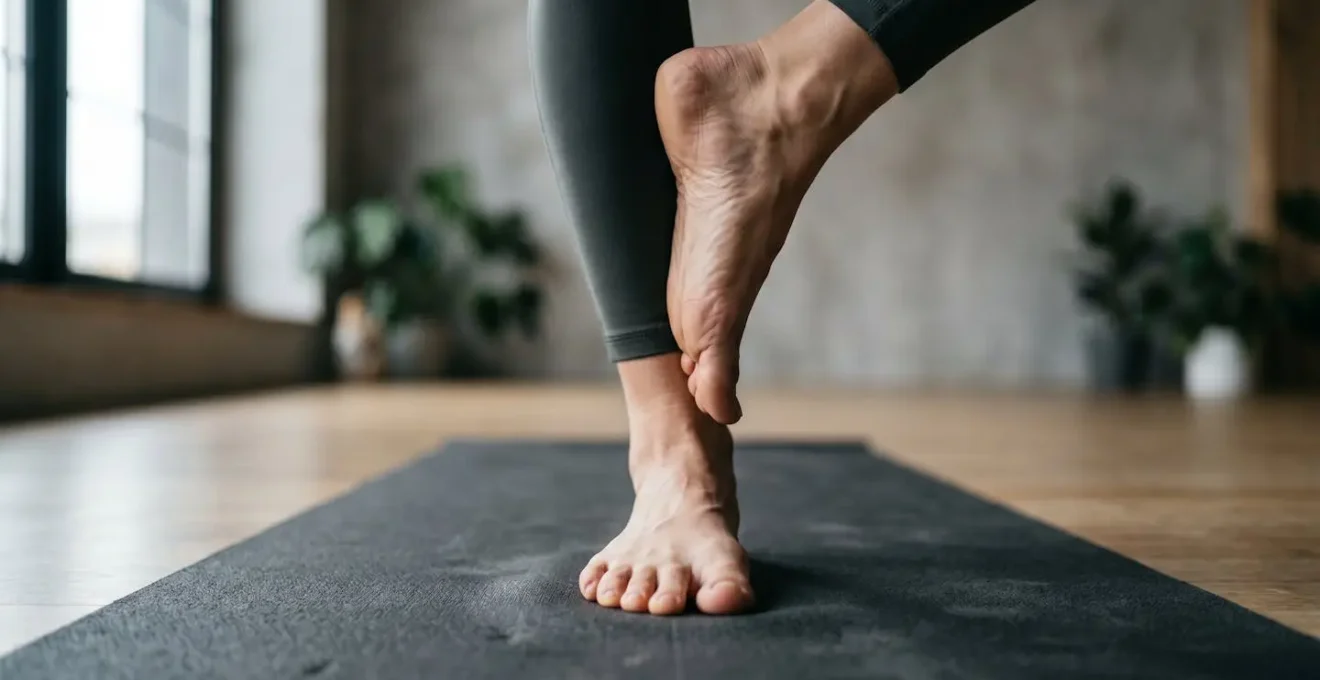
The choice between 4mm and 6mm therefore depends entirely on the mat’s density and your primary practice style. For a dynamic, balance-heavy flow, a dense 4mm mat is superior. If your priority is joint comfort for a slower or restorative practice, a 6mm mat can be an excellent choice, but only if it is also very high-density. A low-density 6mm mat is often the worst of both worlds: insufficient for true joint protection and terrible for stability. The following table breaks down the ideal use cases, as detailed in comprehensive guides on yoga mat thickness.
| Thickness | Best Use Case | Stability Rating | Cushioning | Density Requirement |
|---|---|---|---|---|
| 3-4mm | Balance-heavy flow, travel | Highest | Minimal | Medium to High |
| 5mm | Balanced all-purpose use | High | Moderate | High recommended |
| 6mm | Comfort upgrade, hard floors | Good (if dense) | High | High essential |
| 8mm+ | Restorative, sensitive joints | Lower (unless very firm) | Maximum | Very High critical |
Why Do Hot Yoga Studios Require Specific Mat Types That Regular Studios Don’t?
Hot yoga studios are extreme environments. With temperatures often exceeding 40°C (104°F) and high humidity, practitioners sweat profusely. In this context, a yoga mat ceases to be a simple preference and becomes a critical piece of safety equipment. This is why many studios have strict requirements or mandates on the types of mats and towels used. Their primary concern is risk management and liability. A standard, closed-cell PVC mat becomes dangerously slippery within minutes, creating a significant risk of falls and injuries, especially during dynamic transitions.
Studios must ensure a safe practice environment, and allowing equipment that is known to fail under heated conditions is a direct liability. This has been demonstrated in numerous real-world scenarios, where inadequate equipment leads to dangerous situations.
Case Study: Hot Yoga Studio Mat Safety Requirements
An instructor at a hot yoga studio conducted a test on various rental mats. The findings were stark: cheaper PVC mats, while adequate for a gentle, non-heated class, failed completely in heated conditions. During a standard sequence, hands and feet consistently slipped in Downward Dog, and practitioners struggled to hold poses securely. This created a hazardous practice environment, underscoring why studios must mandate equipment, such as PU or rubber mats combined with high-grip towels, that performs reliably in extreme heat and humidity as a fundamental measure of risk management.
The performance difference is not just anecdotal; it’s measurable. Practitioners using materials designed for heat and sweat can hold poses with more stability and confidence. For instance, a 2023 Yoga Journal survey found a staggering 72% less pose adjustments with PU mats compared to PVC mats in heated classes. Fewer adjustments mean a safer, more focused, and more effective practice. Studios enforce these rules not to be difficult, but because they have a duty of care to protect their clients from the predictable failure of inadequate equipment.
Why Your Brand New Grippy Mat Feels Slippery and How to Fix It?
Unboxing a brand-new mat that was advertised as « ultra-grippy, » only to find yourself slipping in your first practice, is a deeply frustrating experience. This initial slipperiness is rarely a defect in the mat itself but is almost always due to a coating or residue from the manufacturing process. Different materials require different treatments, and knowing the right protocol is key to unlocking your mat’s true grip potential. For example, PVC mats are often coated with a thin, greasy film to prevent them from sticking to the machinery during production. This film must be washed off before the mat’s surface can provide any real traction.
Natural rubber mats, on the other hand, don’t have a slippery coating but can have a strong rubbery smell and a fine layer of dust from the factory. They need to be aired out and wiped down. In contrast, premium Polyurethane (PU) mats are specifically engineered to be grippy from the very first use and should not require any « break-in » period at all. Simply wiping away any packaging dust is usually sufficient.
Finally, user-introduced substances are a common culprit. Applying hand lotion or body oil before practice will coat any mat’s surface and drastically reduce its coefficient of friction. The mat isn’t the problem in this case; the external residue is. Following the correct first-use protocol for your specific mat material is essential for safety and performance.
Action Plan: Material-Specific Protocol for New Yoga Mats
- For PVC Mats: Wash the mat gently with a solution of mild soap and water. Use a soft cloth to scrub the surface lightly to remove the greasy factory layer applied to prevent sticking during production, then rinse thoroughly and air dry completely.
- For TPE Mats: Perform a gentle wash with mild soap and water, similar to PVC mats. Ensure it is fully air-dried before rolling it up to prevent moisture from being trapped.
- For Natural Rubber Mats: Do not use soap. Air the mat out for several days in a well-ventilated area (but out of direct sunlight) to dissipate the natural rubber smell. Before first use, wipe it down with a damp cloth and let it dry. The smell will fade significantly after 2-3 weeks of regular use.
- For PU (Polyurethane) Mats: These require no break-in. Simply wipe the surface with a clean, damp cloth to remove any dust from packaging. They are designed to be grippy from the first use.
- General Maintenance: Always avoid practicing immediately after applying lotions, creams, or oils to your hands and feet. These substances will create a slippery barrier on any mat surface and will require cleaning to restore grip.
How to Test a Yoga Mat’s Grip in a Shop Before Committing to Purchase?
Choosing a yoga mat is a significant investment in your practice and safety, yet most people make their decision based on color or a simple press of the hand. These methods reveal nothing about a mat’s true performance under pressure. To avoid buyer’s remorse, you need to conduct a few discreet but effective tests in the store to evaluate its key properties: grip under shear force, performance when damp, and density.
The most important test is for grip under shear forces—the forward-and-back pressure typical of poses like Downward Dog. A simple downward press with your hand only tests compression, not friction. By simulating the actual forces of your practice, you get a much more accurate feel for the mat’s true coefficient of friction. Similarly, testing for moisture reaction is crucial, as this is where most cheap mats fail. Finally, assessing density will tell you everything you need to know about the mat’s potential stability for balancing poses.
Here is a five-step protocol for testing a mat’s performance before you buy:
- The Mini Downward Dog Test: With the store’s permission, unroll a small section of the mat on the floor. Place both hands shoulder-width apart and press down and forward, putting your body weight into it. Do your hands slide or stay firmly planted? This simulates the shear forces in Downward Dog and is the best test for dry grip.
- The Wet Thumb Test: Discreetly moisten your thumb or a finger (a tiny bit of water from a bottle or even just a little breath moisture works) and press it firmly onto the mat’s surface. Now, try to twist. On a good open-cell mat (PU or rubber), the grip should hold or even increase. On a closed-cell PVC mat, your finger will likely slide easily.
- The Rebound Test: Press your thumb firmly into the mat and release quickly. Observe how fast the indentation disappears. A fast rebound indicates high density and good stability for balance poses. A slow rebound, where the indent lingers, signals a low-density, « squishy » mat that will be wobbly.
- The Pinch and Stretch Test: Gently pinch a small section of the mat between your thumb and forefinger and try to stretch it. If the material stretches easily like a rubber band, it’s likely low-density and will bunch up or warp during dynamic movements like jumping back to plank. A high-density mat will feel solid and resist stretching.
- The Surface Consistency Check: Run your hand over the entire surface of the mat. Feel for any slick patches, blemishes, or areas where the texture feels different. Inconsistencies can indicate poor quality control and may lead to unpredictable grip.
Natural Rubber or TPE Mat: Which Is Better for Hot Yoga Practice in the UK?
For practitioners in climates like the UK—characterized by cool, damp conditions outside the studio—the transition into a hot, humid yoga room presents a unique material challenge. The choice between Natural Rubber and TPE (Thermoplastic Elastomer) is not just about eco-credentials or price; it’s about how each material performs across this temperature and humidity gradient. Both are popular, latex-free (in the case of TPE) alternatives to PVC, but they have distinct properties that make one more suitable for hot yoga.
TPE is lightweight, flexible even when cold, and offers adequate grip for a gentle or moderately sweaty practice. However, its grip is not significantly enhanced by moisture, and in the deluge of a true hot yoga session, it can start to lose traction. Natural Rubber, by contrast, is an open-cell material that excels in heat and humidity. Its grip actively improves as it gets warmer and wetter, providing the reliable, non-slip surface that is critical for safety in a hot studio. However, it has one drawback in a cool climate: it can feel stiff and its grip can be less effective when cold, for example, if left in a car during winter before practice.
The following table, based on data from material comparison guides, breaks down the key differences for a practitioner in this specific environmental context. While the pricing is shown in GBP, the performance principles are universal.
| Feature | Natural Rubber | TPE |
|---|---|---|
| UK Climate Performance | Can feel stiff when cold (e.g., left in car in winter) before warming up | Maintains flexibility in cold conditions |
| Hot Yoga Grip | Excellent – grip improves with heat and moisture | Moderate – adequate but not superior when wet |
| UK Availability & Brands | Liforme, Yogi-Bare (widely available) | Yoga-Mad, various brands |
| UK Price Range (GBP) | £70-£120 | £30-£60 |
| Environmental Profile | Biodegradable, renewable resource | Recyclable (theory), lower energy to manufacture than PVC |
| UK Council Recycling | Biodegrades naturally (5+ years) | Check local council – recyclability varies |
| Allergy Consideration | Contains latex – avoid if allergic | Latex-free alternative |
How to Progress from Standing on One Leg to Eyes-Closed Balance in 8 Weeks?
Progressing to advanced balance work, such as holding a pose with your eyes closed, is less about raw strength and more about refining your proprioception—your nervous system’s ability to sense your body’s position in space. Your yoga mat is not a passive surface in this process; it is your primary source of sensory feedback. A stable, high-density, grippy mat provides clear and reliable information to the nerves in your feet, creating a solid foundation upon which the nervous system can build. Conversely, a slippery or squishy mat sends confusing, « noisy » signals, forcing your body into constant micro-corrections that prevent you from finding the stillness required for eyes-closed balance.
When you close your eyes, you remove your dominant source of spatial information: vision. Your brain must then rely entirely on the proprioceptive feedback from your feet and inner ear. If the mat is slipping even fractionally, your nervous system remains in a high-alert state, focused on preventing a fall rather than achieving deep stability. Therefore, mastering advanced balance is impossible without first mastering your equipment. The mat must be a trusted, non-slip platform that frees your mental bandwidth to focus on internal adjustments.
This 8-week protocol uses the mat as a fundamental training tool to progressively challenge and develop your proprioceptive system:
- Weeks 1-2: Build the Foundation. Practice your one-legged balance poses (e.g., Tree Pose) with eyes open on your most reliable, high-density, grippy mat. Focus on feeling the connection between your foot and the stable surface. The goal is to establish a baseline of clear, trustworthy proprioceptive feedback.
- Weeks 3-4: Challenge the System. Intentionally practice the same poses on less stable surfaces, such as a thicker, lower-density mat, a folded blanket, or a patch of carpet. This forces your nervous system to work harder and adapt to unreliable feedback, strengthening its adaptive capacity.
- Weeks 5-6: Return to Stability and Introduce Sensory Deprivation. Go back to your trusted, stable mat. Practice the poses first with a soft, unfocused gaze (« drishti »). Then, begin introducing brief eye closures of 3-5 seconds. The secure base of the mat allows your mind to feel safe enough to let go of visual input.
- Weeks 7-8: Master Eyes-Closed Balance. On your stable mat, work on extending the duration of your eye closures. Use the mat as your anchor. With the ground secure, you can turn your full attention inward, noticing the subtle shifts in weight and making fine-tuned muscular adjustments to maintain your center of gravity.
Key takeaways
- A mat’s grip in wet conditions is determined by its material structure: open-cell (PU, rubber) absorbs sweat to increase grip, while closed-cell (PVC) repels it, causing dangerous slipperiness.
- Stability in balance poses depends on the mat’s density, not its thickness. A thin, dense mat is far more stable than a thick, squishy one.
- High-performance mats (PU, natural rubber) are not a luxury but a necessary piece of safety equipment for any practice involving sweat, especially hot yoga.
Why Does Your Cheap Yoga Mat Smell Toxic and Slip When You Sweat?
The « new car » smell of a cheap yoga mat is not a sign of freshness; it’s a red flag. That distinct chemical odor is the « off-gassing » of plasticizers, most commonly phthalates, used to make polyvinyl chloride (PVC) flexible enough to be rolled up. As one analysis in the Wavar Yoga Mat Materials Guide explains:
PVC requires chemical plasticizers like phthalates to be flexible, and these are the source of the toxic smell through off-gassing. PVC mats are non-absorbent and can become slippery when sweating heavily due to their closed-cell structure that repels moisture.
– Yoga mat materials analysis, Wavar Yoga Mat Materials Guide 2023
This single material—PVC—is responsible for both of the primary failings of a cheap mat. The closed-cell, non-absorbent surface is the direct cause of the dangerous hydroplaning effect when you sweat, making it a safety liability. The chemicals required for its flexibility are the source of the unpleasant and potentially harmful odor. You are paying less for a product that performs poorly and exposes you to volatile organic compounds (VOCs).
Furthermore, the low price point creates a false economy. These mats lack durability. They quickly show signs of wear, flaking, and losing what little grip they had. This leads to frequent replacement, which often ends up being more expensive in the long run. When calculating the false economy of cheap mats, studies show a low-cost $20 mat replaced annually costs more over five years than a single high-quality $90 mat that can last a decade or more. Investing in a quality mat made from PU or natural rubber is not just an investment in a better, safer practice; it’s a more financially and environmentally sound decision over time.
To ensure a safe, effective, and enjoyable practice, it is crucial to evaluate your mat as a piece of high-performance equipment. Assess your current mat’s material, density, and performance in the heat, and make an informed decision to invest in a product that supports your long-term well-being and progress on the mat.