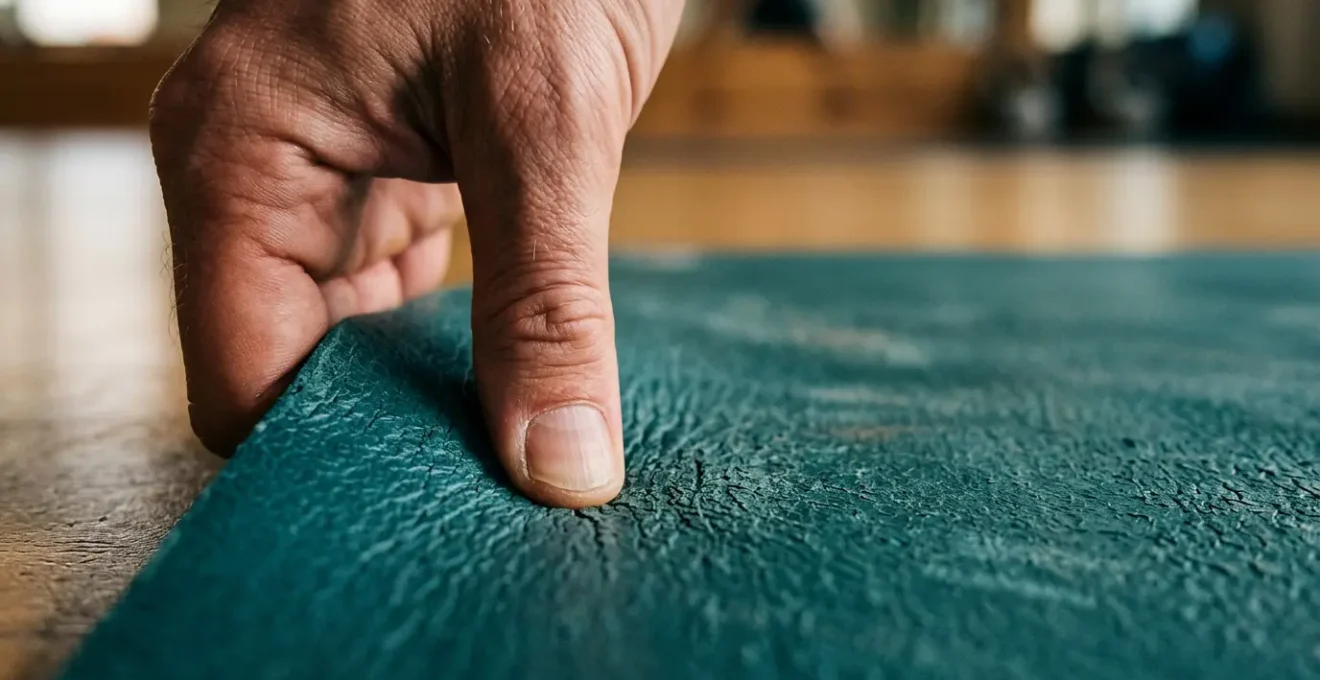
The chemical smell and slipperiness of your cheap mat are not just annoyances; they are symptoms of poor material science and hidden costs that compromise your practice and health.
- Low-cost mats, often made of PVC, degrade quickly, lack grip in humidity, and can release harmful chemicals (off-gassing) when new or heated.
- A quality mat, such as one made from natural rubber, offers superior grip that improves with moisture and a durability that represents a smarter long-term investment.
Recommendation: Choose your yoga equipment based on its material science and true lifecycle cost, not just its upfront price, to ensure a safer, more effective, and sustainable practice.
That acrid, plastic smell that hits you when you unroll a new, cheap yoga mat isn’t the scent of a fresh start; it’s a red flag. So is the treacherous slip that occurs the moment a challenging practice gets you sweating. For many yoga practitioners, these frustrations are a rite of passage, accepted as a normal part of using entry-level equipment. The common advice is often vague: « buy an eco-friendly mat » or « just get one with better grip, » leaving you navigating a confusing market filled with dubious « green » claims and technical jargon.
This cycle of buying, dissatisfaction, and disposal is not only costly and environmentally damaging but also actively hinders the quality of your practice. It distracts you from your breath and alignment, replacing a sense of groundedness with a feeling of instability and a lingering question about the materials you’re in close contact with daily. What if the solution isn’t just to buy another mat, but to fundamentally change how you think about your equipment?
The true key lies in moving beyond the price tag to understand the hidden material science and lifecycle cost of your gear. Your mat isn’t a disposable accessory; it’s a long-term partner for your practice. By understanding why certain materials smell, why they slip, and what « sustainability » truly means, you can make an informed investment in your health, your practice, and the planet. This guide will deconstruct the problems with cheap mats and provide a clear framework for choosing high-performance, non-toxic, and genuinely sustainable yoga equipment.
To navigate this journey from a frustrated user to a conscious consumer, this article breaks down the essential knowledge you need. Explore the topics below to build a practice founded on quality and intention, from your mat to your mindset.
Contents: The Conscious Practitioner’s Guide to Yoga Equipment
- Do You Really Need All Those Props or Can You Start With Just a Mat?
- How to Tell if a Yoga Brand’s Eco Claims Are Genuine or Just Greenwashing?
- Natural Rubber or TPE Mat: Which Is Better for Hot Yoga Practice in the UK?
- Why Buying a £15 Mat Every Year Costs More Than a £60 Mat That Lasts Five Years?
- How to Clean Your Yoga Mat So It Lasts 5 Years Without Becoming a Bacteria Colony?
- Why Does Iyengar Yoga Use So Many Props When Other Styles Use None?
- How to Set Up Your Home So Practicing Becomes Easier Than Not Practicing?
- Why Does Your Mat Work Fine in Winter but Become Slippery Every Summer?
Do You Really Need All Those Props or Can You Start With Just a Mat?
The minimalist image of a yogi with nothing but a mat is powerful, suggesting that the practice is purely internal. While you can certainly begin your journey with just a mat, viewing props as a « crutch » or a sign of being a beginner is a common misconception that limits potential for growth and safety. The purpose of props isn’t to make a pose easier in a way that avoids effort; it’s to make the pose’s true alignment and benefits accessible to your unique body. Different yoga styles hold different philosophies, but the functional value of props is undeniable.
In disciplines like Iyengar yoga, props are central to the methodology. They are seen as teachers, providing feedback and support to help the body understand the correct energetic and structural lines of an asana. This is not about weakness, but about anatomical precision. As Iyengar practitioners often state, props serve a critical function in maintaining alignment and preventing injury. For instance, in a forward fold, if tight hamstrings cause your back to round, a block under your hands helps maintain a long spine, which is the primary goal of the pose.
Props aren’t a crutch, but a way to bring the floor to you to maintain hip alignment and prevent SI joint injury.
– Iyengar Yoga practitioners, as noted in yoga alignment methodology
Starting with just a mat is perfectly fine, but as your practice develops, integrating a few key props like two blocks and a strap can radically transform your understanding of alignment. They allow you to explore poses with more integrity and safety, building a foundation of intelligence in your body that a mat-only practice might take much longer to achieve. The question isn’t whether you *need* them, but how they can intelligently support and deepen your practice over time.
How to Tell if a Yoga Brand’s Eco Claims Are Genuine or Just Greenwashing?
As consciousness around sustainability grows, terms like « eco-friendly, » « green, » and « mindfully made » have become marketing buzzwords. Unfortunately, many of these claims are vague, misleading, or entirely unsubstantiated—a practice known as greenwashing. The wellness industry is not immune, and discerning genuine commitment from clever marketing is a crucial skill for the conscious consumer. The problem is widespread; for example, recent research in the fashion sector revealed that over 60% of sustainability claims are misleading.
So, how do you cut through the noise? The key is to demand proof and look for what is known as « Radical Transparency. » A truly sustainable brand will not hide behind vague language; it will proudly provide concrete data about its entire supply chain, from raw material sourcing to the carbon footprint of its shipping. Instead of just saying a product is « eco-friendly, » they will tell you *why*—by showing you the certifications, the factory audit reports, and the data on water usage or emissions per product. Be wary of brands that simply display certification logos without providing verifiable documentation.
To protect yourself from misleading claims and make choices that truly align with your values, you need a systematic approach. The following checklist provides a framework for investigating a brand’s environmental promises.
Your Greenwashing Detective Checklist: How to Verify Eco-Friendly Claims
- Demand Concrete Data: Scrutinize the brand’s ‘Sustainability’ page. Look for hard numbers (CO2 emissions per product, water usage, factory audit reports) instead of vague terms like ‘eco-friendly’ or ‘mindfully made’.
- Verify Third-Party Certifications: Look for recognized certifications like OEKO-TEX, GOTS (Global Organic Textile Standard), or FSC (Forest Stewardship Council). Crucially, understand their scope—OEKO-TEX certifies that a product is free from harmful substances but says nothing about the environmental impact of its production.
- Seek Radical Transparency: Prioritize brands that openly discuss their entire supply chain. This includes details on raw material sourcing, manufacturing processes, and the carbon footprint of shipping.
- Check for Fraudulent Badges: Some companies use certification logos without ever being certified. You can often verify a brand’s status directly on the certifier’s website.
- Request Full Documentation: A genuinely transparent company should be willing and able to provide full certification documentation and the scientific evidence backing its eco-friendly claims upon request.
Natural Rubber or TPE Mat: Which Is Better for Hot Yoga Practice in the UK?
For practitioners of hot yoga, Bikram, or any vigorous vinyasa style, a mat’s performance is non-negotiable. Grip becomes the single most important factor, and this is where material science comes into play. The two most popular alternatives to cheap PVC mats are TPE (Thermoplastic Elastomer) and natural rubber. While both are superior to PVC, they behave very differently in high-heat, high-humidity environments, making one a clear winner for sweaty practices, especially in the damp climate of the UK.
The difference comes down to their cellular structure. TPE mats have a closed-cell structure. This means the surface is non-porous; it doesn’t absorb moisture. While this makes it easy to wipe clean, it also means that sweat pools on the surface, creating a slippery layer between your hands and the mat. For hot yoga, a TPE mat almost always requires a yoga towel on top to absorb sweat and provide grip. In contrast, premium natural rubber mats have an open-cell structure. They are porous and act like a sponge, absorbing sweat to maintain direct contact and friction, which actually increases grip as you get sweatier.
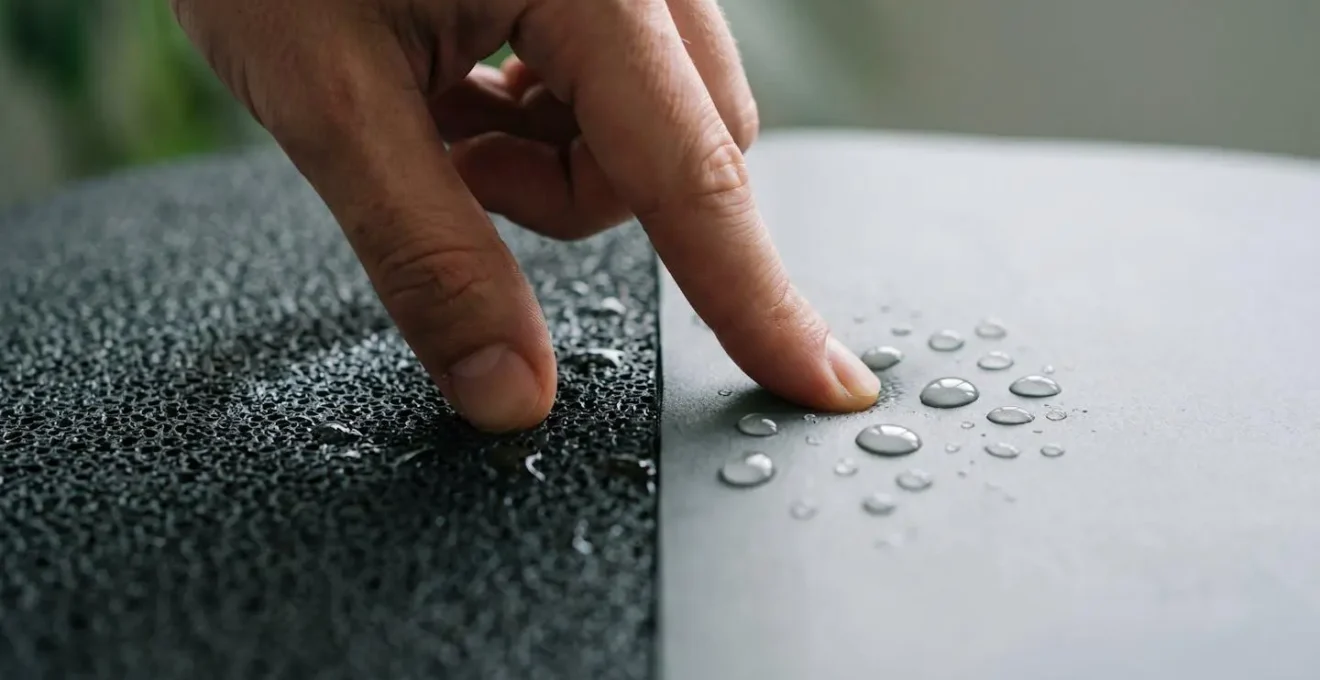
This illustration of moisture on a mat surface highlights the core difference. On a closed-cell TPE mat, sweat would bead up as shown, creating a slippery surface. On an open-cell rubber mat, that same sweat would be absorbed into the material, preserving the crucial connection needed for a stable Downward-Facing Dog. The following table breaks down the key differences to help you choose the right material for your hot yoga practice.
This detailed comparison, drawing from a comparative analysis of mat materials, shows a clear trade-off between grip, maintenance, and portability.
| Feature | Natural Rubber | TPE (Thermoplastic Elastomer) |
|---|---|---|
| Cell Structure | Open-cell (porous) – absorbs sweat to maintain grip | Closed-cell – requires towel to prevent pooling and slipping |
| Grip in High Humidity | Superior grip that improves with moisture | Moderate grip, can become slippery when wet |
| Post-Class Drying (UK climate) | Heavier, takes much longer to dry in humid climate – potential bacterial growth if not aired properly | Can be wiped dry instantly |
| Weight | Heavier (less portable) | 30-50% lighter than rubber – ideal for travel |
| Durability | 2-5 years with proper care | Degrades faster under heavy use |
| Eco-friendliness | Biodegradable, renewable resource | Recyclable but synthetic (not biodegradable) |
Why Buying a £15 Mat Every Year Costs More Than a £60 Mat That Lasts Five Years?
When standing in a store, the choice between a £15 mat and a £60 mat seems obvious from a purely financial perspective. The cheaper option feels like a low-risk entry point. However, this initial saving is an illusion. The true cost of any product is not its purchase price, but its lifecycle cost—the total amount you spend over its entire lifespan. When it comes to yoga mats, durability is the great divider, and cheap mats are designed to be disposable.
A typical £15 mat is made from PVC, a material known for poor durability. With regular use (2-3 times a week), it will start to flake, lose its cushioning, and develop permanent smells within a year. You are then forced to replace it, starting the cycle anew. Over five years, you will have spent £15 x 5 = £75, and generated five mats worth of landfill waste. In contrast, a high-quality £60 mat, typically made from dense natural rubber or high-grade polyurethane, is built for performance and longevity. With proper care, it can easily last five years or more.
This isn’t just an anecdotal claim; it’s backed by material science. Industry data confirms the vast difference in durability. As an analysis of mat lifespans shows, natural rubber mats can last 2-5 years with proper care, while budget PVC mats typically last 6-12 months. The superior materials of a premium mat resist the compression, abrasion, and microbial growth that quickly degrade a cheap one. So, the £60 mat not only provides a safer and more stable practice but also costs you less over time—£60 for five years versus £75 for five years of frustration.
This calculation doesn’t even account for the environmental cost of manufacturing and disposing of five mats instead of one. By shifting your mindset from « what is the cheapest option now? » to « what is the best value over five years? », you make a decision that is better for your wallet, your practice, and the planet. It’s the ultimate win-win-win.
How to Clean Your Yoga Mat So It Lasts 5 Years Without Becoming a Bacteria Colony?
Investing in a high-quality mat is the first step; learning how to care for it is the second. Without proper cleaning, even the most durable mat can degrade prematurely and become a breeding ground for bacteria, fungus, and odor. The platitude « clean your mat regularly » is not enough, because the wrong cleaning method can be as damaging as no cleaning at all. The key to longevity is using a material-specific cleaning protocol that removes microbes without harming the mat itself.
The most crucial distinction is between open-cell (like natural rubber) and closed-cell (like TPE or PVC) mats. A closed-cell mat is non-absorbent, so a simple wipe-down with a DIY solution of water and white vinegar is effective. However, using that same acidic vinegar solution on an open-cell natural rubber mat is a huge mistake. Vinegar will dry out the rubber, causing it to become brittle and crack over time, drastically shortening its lifespan. For natural rubber, you must use a specialized, pH-neutral cleaner designed to preserve its integrity.
Furthermore, a simple surface clean doesn’t always address the invisible layer of grime known as biofilm. This slimy layer is a colony of bacteria held together by body oils and sweat, and it’s what causes persistent odors and can even make a mat feel slippery. To truly deep clean your mat and ensure its longevity, a more thorough protocol is required. Follow these steps to keep your mat in peak condition for years to come.
- For TPE (closed-cell) mats: A DIY vinegar solution works perfectly. Mix 3 parts distilled water with 1 part white vinegar in a reusable glass bottle. Spritz and wipe down after every use to disinfect the surface.
- For Natural Rubber (open-cell) mats: AVOID vinegar solutions, which degrade and dry out rubber. Use only pH-neutral cleaners specifically designed for natural rubber to prevent cracking and preserve the material’s suppleness.
- Two-Step Biofilm Elimination: For a deep clean, first apply the appropriate cleaner to kill surface microbes. Second, use an enzymatic cleaner (similar to those used for pet stains) to break down the biofilm and the body oils that hold it together.
- Monthly Deep Clean Schedule: Once a month, perform a full surface cleaning with the material-specific solution. Afterwards, hang the mat to dry completely in a shaded, well-ventilated area. Never leave it in direct sunlight, as UV rays can degrade the material.
- Annual Conditioning for Natural Rubber: To drastically extend its lifespan to 5+ years, condition your natural rubber mat once or twice a year. Lightly apply a diluted mixture of jojoba oil and water to prevent cracking and maintain its natural flexibility.
- The Critical Drying Rule: Never roll up your mat while it is still damp. Bacteria and mildew thrive in dark, moist environments. Always ensure your mat is completely air-dried before storing it.
Why Does Iyengar Yoga Use So Many Props When Other Styles Use None?
To an observer accustomed to the continuous movement of a Vinyasa class, an Iyengar yoga class can look almost like a construction site, with students using blocks, straps, blankets, and bolsters to build intricate supports for their bodies. This stark difference in methodology stems from a core philosophical divergence: where many styles prioritize flow and rhythm, Iyengar yoga prioritizes anatomical precision and proprioception (your body’s awareness of its position in space).
In the Iyengar tradition, props are not seen as a crutch or an « easy version » of a pose. They are sophisticated tools for learning. The fundamental idea is that every yoga pose has a universal, ideal shape and energetic action. However, every human body is unique, with different limb lengths, flexibility levels, and torso-to-leg ratios. Props are used to bridge the gap between an individual’s unique anatomy and the ideal form of the pose. This ensures that every student, regardless of their natural ability, can experience the pose’s intended benefits safely and effectively.
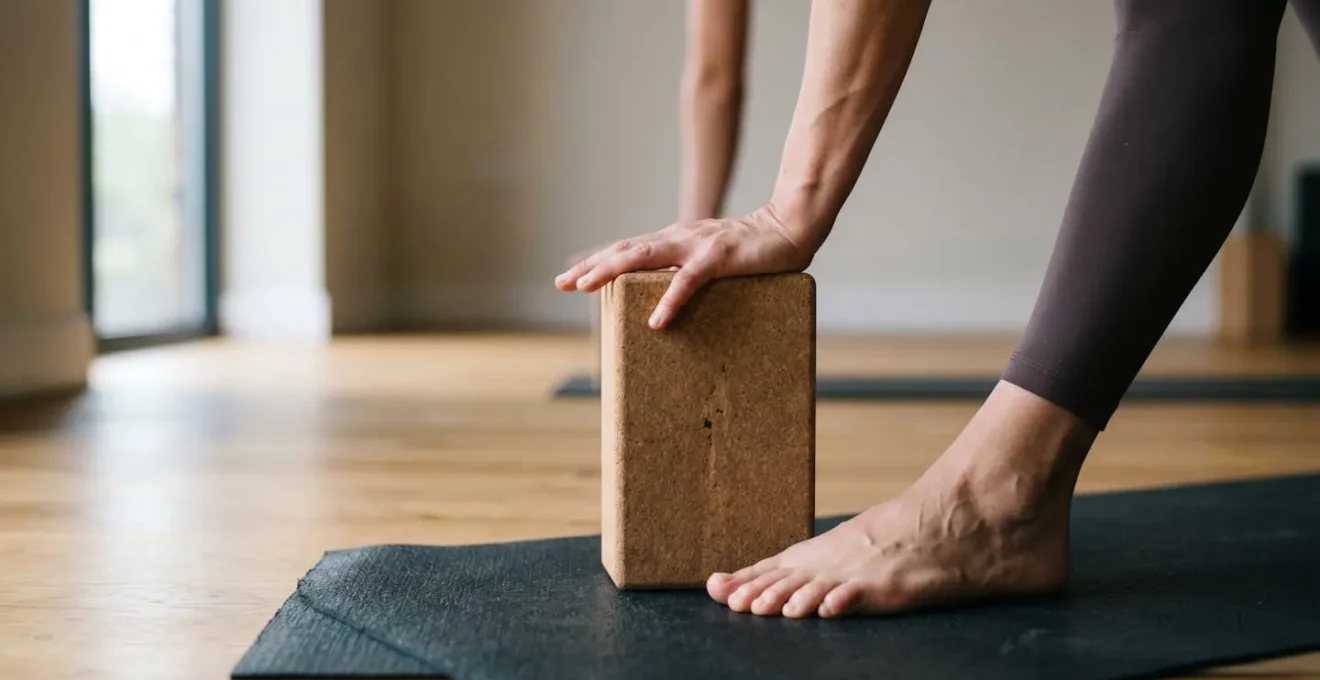
Props adapt the universal shape of the pose to an individual’s unique anatomy (torso-to-leg ratio, arm length), making the benefits of the pose accessible to everyone, regardless of natural flexibility.
– Iyengar Yoga methodology, focused on anatomical precision and proprioception
Consider Triangle Pose (Trikonasana). The goal is to lengthen both sides of the torso evenly. If a person with shorter arms or tighter hamstrings tries to reach the floor, they will inevitably collapse their upper body and compromise the pose. By placing a block under their hand, they « bring the floor up to them, » allowing them to maintain the full extension of the spine and experience the true action of the asana. In this way, props don’t diminish the work; they refine it, teaching the body the correct alignment from the inside out.
How to Set Up Your Home So Practicing Becomes Easier Than Not Practicing?
The biggest obstacle to a consistent home yoga practice isn’t a lack of time or a perfect mat; it’s friction. In behavioral science, this is known as « activation energy »—the effort required to start a task. If rolling out your mat, finding your props, and creating a peaceful space takes ten minutes of rummaging through a closet, the activation energy is high. Your brain will often choose the path of least resistance: sinking into the couch. The solution, inspired by the principles in James Clear’s « Atomic Habits, » is to design a space where the activation energy for practicing is virtually zero.
The goal is to make starting your practice so ridiculously easy that it becomes harder to avoid it than to do it. This isn’t about creating a « perfect » yoga sanctuary (though that’s nice if you have the space). It’s about strategically placing cues and removing barriers to create a frictionless path to your mat. This involves making the desired habit obvious, attractive, easy, and satisfying. By engineering your environment, you rely less on willpower and more on well-designed systems.
Here is a framework for applying these principles to create a home environment that pulls you into your practice:
- Make it Obvious: The most powerful step is to keep your mat permanently unrolled in a dedicated corner of a room you use often. This constant visual cue triggers the thought of practicing. Choose beautiful props that you want to have on display rather than hiding them away.
- Make it Attractive: Curate specific sensory triggers that you associate only with yoga. This could be a particular essential oil scent you diffuse five minutes before you start, a specific « yoga-only » playlist, or the sound of a bell. This creates a Pavlovian response that shifts your brain into « yoga mode. »
- Make it Easy: Apply the « 2-Minute Rule. » Your setup should allow you to get on your mat and start moving in under 10 seconds. Reduce every point of friction. If you like practicing in the morning, lay out your yoga clothes the night before.
- Make it Satisfying: The reward reinforces the habit loop. Design a post-practice ritual as carefully as the setup. Have a comfortable meditation cushion nearby, a pre-stocked tea station, or a journal ready to capture your thoughts. Make the ending of your practice as pleasant as the beginning.
- Increase Friction for Competing Habits: During your designated practice time, make competing behaviors harder. If you tend to scroll on your phone, leave it in another room. If you get distracted by a messy desk, clear it beforehand or face away from it.
By lowering the barrier to entry, you are no longer deciding *if* you will practice, but simply *when* you will step onto the mat that’s already waiting for you. It’s a simple but profound shift in perspective.
Key Takeaways
- The true cost of a yoga mat is not its price tag, but its price-per-year of use. Durability is the key to value.
- Material science, especially the difference between open-cell (absorbent) and closed-cell (non-absorbent) structures, dictates a mat’s performance, particularly grip in humid conditions.
- Yoga props are not a sign of weakness but are sophisticated tools for achieving anatomical precision, making poses safer and more effective for every body type.
Why Does Your Mat Work Fine in Winter but Become Slippery Every Summer?
It’s a perplexing experience for many yogis: the mat that felt perfectly grippy during the cool, dry months of winter suddenly becomes a slip-and-slide in the humidity of summer. This isn’t your imagination; it’s a real phenomenon rooted in the physics of friction and material science. The culprit is moisture—both the sweat from your body and the humidity in the air—and how it interacts with the surface of your mat.
The science of friction in this context is called tribology. A materials science perspective explains this seasonal change perfectly. As a researcher might put it:
In winter (low humidity), small amounts of sweat can increase the ‘tackiness’ of a mat’s surface. In summer (high humidity), the combination of ambient moisture from the air and increased sweat creates a thicker layer of water. This layer can break the surface tension, causing ‘hydroplaning’ between your skin and the mat.
– Materials science tribology research, on the physics of friction in yoga practice
This « hydroplaning » effect is the same reason car tires can lose traction on a wet road. A thin film of water prevents direct contact, eliminating the friction needed for grip. This is most pronounced on closed-cell mats (like PVC and TPE), which cannot absorb this moisture layer. In contrast, open-cell mats (like natural rubber) mitigate this by wicking the moisture away from the surface, maintaining that crucial skin-to-mat connection.
Furthermore, heat and humidity don’t just affect grip; they can also exacerbate the release of chemicals from cheap PVC mats. The « new mat smell » is caused by the off-gassing of volatile organic compounds (VOCs), including phthalates. Heat accelerates this process. For instance, a 2018 study found that at 104°F (a typical hot yoga room temperature), total phthalate concentrations in the air could increase significantly. This means that in summer or a hot class, your slippery mat might also be exposing you to more potentially harmful chemicals.
Your yoga equipment should support your practice, not hinder it. By applying this deeper understanding of material science, lifecycle cost, and genuine sustainability, you can now evaluate your current gear and make future purchases with confidence. The goal is to build a collection of tools that are not only effective and safe but also align with your values, allowing you to focus on what truly matters: your practice.