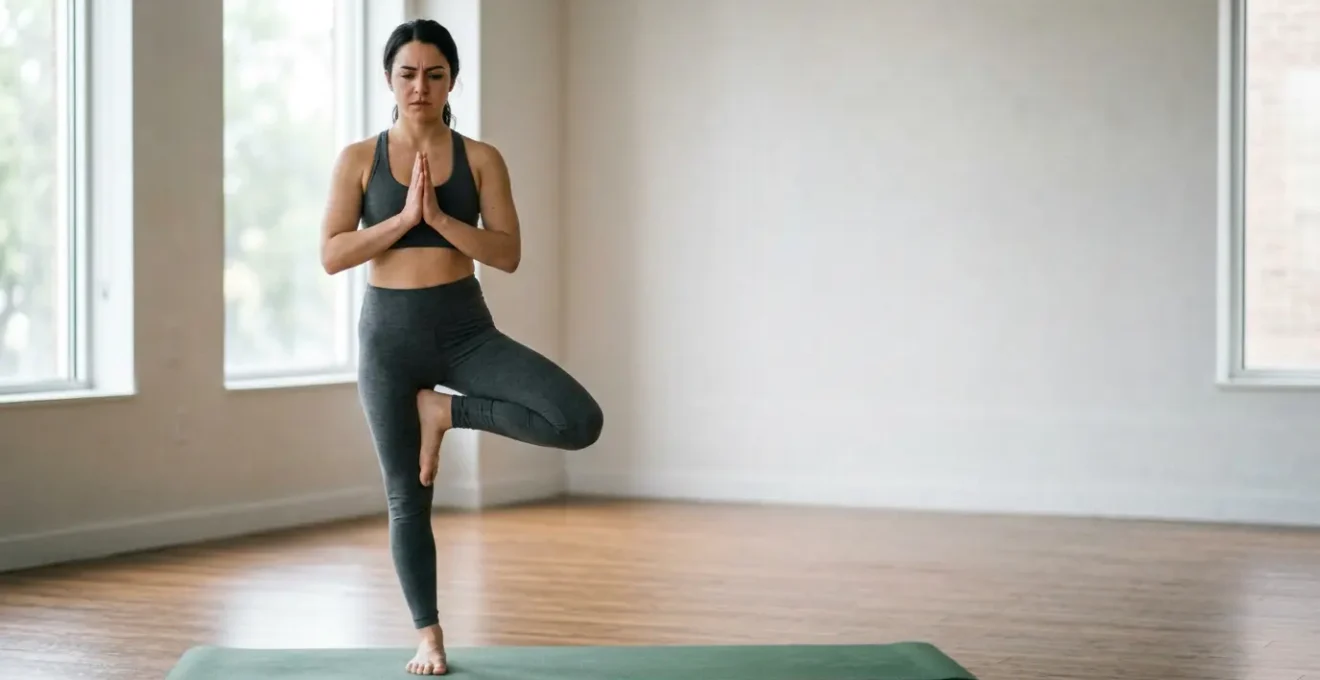
Your recurring balance issues aren’t a sign of weakness, but a symptom of ‘proprioceptive neglect’—a fixable disconnect between your brain and body.
- Lasting stability comes from training a trainable ‘sixth sense’ called proprioception, not just from muscle strength or focus.
- Chronic issues like repeated ankle sprains and a general feeling of bodily disconnection are often disguised proprioception deficits.
Recommendation: Shift from passively ‘holding’ poses to actively challenging your sensory system with controlled instability to build a truly unshakeable foundation.
You’ve been practicing for years. You can hold a Downward Dog, flow through a vinyasa, and you understand the alignment cues. Yet, when it comes to Tree Pose, that familiar wobble returns. You clench your toes, stare intently at a spot on the wall, and engage your core, just like you’ve been told. Sometimes it works; often, it doesn’t. The frustration mounts because your effort doesn’t seem to correlate with your stability. It feels like a lottery.
The conventional wisdom tells you to « practice more, » « find your drishti, » or « root down. » While these cues aren’t wrong, they are incomplete. They are surface-level instructions for a problem that runs much deeper, down to the level of your nervous system. They address the ‘what’ but completely ignore the ‘why’. What if the issue isn’t your strength, your focus, or your dedication? What if your body and brain have simply forgotten how to have a clear conversation?
The true key to unshakeable balance lies in a concept you rarely hear about in a typical yoga class: proprioception. This is your body’s sixth sense, the continuous, subconscious feedback loop that tells your brain where your limbs are in space without you having to look. Your chronic instability is not a failure of practice, but a symptom of an untrained proprioceptive system. It’s a dormant skill waiting to be reawakened.
This article will serve as a diagnostic tool and a corrective training manual. We will dissect the science of proprioception, provide a clear, progressive plan to rebuild it, and explore how to integrate this training into your existing yoga practice. You will learn to treat balance not as an elusive art, but as a tangible, trainable neurological skill.
The following sections will guide you through understanding, diagnosing, and retraining this vital sense. We will explore everything from the fundamental science of proprioception to practical ways to challenge your balance safely and effectively within your yoga flow.
Table of Contents: Why You Keep Losing Balance in Tree Pose Even After Years of Practice?
- What Is Proprioception and Why Does It Get Worse If You Do Not Challenge It?
- How to Progress from Standing on One Leg to Eyes-Closed Balance in 8 Weeks?
- Yoga, Wobble Board or Barefoot Walking: Which Improves Balance Fastest?
- Are Your Repeated Ankle Sprains a Proprioception Problem in Disguise?
- How to Add Balance Challenges to Sun Salutations Without Breaking the Flow?
- How to Retrain Your Body to Notice Slumping Before Pain Starts?
- What Does « Feeling Your Body » Actually Mean When You Feel Nothing Specific?
- Why Do You Feel Disconnected from Your Body Even During Yoga Practice?
What Is Proprioception and Why Does It Get Worse If You Do Not Challenge It?
Proprioception is often called the « sixth sense. » It’s the silent, constant stream of information from sensors in your muscles, tendons, and joints that tells your brain about your body’s position, motion, and equilibrium. When you close your eyes and touch your nose, that’s proprioception at work. It’s the sense that allows you to walk without looking at your feet. In yoga, it’s what should be governing your stability in Tree Pose, allowing your brain to make micro-adjustments in your standing leg’s ankle and hip without conscious thought.
The problem is that this sense, like a muscle, atrophies from disuse. In our modern lives, we spend most of our time on flat, stable surfaces and in supportive chairs. Our nervous system receives predictable, monotonous sensory input. This leads to what can be termed proprioceptive neglect: the brain, starved of novel stimuli, starts to « tune out » the signals from the body. It becomes lazy. When you then step onto your yoga mat and ask it to perform a complex task like balancing on one leg, it’s unprepared for the sudden demand for a rich, high-fidelity neuromuscular dialogue.
This neurological « de-skilling » is why your balance can feel inconsistent or even degrade over time, despite regular practice. If your yoga routine itself becomes too repetitive, your body adapts and the challenge disappears. The nervous system no longer needs to learn or refine its body map. As researchers from the Frontiers in Rehabilitation Sciences note, testing this sense requires removing other inputs:
Proprioception can only be accurately quantified during motor tasks that do not rely on other sensory input. For example, postural control requires the integration of visual, vestibular, and proprioceptive information.
– Frontiers in Rehabilitation Sciences, The Effectiveness of Proprioceptive Training for Improving Motor Performance and Motor Dysfunction: A Systematic Review
Therefore, to improve proprioception, you must intentionally and progressively challenge it. You must create situations where your brain cannot rely on its dominant sense—vision—and is forced to listen more closely to the subtle somatic signals coming from your body.
How to Progress from Standing on One Leg to Eyes-Closed Balance in 8 Weeks?
Rebuilding proprioception isn’t about brute force; it’s about systematic, progressive training. You must re-introduce challenges in a way that allows your nervous system to adapt without becoming overwhelmed. The goal is to move from a state of high stability (eyes open, firm ground) to one of controlled instability (eyes closed, unstable surface), forcing your brain to engage in sensory re-weighting—shifting its reliance from vision to proprioception.
The following 8-week protocol, adapted from clinical rehabilitation principles, provides a clear path. The key is consistency and patience. Each stage builds the necessary neurological foundation for the next. Aim for two to three sessions per week, dedicating just 5-10 minutes to this specific work. This can be done separately or as part of your yoga warm-up.
- Weeks 1-2: Establish a Baseline. Practice a basic single-leg stance (Tadasana on one leg) on a stable, hard surface. Keep your eyes open with a soft gaze. Focus on holding for 30-60 seconds on each leg. The goal here is simple endurance and allowing your brain to map the basic pattern.
- Weeks 3-4: Introduce Vestibular Challenge. While holding the single-leg stance, introduce gentle head movements. Slowly turn your head to look left and right. Then, try tilting your head up towards the ceiling and down towards the floor. This disrupts your vestibular (inner ear) system and forces your proprioceptive system to work harder.
- Weeks 5-6: Introduce Surface Instability. Now, progress to an unstable surface. This could be a folded yoga blanket, a foam pad, or a BOSU ball. Begin again with eyes open, simply holding the single-leg stance. Notice the dramatic increase in ankle muscle activation.
- Weeks 7-8: Remove Visual Input. This is the final and most challenging step. On the unstable surface, first soften your gaze, then attempt to close your eyes for just a few seconds at a time. Expect to wobble; this is not failure, it is neurological feedback. The wobble is your brain actively learning to interpret the new, high-resolution data from your feet and ankles.
Throughout this process, the focus is on the quality of the practice, not the perfection of the hold. Allowing for controlled wobble is more beneficial than remaining rigid for a shorter period.
Yoga, Wobble Board or Barefoot Walking: Which Improves Balance Fastest?
When aiming to accelerate proprioceptive gains, practitioners often wonder which modality is superior. Should you focus solely on your asana practice, invest in a wobble board, or simply take off your shoes more often? The answer is not about choosing one over the other, but understanding how they work together in a synergistic way.
Yoga is excellent for integrating balance into complex, full-body movements. Poses like Vrksasana (Tree Pose), Garudasana (Eagle Pose), and the Warrior III transition challenge proprioception in a functional, dynamic context. However, if the practice becomes too routine, its proprioceptive benefits diminish. The key is variety and introducing micro-challenges.
A wobble board or balance disc is a tool for targeted, isolated proprioceptive training. It provides a high degree of controlled instability, forcing the hundreds of muscles and sensors in your feet and ankles to fire rapidly. This is like taking your neuromuscular system to the gym for a high-intensity workout. It’s highly efficient for building foundational ankle stability but lacks the full-body integration of yoga.
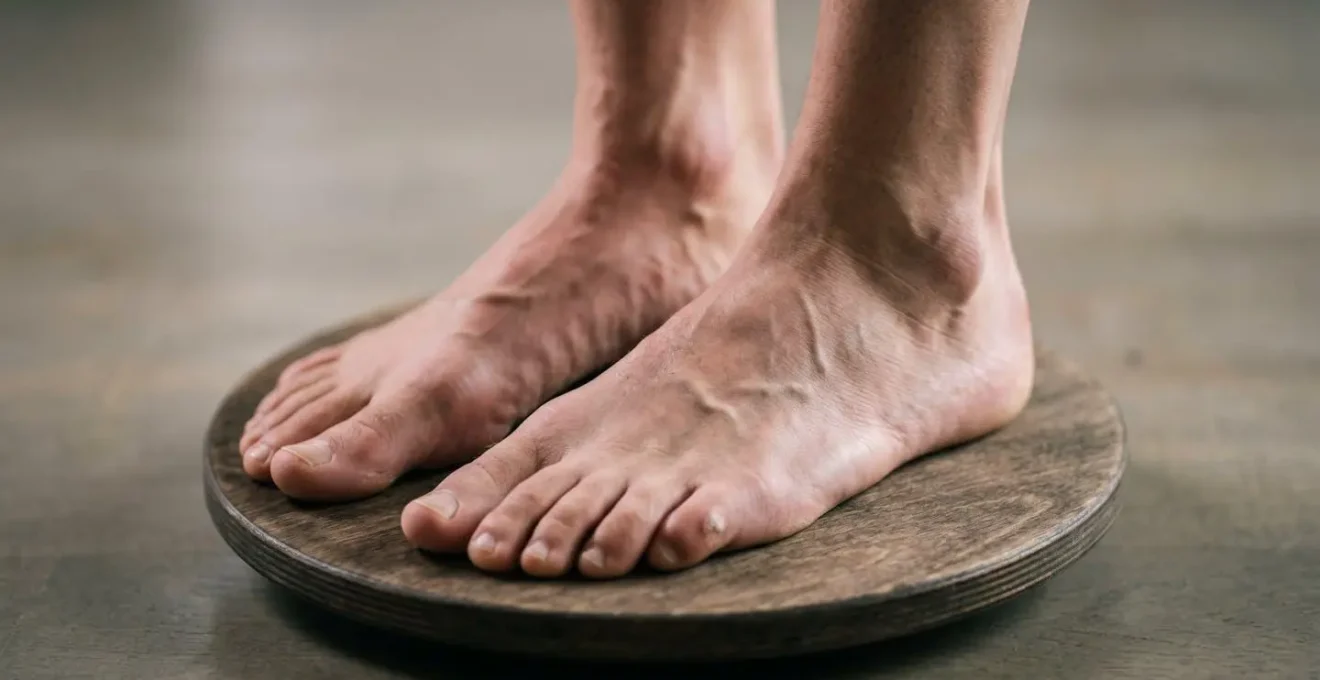
Barefoot walking, especially on varied, natural surfaces like grass, sand, or a trail, is perhaps the most fundamental and accessible tool. Modern cushioned shoes act like sensory deprivation tanks for our feet, dulling the rich feedback the ground provides. Walking barefoot reawakens these pathways. In fact, a 2022 study in BMC Geriatrics found that barefoot walking significantly improved stability in older adults, specifically by reducing variability when recovering from a stumble.
For the fastest improvement, a combined approach is optimal. Use barefoot walking as your daily baseline to keep the sensory channels open. Use a wobble board for short, intense, isolated training sessions 2-3 times a week. And finally, apply these newfound skills within your yoga practice by introducing the novel challenges discussed in the following sections. This creates a holistic system where foundational sensory input is refined through targeted training and then integrated into complex movement.
Are Your Repeated Ankle Sprains a Proprioception Problem in Disguise?
For many people, a sprained ankle is a recurring injury. You might misstep off a curb or roll your ankle during a run, and despite rest and icing, it seems to happen again months later. This cycle is rarely a matter of bad luck; it’s a classic sign of a significant, unaddressed proprioceptive deficit. When you sprain an ankle, you don’t just damage the ligaments; you damage the delicate nerve receptors (proprioceptors) embedded within them.
These receptors are responsible for sending critical information to your brain about the joint’s position. When they are damaged, the signal is corrupted or lost. Your brain literally doesn’t know where your ankle is in space, making it highly vulnerable to re-injury. This condition is known as Chronic Ankle Instability (CAI), and its prevalence is alarming. This isn’t a rare occurrence; research shows that for about 40% of patients, an initial ankle sprain leads to this chronic, proprioceptively-impaired state. Without specific retraining, the brain does not automatically recover this lost sensory data.
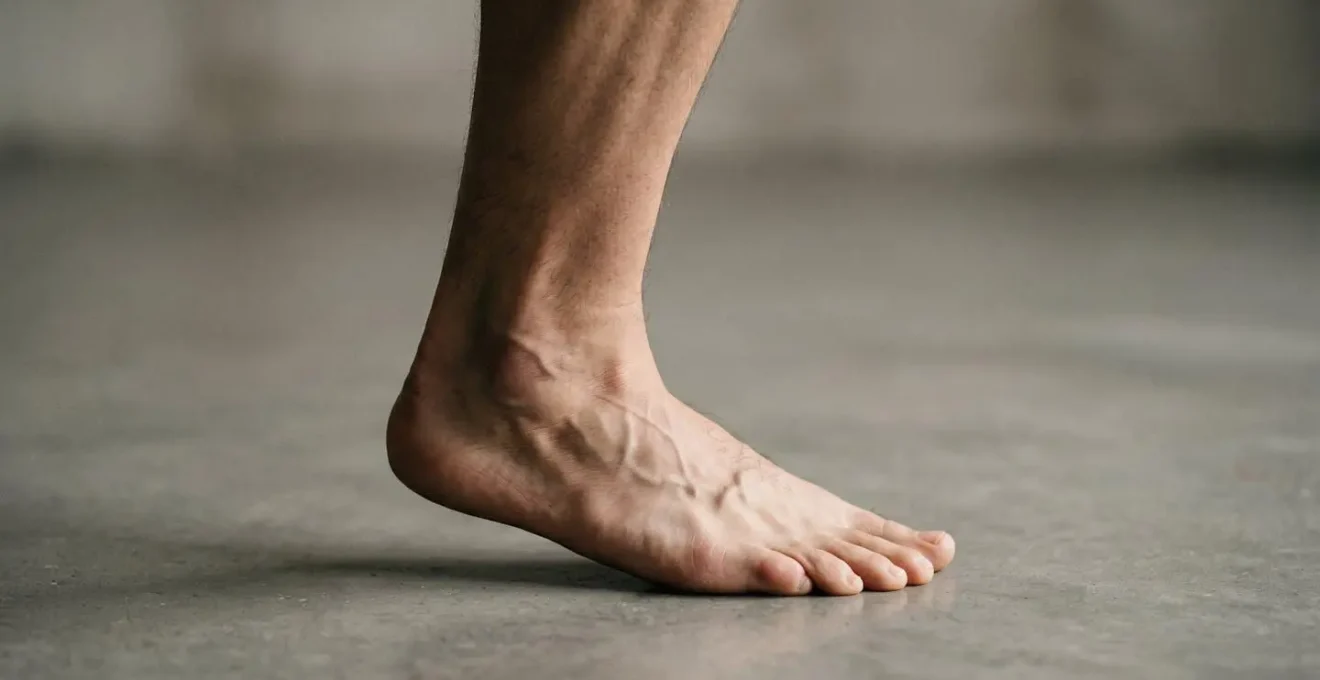
A simple self-test can be illuminating. Stand on one leg—the one with the history of sprains—and close your eyes. Compare the amount of wobble and the duration you can hold the pose to your « good » ankle. The difference is often dramatic. The excessive swaying is your visual system trying, and failing, to compensate for the missing somatic signal from the joint.
The solution is not more passive stretching or strengthening alone. It requires targeted proprioceptive drills like those outlined in the 8-week plan, with a specific focus on the injured side. Using a balance board or foam pad is especially crucial here, as it forces the nervous system to rebuild those damaged communication lines and re-establish a clear and reliable body map of the ankle joint. Ignoring this step is why so many people are caught in a frustrating and painful cycle of re-injury.
How to Add Balance Challenges to Sun Salutations Without Breaking the Flow?
Once you’ve started building foundational proprioception with isolated drills, the next step is to integrate that skill into dynamic movement. The Sun Salutation (Surya Namaskar) is the perfect laboratory for this. The goal is not to disrupt the rhythm but to weave in « micro-challenges » that keep your nervous system engaged and learning, preventing the flow from becoming a mindless routine.
Instead of just moving through the sequence, you can turn it into a powerful proprioceptive training session. This involves subtly altering your base of support or sensory input to force your body to rely less on habit and more on real-time feedback. The idea is to make the familiar feel slightly unfamiliar, which is the exact stimulus your brain needs to sharpen its body map. This approach transforms your vinyasa from simple exercise into a sophisticated form of neuromuscular dialogue.
By layering these small, intentional disruptions into your flow, you continuously challenge your stability in a functional context. This trains your body to be resilient and adaptable not just in static poses, but during the transitions between them—which is where balance is often most critical.
Action Plan: Integrating Micro-Challenges into Your Flow
- In Tadasana (Mountain Pose): Before you begin, infinitesimally lift your heels or toes. The goal isn’t a visible lift, but to feel the weight shift and the base of support narrow, forcing immediate ankle stabilization.
- During Transitions: Practice the step forward from Downward Dog to a lunge in extreme slow motion. This exposes every subtle wobble and stability weakness that is normally masked by momentum.
- In Plank or Downward Dog: Try the « Floating Limb » technique. Shift your weight until one hand or one foot becomes completely light, hovering just millimeters off the mat. This forces your core and stabilizing limbs to manage an asymmetrical load.
- Throughout the Flow: Attempt to execute the entire Sun Salutation on the balls of your feet. This dramatically narrows your base of support and constantly challenges your ankle and foot stability.
- Vary Your Gaze: Deliberately change your focal point. During poses like Upward-Facing Dog or Warrior I, try looking up, down, or turning your head from side to side. This challenges your vestibular system and forces greater proprioceptive reliance.
How to Retrain Your Body to Notice Slumping Before Pain Starts?
The same sensory neglect that causes poor balance also contributes to poor posture. Just as your brain tunes out signals from your feet, it can also ignore the subtle cues that precede postural collapse, like the slump in your spine when you’re focused on your computer. You often only notice the problem when it screams for attention in the form of back or neck pain. The key is to retrain your awareness to catch the whisper before it becomes a scream.
This involves developing interoceptive awareness—the sense of your body’s internal state. While proprioception is about position, interoception is about sensation: feelings of tightness, breath restriction, or fatigue. You need to identify your personal « somatic alarm bells. » For some, the first sign of slumping is a slight tightening in the jaw. for others, it’s a shallowing of the breath or a feeling of heaviness in the chest. These are the precursors, the early-warning signals that your posture is beginning to fail.
A powerful technique is to use your breath as a biofeedback tool. A full, diaphragmatic breath requires an upright, open posture. The moment your breath feels restricted, it’s a reliable indicator that your rib cage has started to collapse. Instead of the common but unsustainable cue to « pull your shoulder blades back, » focus on activating the serratus anterior muscles (under your armpits) to create a subtle forward and upward lift in the chest. This creates a more sustainable and structurally sound upright posture.
Furthermore, start linking your posture to your emotional state. Notice how your body collapses when you are bored, stressed, or tired. By reframing the slump not as a failure but as a valuable internal signal, you can respond with curiosity instead of judgment. This shift in perspective is the foundation for creating a lasting habit of postural self-correction, long before discomfort sets in.
What Does « Feeling Your Body » Actually Mean When You Feel Nothing Specific?
Yoga teachers often say, « feel your body » or « listen to your body, » but for many, this instruction is profoundly confusing. You try to tune in, but what you encounter is a vague numbness or a cacophony of competing sensations. What does « feeling » actually mean when you don’t feel anything specific? The answer lies in deconstructing the different channels of sensory information and starting with the « loudest » signals.
Feeling your body isn’t a single, mystical skill; it’s the ability to differentiate between multiple sensory inputs. As explained by YogaUOnline, there’s a crucial difference between your external and internal senses:
Whereas proprioception is about where your body is in space, interoception is about how your body feels. Do I feel hungry, have to pee, feel hot? When you are tuned in, you make appropriate (and often unconscious) behavioral decisions to return to homeostasis.
– YogaUOnline, Proprioception And Interoception In Yoga
If you’re struggling to connect, don’t start by searching for a subtle energetic shift. Start with the most undeniable sensations available. This could be thermoception (the cool air on your skin), nociception (the pressure of the mat against your back), or the simple sound of your own breath. These are your entry points. Acknowledge these gross sensations without judgment.
From there, you can use a simple principle: action precedes sensation. If you can’t « feel » your foot, don’t just think about it. Instead, actively press your big toe into the mat, spread your other toes wide, and then relax. Now, notice the after-sensation—the warmth, the tingling, the feeling of blood flow. You created a signal that you can now perceive. Start with a very small area, like a single finger or toe, and focus all your awareness on its temperature, the pressure on it, and its exact position in space. By starting small and using action to generate sensation, you begin the process of rebuilding the neural pathways required to « feel your body » with clarity and specificity.
Key takeaways
- Your balance problem is likely neurological, not a lack of strength, stemming from an untrained proprioceptive system.
- Improving balance requires systematic, progressive challenges that force your brain to rely on bodily feedback over visual input.
- Chronic issues like recurring ankle sprains and postural slumping are often symptoms of the same underlying sensory disconnection.
Why Do You Feel Disconnected from Your Body Even During Yoga Practice?
Even with consistent practice, you might experience moments, or entire classes, where you feel profoundly disconnected from your physical self. You go through the motions, but your mind is elsewhere, and your body feels like a foreign object. This sense of disembodiment can be deeply unsettling and is often rooted in two primary factors: your physiological state and your psychological approach to the practice.
Physiologically, a state of chronic stress is a major culprit. When your sympathetic nervous system (the « fight-or-flight » response) is chronically activated, your brain perceives the body as a source of threat or overwhelming noise. As a protective mechanism, it simply « checks out. » This is not a conscious choice but a primal survival strategy.
Case Study: Sympathetic Activation and Somatic Disconnection
Research demonstrates that a chronically activated sympathetic nervous system, often due to stress or anxiety, can make bodily sensations feel overwhelming, leading the mind to ‘check out’ as a protective mechanism. When the body is in a threat state, proprioception is one of the first senses to diminish because the feeling of pain can overcome the feeling of where your body is in space. This is evident in cases of chronic pain where neurogenic inflammation can impair the nervous system’s ability to take in proprioceptive information.
Psychologically, the very intention you bring to the mat can create this disconnection. When your focus shifts from internal experience to external validation, the connection is severed. As the experts at Shut Up & Yoga point out, performance anxiety is a direct path to disembodiment:
When practice becomes performance, striving for the perfect pose or judging your balance shifts focus from internal experience (interoception) to external validation, causing an immediate sense of disconnection.
– Shut Up & Yoga, Your Brain on Yoga, Part II: Proprioception
Ultimately, this feeling of disconnection is a signal. It’s your nervous system telling you that it is either in a threat state or that your mental focus has shifted from process to outcome. The solution is to consciously shift back: to prioritize calming the nervous system through breathwork and to re-engage with the raw, non-judgmental sensations of the present moment, as discussed previously.
To truly reclaim your stability and feel at home in your body, the fundamental shift is to treat your practice not as a performance to be judged, but as a rich conversation to be had. It’s time to stop just moving your body and start listening to it. Begin implementing these principles of proprioceptive training today to transform your balance from a source of frustration into a foundation of strength.