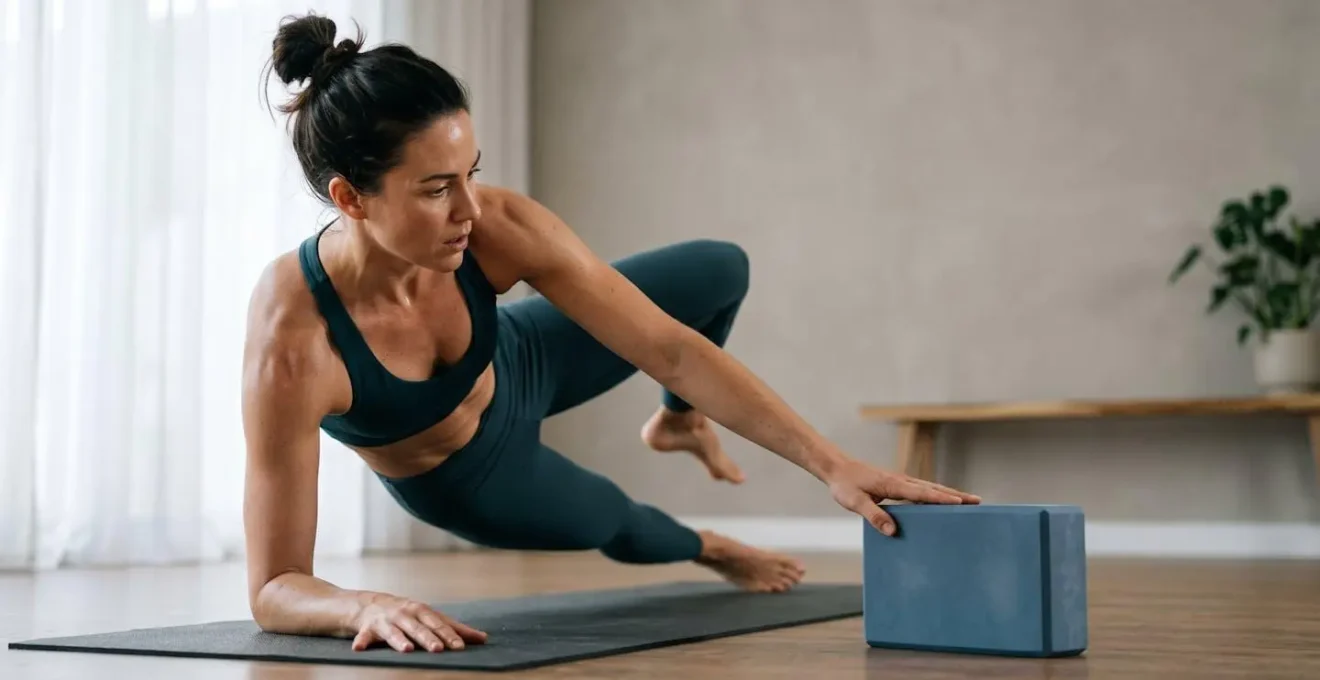
The strength you build in the gym often fails in daily life because it’s built in a stable, predictable bubble. Real-world strength is a neurological skill for managing instability.
- Gym strength focuses on isolating muscles, while functional strength integrates them to control unpredictable, uneven loads—like groceries or a toddler.
- Key longevity markers, like the ability to get up from the floor, depend on this integrated strength, not on how much you can bench press.
Recommendation: Shift your focus from training muscles to building a ‘movement vocabulary’ through exercises that challenge your balance, coordination, and ability to handle asymmetric loads.
It’s a frustratingly common paradox. You can hold a perfect plank for what feels like an eternity, diligently complete your sets of squats and presses, and consider yourself ‘fit’. Yet, when faced with a flight of stairs and two heavy shopping bags, your body feels surprisingly weak, your breath shortens, and your lower back starts to ache. This disconnect isn’t a failure of your effort; it’s a failure of translation. The strength you’ve built in the controlled, symmetrical, and stable environment of the gym or a yoga mat is a different language from the one your body needs to speak in the chaotic, unpredictable real world.
Most fitness advice focuses on building bigger muscles or holding poses longer. We’re told to do more reps, lift heavier, or perfect our form on isolated movements. But this often leads to developing « show muscles » that look good in the mirror but lack the deep, reflexive stability required for everyday tasks. The problem isn’t a lack of strength, but a lack of *coordination*. Your nervous system hasn’t been trained to automatically stabilize your spine and joints when faced with an uneven, shifting load.
But what if the key wasn’t just adding more exercises, but changing the very *quality* of your movement? The true measure of fitness isn’t your one-rep max, but your ability to move through life with ease and resilience. It’s about developing a robust neuromuscular system that can adapt to any challenge, from lifting a suitcase into an overhead bin to getting up off the floor without a second thought. This is the essence of functional strength—a quality that predicts not just performance, but long-term health and independence.
This article will deconstruct the difference between superficial gym strength and deep, usable strength. We will explore how to integrate functional challenges into your existing routines, identify the key movements that predict longevity, and provide practical tests and drills to bridge the gap between your fitness potential and your real-world physical power.
To help you navigate this path from static strength to dynamic capability, we have structured this guide to address the most critical aspects of building a truly functional body. The following sections will provide a clear roadmap.
Summary: From a 2-Minute Plank to Real-World Power
- What Is the Difference Between Gym Strength and Strength You Can Actually Use?
- How to Add Functional Movements to Your Yoga Routine Without Losing Its Essence?
- Which Floor-to-Standing Exercises Predict Longevity and How to Train Them?
- The Mistake of Building Mirror Muscles While Ignoring Movements That Matter
- Can You Pass These 3 Simple Tests That Predict Physical Independence at 70?
- How to Engage Your Deep Core When Lifting Your Toddler Without Thinking About It?
- Which Movements at 50 Predict Whether You Will Need Help Getting Dressed at 80?
- Why Crunches Alone Will Never Fix Your Lower Back Pain After 40?
What Is the Difference Between Gym Strength and Strength You Can Actually Use?
The core difference between the strength you build in the gym and the strength you need for daily life lies in one word: predictability. Gym strength is often developed in a highly controlled environment. A barbell is perfectly balanced, a machine moves along a fixed path, and the floor is always flat. This type of training is excellent for muscle hypertrophy—making muscles bigger—by isolating them. Holding a plank is a prime example of static, symmetrical strength. Your body is braced in a stable, predictable position.
Real-world or ‘functional’ strength, however, is your capacity to handle unpredictable and unstable loads in multiple planes of motion. Think of carrying a wriggling child, hoisting a lopsided grocery bag, or catching yourself from a stumble. These tasks require not just raw muscle power, but sophisticated neuromuscular coordination. Your brain must instantly recruit dozens of muscles in a precise sequence to stabilize your joints and spine while you move. As REP Fitness Training Research aptly puts it, there’s a fundamental difference in purpose.
Functional strength training is viewed as a means to an end, while traditional strength training is an end unto itself.
– REP Fitness Training Research, Functional Training vs. Strength Training Analysis
While gym strength focuses on the capacity of an isolated muscle, functional strength trains complex movement patterns that improve coordination of multiple muscle groups together. It’s the difference between having a large vocabulary of individual words (strong muscles) and being able to form coherent, eloquent sentences to navigate any conversation (complex movements). That shopping bag doesn’t just challenge your bicep; it challenges your grip, your core’s ability to resist twisting, and your opposite hip’s stability with every step.
How to Add Functional Movements to Your Yoga Routine Without Losing Its Essence?
Yoga is a fantastic foundation for functional movement, building flexibility, body awareness, and baseline strength. However, traditional practice is often highly symmetrical. You perform Warrior II on the right, then repeat it identically on the left. This builds balanced strength but doesn’t prepare the body for the most common real-world challenge: asymmetric loading. Life is rarely balanced; you carry a bag on one shoulder, hold a door with one hand, or lift a box from one side.
The key to evolving your yoga practice is to introduce subtle, uneven loads without sacrificing mindfulness and breath. This trains your deep core stabilizers to provide the « reflexive stability » needed to protect your spine. Instead of just holding a pose, you’re teaching your body to actively resist being pulled out of alignment. This small tweak can dramatically increase the functional carryover of your practice.
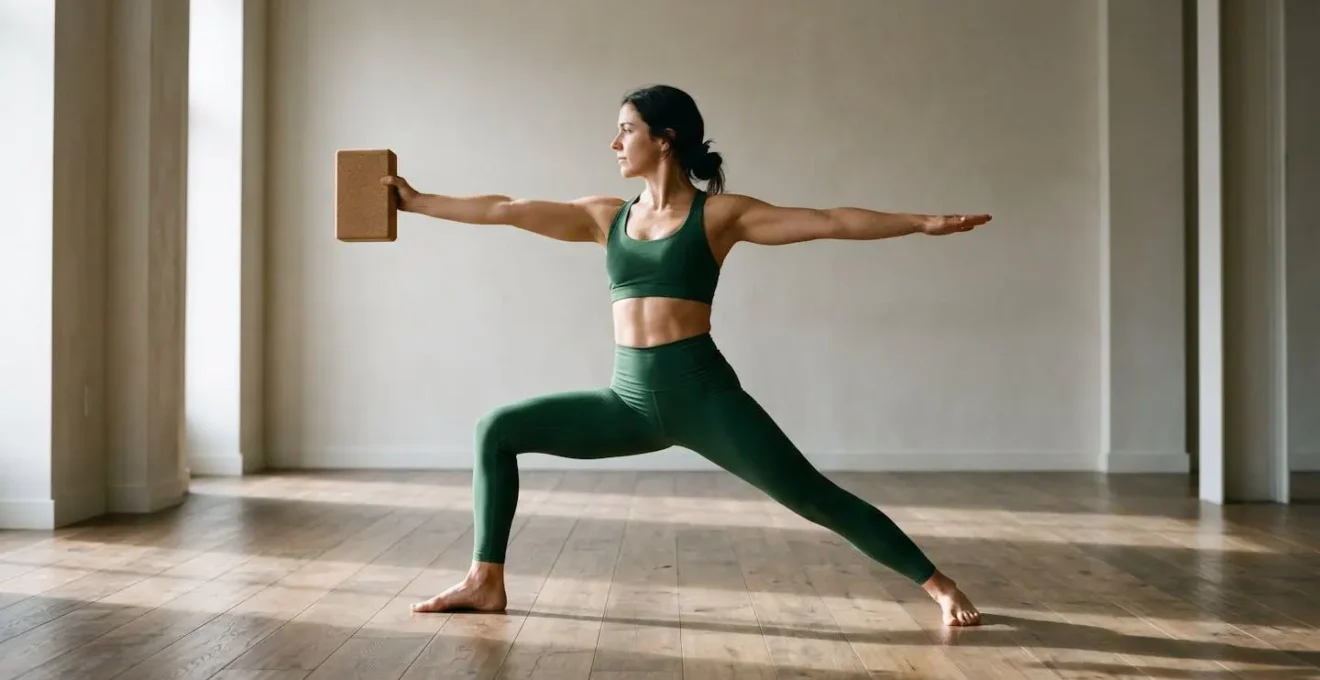
As seen in the image, simply holding a light weight—like a yoga block or a small dumbbell—in one hand during a pose like Warrior II instantly changes the dynamic. Your core has to work overtime to prevent your torso from side-bending toward the weight. You are now training the anti-lateral flexion capacity of your obliques in a way a symmetrical pose never could. This is how you start building a smarter, more adaptive core.
Which Floor-to-Standing Exercises Predict Longevity and How to Train Them?
One of the most powerful predictors of your long-term health and independence has nothing to do with how much you can lift. It’s your ability to get up from the floor. This seemingly simple act is a complex symphony of strength, balance, mobility, and coordination—the very essence of functional fitness. The most studied measure of this ability is the Sitting-Rising Test (SRT), a simple test where you try to sit down on the floor and stand back up using as little support as possible.
Scored out of 10 points (5 for sitting, 5 for rising), with one point deducted for each hand, knee, or other support used, the SRT is shockingly predictive of mortality. The data is stark: a study in the European Journal of Preventive Cardiology found that participants with SRT scores of 0-4 showed a 42.1% death rate over the study period, compared to just 3.7% for those scoring a perfect 10. The reason is that this single test encapsulates your entire ‘movement vocabulary’. It reveals your body’s ability to coordinate its parts into a fluid, powerful whole.
Case Study: The Sitting-Rising Test as a Comprehensive Fitness Assessment
An analysis by Harvard Health on the SRT revealed its profound diagnostic power. Participants who scored in the lowest range (0 to 4 points) were nearly four times more likely to die from any cause compared to those who scored a perfect 10. The test simultaneously assesses muscle strength (especially in the legs and core), flexibility (in the hips and knees), balance, and body composition. These are the exact components required for independent living as we age, making the SRT a far more meaningful marker of health than isolated metrics like BMI or cholesterol alone.
To train this, you don’t need a fancy gym. Practice variations of getting up and down. Start from a lunge, a cross-legged seat, or from lying on your back. The goal is to gradually reduce your reliance on your hands, building the integrated strength and mobility that defines a truly capable body.
The Mistake of Building Mirror Muscles While Ignoring Movements That Matter
Modern gym culture often prioritizes the « mirror muscles »—the ones you can easily see, like the chest, biceps, and quads. While aesthetically pleasing, focusing exclusively on these muscles creates a dangerous imbalance. It neglects the posterior chain, the rotational core muscles, and, most critically, the foundational movements that actually predict your ability to function in the world. Perhaps the most overlooked and vital of these is grip strength.
Your grip is not just about your hands; it’s a direct indicator of your overall neural drive and full-body tension. A weak grip is a powerful sign of systemic weakness. In fact, a landmark study in The Lancet demonstrated that grip strength was a stronger predictor of all-cause and cardiovascular mortality than even systolic blood pressure. This is because tasks that build grip—carrying, climbing, pulling—require the full-body neuromuscular coordination that mirror-muscle training ignores.
For every 5 kg decrease in grip strength, there was a 16% increase in all-cause mortality, as well as a significant increase in risk for cardiovascular death, stroke, and heart attack—even after adjusting for age, gender, smoking, physical activity, and other factors.
– PURE Study Researchers, Prospective Urban Rural Epidemiology Study
The lesson is clear: the strength that keeps you healthy and capable isn’t necessarily the strength that shows. Instead of another set of bicep curls, spend time doing loaded carries (like a Farmer’s Walk), hanging from a bar, or practicing bottom-up kettlebell presses. These movements build the rugged, integrated strength that matters long after your gym session is over.
Can You Pass These 3 Simple Tests That Predict Physical Independence at 70?
So, how do you measure your real-world, functional strength? Forget about your squat max for a moment. True physical autonomy in your later years is predicted by a different set of skills: your ability to carry heavy things, maintain balance without visual cues, and move between different levels with coordinated power. These three simple tests can give you a surprisingly accurate snapshot of your functional fitness and highlight areas you need to work on.
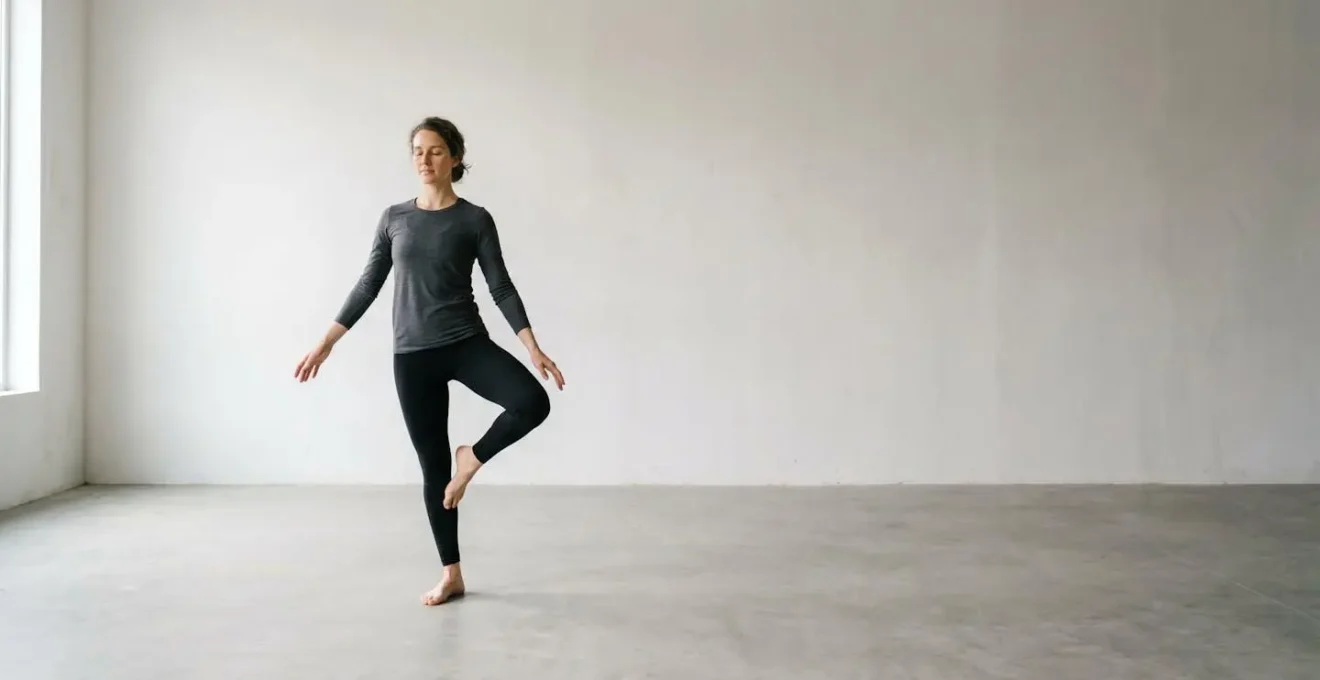
The single-leg stand with eyes closed, for example, is a direct test of your proprioception—your brain’s internal map of where your body is in space. Without visual input, your nervous system must rely entirely on the tiny receptors in your joints and muscles to maintain balance. This is the same skill that prevents falls on uneven ground or in a dark room. An inability to perform this test signals a decline in neuromuscular health that isolated strength training will never address.
The following table, based on metrics highlighted by leading health institutions, outlines three essential assessments. As this comparative analysis from Harvard Health shows, these simple tests reveal complex capabilities.
| Test Name | What It Measures | Passing Standard | Longevity Correlation |
|---|---|---|---|
| Loaded Carry Test | Grip endurance, core stiffness under load, gait pattern | Walk 60 seconds carrying 25% of body weight total (divided between both hands) | Direct predictor of functional capacity for daily tasks like grocery shopping |
| Eyes-Closed Single-Leg Stand | Proprioception and internal balance (without visual input) | 30 seconds standing on one leg with eyes closed | Powerful indicator of fall risk and neuromuscular health |
| Floor-to-Kneeling-to-Standing Test | Hip mobility, lunge-pattern strength, total-body coordination | Transition from lying to tall kneeling to standing without hand support | Tests skills crucial for getting up and stair climbing – modified version of SRT |
Try these tests honestly. They are not about passing or failing, but about gathering information. Your results provide a clear, personalized roadmap for the exact functional skills you need to train to ensure a long, active, and independent life.
How to Engage Your Deep Core When Lifting Your Toddler Without Thinking About It?
The title of this section contains the most important phrase: « without thinking about it. » When you deadlift in a gym, you follow a conscious checklist: brace your core, set your lats, hinge at the hips. When your toddler suddenly runs towards you for a hug, you have a split second to lift them. There’s no time for a checklist. You need reflexive stability—your core’s ability to engage automatically to protect your spine.
This reflex is built not through endless crunches, but by coordinating your breath with movement under load. The key is the « exhale on exertion » principle. A sharp, forceful exhale (like making a « Tsss » sound) as you lift creates a phenomenon called co-contraction. It automatically engages your deep core musculature, including the transverse abdominis and pelvic floor, creating a natural corset of support. This turns your core from a group of muscles you have to *think* about flexing into an intelligent, responsive system.
The second piece of the puzzle is initiating the lift correctly. Most people lift with their back because they’ve lost the instinctive hip hinge pattern from years of sitting. Re-learning to initiate a lift by sending your hips backward, rather than bending your spine, allows your powerful leg and glute muscles to do the heavy work, while your core simply acts as a stiff, stable bridge to transfer that force. This is how you lift safely and powerfully, every single time, without a second thought.
Which Movements at 50 Predict Whether You Will Need Help Getting Dressed at 80?
Your ability to live independently in your 80s is determined by the movement habits you cultivate in your 50s. Activities of Daily Living (ADLs)—like dressing, bathing, and cooking—don’t require massive strength, but they do require a specific and often-neglected ‘movement vocabulary’. Two of the most critical and predictive of these are shoulder mobility and gait speed.
It may seem trivial, but the ability to reach behind your back is a direct marker for your future ability to dress yourself. As we age, a sedentary lifestyle leads to a stiff thoracic spine (upper back) and internally rotated shoulders. This progressive loss of mobility can make simple acts like fastening a bra, tucking in a shirt, or zipping a dress impossible without assistance. This is a clear case where specific mobility, not general strength, dictates function.
Case Study: Shoulder Mobility and Independence in Daily Living
The « behind-the-back handclasp test, » where you attempt to touch the fingers of both hands behind your back, is a direct predictor of the ability to perform essential dressing tasks. Research shows that a significant loss of this specific movement pattern by age 50 is a major indicator of needing dressing assistance in later years. The good news is this is highly trainable. Yoga poses like the arm variations in Gomukhasana (Cow Face Pose) and Parivrtta Balasana (Thread the Needle Pose) directly address the thoracic mobility and shoulder rotation required to maintain this vital skill for independent dressing.
Equally important is your gait speed, or natural walking pace. It’s considered by geriatricians as the « sixth vital sign. » A slowing walk is a powerful predictor of frailty, fall risk, and cognitive decline. Maintaining a brisk walking pace requires leg strength, cardiovascular health, and dynamic balance—all cornerstones of functional fitness. The message is simple: the small movements you either preserve or lose today will have an outsized impact on the quality of your life tomorrow.
Key Takeaways
- True strength is measured by your ability to manage instability and unpredictable loads, not by lifting heavy weights in a controlled setting.
- Functional movements that predict longevity—like getting up from the floor and carrying heavy objects—rely on neuromuscular coordination, not just muscle size.
- Focus on training movement patterns, not just muscles, by incorporating asymmetric loads, multi-planar motions, and exercises that challenge your balance and reflexive core stability.
Why Crunches Alone Will Never Fix Your Lower Back Pain After 40?
For decades, the default prescription for a « weak core » and lower back pain has been to do more crunches and sit-ups. This advice is not only outdated; it’s often counterproductive, especially after 40. The fundamental misunderstanding lies in the role of the lumbar spine. For most daily activities, the lower back isn’t designed to be a primary generator of movement; it’s designed to be a stiff, stable transmitter of force between the powerful hips and the mobile upper body.
Crunches train repeated spinal flexion (bending forward). Yet, most non-traumatic lower back pain is caused by an inability to *prevent* unwanted micro-movements in the lumbar spine during tasks like lifting, twisting, or even walking. As the world-renowned spine biomechanist Dr. Stuart McGill states, the solution isn’t more movement; it’s better stability.
Low back pain is often caused by a lack of ‘stiffness’ or the inability to prevent micro-movements in the lumbar spine. Crunches train spinal flexion, the very movement you need to prevent.
– Dr. Stuart McGill, McGill Method Core Training Research
A healthy core provides « proximal stiffness for distal mobility »—a rigid torso that allows the arms and legs to move powerfully and safely. Crunches do the opposite. They teach the spine to bend when it should be bracing. The solution is to train the core for its real job: resisting motion. Exercises like the plank, side plank, bird-dog, and loaded carries teach the abdominal wall, obliques, and back muscles to co-contract and create the 360-degree stability that protects the spine from shear forces.
Your 4-Point Audit for a Smarter Core Routine
- Check for Stability, Not Flexion: Does your routine prioritize anti-movement exercises (planks, bird-dogs, carries) that teach the lumbar spine to remain stable under load, rather than exercises that repeatedly bend it (crunches)?
- Assess Mobility Above and Below: Are you actively working on mobility for your hips (hip flexor stretches, 90/90s) and your thoracic spine (T-spine rotations, cat-cow)? Stiffness in these areas forces the lower back to compensate with dangerous, excessive movement.
- Audit Your Movement Hierarchy: When you lift something, does the movement start with a hinge from your hips, or a bend from your lower back? Film yourself to check; you might be reinforcing a dysfunctional pattern without realizing it.
- Incorporate Breath and Release: Is diaphragmatic breathing a part of your practice? Do you include stretches for your hip flexors (psoas) and QL? Releasing this « triangle of tension » can dramatically reduce compressive forces on your lumbar spine.
By shifting from flexion-based exercises to stability-focused training, you address the root cause of the problem, building a core that is truly resilient and protective for the long haul.
The journey from gym-strong to life-strong is a paradigm shift. It requires you to value coordination over isolation, stability over flexion, and resilience over aesthetics. Start by assessing your own functional capacity with the tests in this guide and begin to pepper your workouts with movements that challenge your balance and control. This is how you build a body that not only looks fit but is truly prepared for a long, capable, and pain-free life.