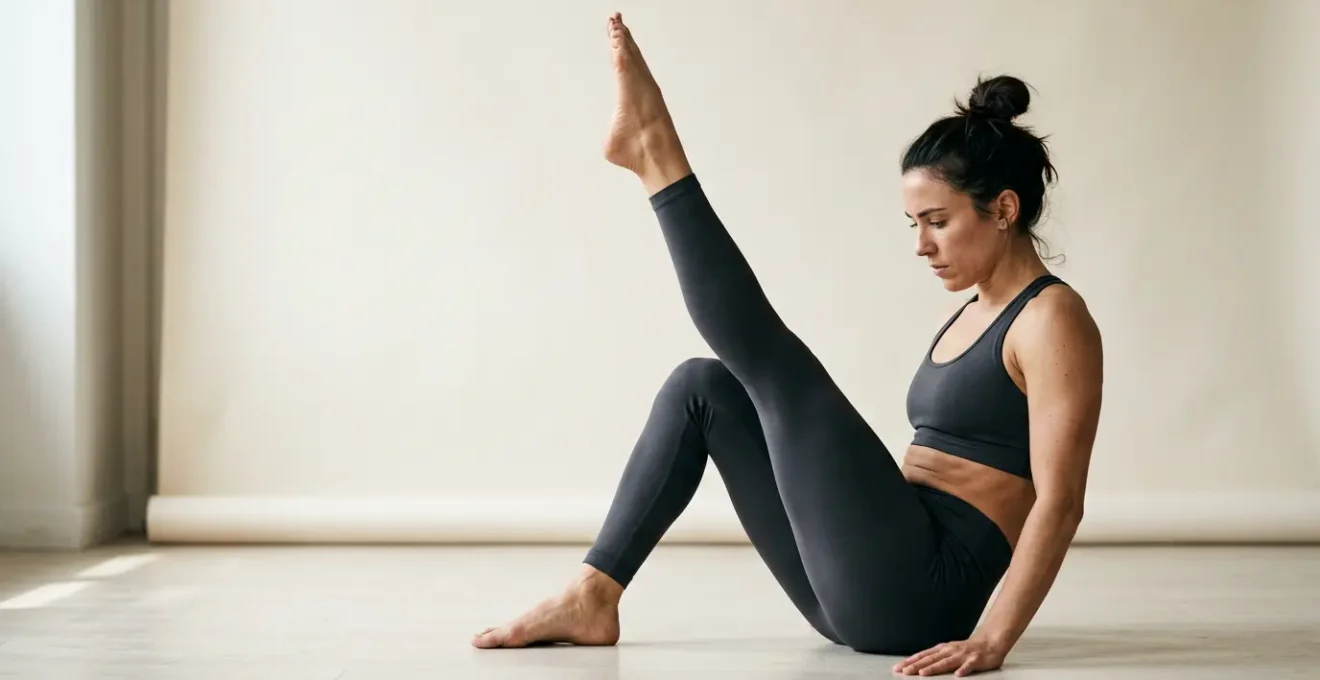
The frustrating gap between your passive flexibility and active movement isn’t a muscular issue—it’s a neurological one.
- Your brain restricts movement in ranges where it doesn’t feel strong and in control, creating a « motor control gap. »
- Static stretching alone can increase this gap, potentially leading to instability, while targeted strength training at your end-range closes it.
Recommendation: Shift your focus from simply lengthening muscles to teaching your nervous system to trust and control your full range of motion through strength-integrated mobility.
It’s a common paradox in the world of yoga and fitness. You diligently follow your stretching routine, finally able to press your palms flat to the floor in a forward fold. Yet, later that day, you try to perform a dynamic movement like a high kick or a deep squat, and your body feels stiff and restricted, as if that morning’s flexibility never existed. This isn’t a failure of your muscles or your discipline; it’s a fundamental misunderstanding of what creates usable, functional flexibility. The conventional wisdom to « just stretch more » often overlooks the most critical component: strength.
Many practitioners believe the path to greater mobility is paved with longer holds in passive stretches. While this can increase your passive range of motion—the range you can achieve with an external force, like gravity or your hands—it does little to improve your active range of motion, which is what you can achieve using only your own muscular strength. This discrepancy is where the problem lies. The true key isn’t just about achieving a position; it’s about owning it. It’s about building the neurological control and tissue tolerance to generate force and be stable throughout your entire range of motion, especially at the very end.
This article will deconstruct this frustrating paradox. We will move beyond the superficial advice and explore the science of strength-integrated mobility. You will learn why your flexibility might not be translating into better movement, how to turn that passive range into active strength, and how to build a resilient body that is both flexible and powerful. We will cover the specific methods that create permanent gains, the hidden dangers of flexibility without control, and why some of the most common stretching advice fails to deliver results.
This comprehensive guide will walk you through the essential principles and actionable strategies to finally bridge the gap between how flexible you are and how well you can move. Explore the sections below to master the art of usable flexibility.
Summary: Why Can You Touch Your Toes in the Morning but Cannot Kick Above Your Waist?
- What Does It Mean to Have Flexibility You Cannot Actually Control?
- How to Strengthen the Bottom of Your Squat So Your Flexibility Becomes Usable?
- Static Stretching or Weighted Mobility: Which Creates Permanent Flexibility Gains?
- The Flexibility Trap That Leads to Joint Instability and Injury Within a Year
- When Should You Train Active Flexibility: Before, After or Separate from Yoga?
- Yoga or Mobility Drills: Which Improves Hip Range Faster for Runners Over 45?
- What Is Fascia and Why Does It Get Stiff Even When Your Muscles Are Flexible?
- Why Does Stretching Never Seem to Release That Stubborn Tightness in Your IT Band?
What Does It Mean to Have Flexibility You Cannot Actually Control?
Having flexibility you cannot control is the classic sign of a large gap between your passive range of motion (PROM) and your active range of motion (AROM). PROM is the extent to which a joint can be moved by an external force—like gravity in a forward fold or a partner pushing your leg. AROM, on the other hand, is the range you can achieve purely through the contraction of your own muscles. It is well-established in physiotherapy research that Active ROM is usually less than passive ROM. When this difference becomes significant, it signals a problem not of muscle length, but of neurological control.
Your brain is the ultimate guardian of your body. If it perceives a range of motion as weak, unstable, or unknown, it will actively inhibit movement into that range to prevent injury. It essentially puts on the brakes. You might be able to passively force your hip into deep flexion, but if your nervous system doesn’t have the strength and coordination to control that position, it won’t let you get there on your own. This is a protective mechanism. This « motor control gap » is why you can touch your toes but can’t lift your leg high in front of you; one is passive and supported, the other is active and requires immense control.
Ignoring this gap is a common mistake. As Velo University Performance Research explains, this isn’t just about flexibility. It’s about a disconnect between your brain and your body.
A large gap between your passive and active ROM may indicate a motor control issue, not just a flexibility problem.
– Velo University Performance Research, Active vs Passive Range of Motion Analysis
Therefore, the goal is not to endlessly increase passive range but to shrink the gap by teaching your nervous system that you are strong and safe in the ranges you already possess. This is achieved by building end-range strength, which gives your brain the confidence to grant you access to that flexibility during active, dynamic movement. The flexibility becomes an asset rather than just a party trick.
How to Strengthen the Bottom of Your Squat So Your Flexibility Becomes Usable?
Many people can sink into a deep « ass-to-grass » squat by relaxing and using their body weight, but they feel weak and unstable there, unable to initiate the upward movement without shifting or losing tension. This is a perfect example of passive flexibility without active control. To make that deep squat usable, you must build strength at the end-range. This involves training your muscles—specifically your glutes, adductors, and quads—to fire effectively in that maximally compressed position.
One of the most effective methods is using isometric holds and controlled eccentrics. Instead of just dropping into the squat, control the descent slowly (a 3-5 second eccentric phase), pause at the absolute bottom for 2-3 seconds while actively trying to « pull yourself deeper » and maintain full-body tension, and then drive up. This teaches your nervous system that the bottom position is a safe and active place to be. Another powerful technique is the « end-range lift-off. » From the bottom of a squat, you can try to lift one foot an inch off the ground while keeping your torso upright, forcing the stabilizing muscles of the planted leg and hip to work overtime in their most shortened state.

As this image demonstrates, a strong end-range position is not passive. It involves intense muscle engagement to create stability. Notice the defined muscle tension and precise joint alignment, which are hallmarks of active control, not just passive depth. You can also use tools like kettlebells for goblet squats, where the anterior load forces your core and posterior chain to engage more, providing a counterbalance that helps you own the deep position. The focus must always be on tension and control, not just depth for its own sake.
Action Plan: Build Your End-Range Squat Strength
- Assess Your Gap: Film yourself performing a passive, relaxed deep squat versus an active, controlled one. Note the difference in depth and stability.
- Implement Paused Squats: For 3 sets of 5-8 reps, use a light weight and descend slowly for 3-5 seconds. Pause at the deepest position you can control for 3 seconds, focusing on maximal tension.
- Incorporate End-Range Isometrics: After your main sets, perform 3 sets of 10-15 second holds at the bottom of your squat, actively pushing your knees out and keeping your chest up.
- Practice Lift-Offs: In a bodyweight squat, perform 3 sets of 5 lift-offs per foot, holding each lift for 2-3 seconds. Minimize any weight shift or loss of posture.
- Re-test Monthly: Film your active, controlled squat again to track improvements in depth, stability, and the feeling of power out of the bottom.
Static Stretching or Weighted Mobility: Which Creates Permanent Flexibility Gains?
The debate between static stretching and weighted mobility hinges on what kind of « flexibility » you want. If the goal is simply to increase passive range of motion, long-hold static stretching can achieve that by inducing a temporary relaxation response in the nervous system and plastic deformation in connective tissues. However, these gains are often transient because they don’t come with the corresponding motor control. The brain hasn’t learned to control this new range, so it often reverts to its previous, « safer » state. This is why you may feel flexible right after a yoga class but tight again the next morning.
Weighted mobility, also known as loaded stretching, takes a different approach. By introducing an external load (like a dumbbell or kettlebell) at the end-range of a movement, you are simultaneously stretching the tissue and asking it to produce force. This sends a powerful signal to the nervous system: « We need to be strong and stable here. » This process helps build new contractile tissue in a lengthened position and improves proprioceptive feedback, essentially upgrading your body’s internal map of what is possible and safe. The gains are built on a foundation of strength, making them far more permanent and functional.
Consider a Jefferson curl, where you slowly roll down vertebra by vertebra holding a light weight. This actively lengthens the entire posterior chain under a controlled load. Or a weighted pancake good morning, which builds strength in the adductors and hamstrings at their end-range of abduction and flexion. These methods don’t just push you into a stretch; they force you to own the position. While static stretching has its place for recovery and nervous system down-regulation, for creating lasting, usable range of motion, weighted mobility is superior. It directly addresses the neurological component of flexibility, closing the gap between what you can do passively and what you can do actively.
The Flexibility Trap That Leads to Joint Instability and Injury Within a Year
The relentless pursuit of passive flexibility without a parallel focus on building strength is a dangerous trap. It creates what is known as hypermobility or joint laxity, where the joints have excessive range of motion without the muscular support to control it. While some individuals are genetically predisposed to hypermobility, it can also be acquired by aggressively stretching ligaments and joint capsules—the body’s passive restraints—beyond their functional capacity. This is the dark side of « bendy » culture, where extreme flexibility is celebrated without acknowledging the potential for harm.
When you have a large motor control gap, your joints can easily be pushed into vulnerable positions during dynamic or unexpected movements. Without strong, responsive muscles to act as « active restraints, » the stress is transferred directly to the ligaments and cartilage, which are not designed to handle such loads repeatedly. This can lead to microtrauma, chronic pain, and eventually, significant injury. The body feels « loose » and unstable, and what was once a quest for freedom of movement becomes a source of persistent instability and pain.
This is not just a theoretical risk. Scientific evidence clearly links hypermobility to a higher incidence of injury, particularly in joints like the shoulder and knee. For instance, a 2021 systematic review and meta-analysis revealed that athletes with joint hypermobility were 3.25 times more likely to suffer shoulder injuries. The joint has too much slack, and the stabilizing muscles can’t keep up. The trap is that in the short term, increased flexibility feels like progress. It can take months, or even a year, for the cumulative stress of uncontrolled movement to manifest as a serious injury, by which point the underlying instability is already well-established.
When Should You Train Active Flexibility: Before, After or Separate from Yoga?
The timing of your active flexibility training depends on your specific goal for that session. There isn’t a single « best » time; instead, you should program it strategically. Active flexibility and mobility work can serve as preparation for movement, a primary training focus, or a recovery tool. The key is to match the method to the desired outcome. You wouldn’t perform exhaustive loaded stretching right before attempting a one-rep max squat, just as you wouldn’t rely on a few quick leg swings to create long-term changes in hip mobility.
Before a workout or yoga session, the goal is preparation. Here, you should focus on dynamic mobility drills and controlled articular rotations (CARs). These movements take your joints through their current active range of motion, priming the nervous system, lubricating the joints, and increasing blood flow to the target tissues. This is about « waking up » the ranges you already have, not trying to expand them. An example would be performing controlled hip circles or thoracic spine rotations before a squat or overhead press day. This ensures your brain and muscles are ready for the demands to come.

To create long-term change and build new active range of motion, this type of training should be treated as its own workout, separate from your main training or yoga practice. This is where you would incorporate loaded stretching, end-range isometrics, and PNF techniques. These methods are neurologically demanding and create a significant training stimulus, which requires proper energy and focus. Performing them when you’re already fatigued after a hard workout will yield subpar results and could increase injury risk. Dedicate 1-2 sessions per week solely to this type of work for the best adaptations. After a yoga or lifting session, light static stretching can be used to help down-regulate the nervous system and promote recovery, but it should not be mistaken for developmental mobility work.
Yoga or Mobility Drills: Which Improves Hip Range Faster for Runners Over 45?
For runners over 45, improving hip range of motion is crucial for maintaining stride length, efficiency, and preventing injury. However, this demographic faces unique challenges, including age-related muscle loss (sarcopenia) and potentially decades of repetitive, single-plane movement. While a general yoga class can offer benefits like stress reduction and basic flexibility, targeted mobility drills are often a more direct and faster path to improving usable hip range for running.
The primary reason is specificity. Running is a dynamic, single-leg activity. Mobility drills, such as controlled articular rotations (CARs), banded hip mobilizations, and end-range strength exercises like Cossack squats, directly target the specific neuromuscular patterns and strength deficits that limit a runner’s gait. They focus on building control and strength through the entire range of motion, which is exactly what a runner needs to absorb impact and generate power. A yoga class, while beneficial, may spend significant time in passive stretches or positions that don’t directly translate to the demands of running. A deep, passive lunge in yoga may not improve a runner’s ability to actively extend their hip during toe-off.
Furthermore, as we age, maintaining muscle mass and neurological function becomes paramount. Mobility drills that incorporate resistance or active muscle contraction are essentially a form of strength training. This approach not only improves range of motion but also strengthens the muscles that control that range, directly combating sarcopenia. In fact, a 2024 randomized controlled trial demonstrated that an 8-week dynamic neuromuscular stabilization program significantly improved strength, endurance, and flexibility in adults. For a runner over 45, this integrated approach is far more efficient than separating stretching from strengthening. While yoga can be an excellent complementary practice, for rapid, functional improvements in hip mobility for running, a dedicated program of specific mobility drills will yield faster and more durable results.
What Is Fascia and Why Does It Get Stiff Even When Your Muscles Are Flexible?
Fascia is a fascinating and complex web of connective tissue that surrounds and interconnects every muscle, bone, nerve, and organ in your body. Think of it as a single, continuous 3D body-suit that provides structure, allows muscles to slide past one another, and transmits forces throughout the body. It is rich in sensory nerve endings, making it a crucial organ of proprioception—your body’s sense of self in space. When your fascia is healthy, it is hydrated, pliable, and resilient, allowing for smooth, efficient movement.
Fascial stiffness can occur for several reasons, even when the muscles themselves are pliable. One primary cause is dehydration and lack of movement. Like a sponge, fascia needs to be moved, compressed, and stretched to stay hydrated and healthy. A sedentary lifestyle or repetitive movements in a limited range can cause layers of fascia to adhere to one another, creating « fuzz » or adhesions that restrict gliding. Another key factor is the nervous system. Fascia is densely innervated by the sympathetic nervous system (the « fight or flight » system). Chronic stress can lead to a state of increased fascial tension, effectively « tightening » the entire suit without any change in muscle length.
This is why you can have « flexible » muscles but still feel stiff; the restriction isn’t in the muscle belly itself but in the surrounding or interconnecting fascial network. A classic example is the thoracolumbar fascia in the lower back, a dense diamond-shaped sheet that can become stiff and sensitive due to stress or poor movement patterns, leading to feelings of chronic low back tightness. This highlights a limitation of simple muscle stretching. To address fascial stiffness, you need a multi-faceted approach that includes varied movement, hydration, and strategies that directly address the nervous system’s role in creating tension.
Case Study: Neuro-Athletic Training for Fascial Health
A recent 2024 randomized controlled trial with elite volleyball players illustrates this connection perfectly. The study found that a neuro-athletic training (NAT) program significantly improved flexibility not by just stretching tissue, but by optimizing neuromuscular adaptability and proprioceptive feedback. The training, which targets the nervous system’s control over movement, demonstrated that improvements in flexibility and fascial health come from enhanced sensorimotor integration. This proves that « stiffness » is often a brain-based output that can be changed by giving the nervous system better information, rather than just forcing the tissue to lengthen.
Key Takeaways
- The gap between passive flexibility and active movement is a neurological signal of a lack of control, not a muscular limitation.
- True mobility is built by developing strength and stability at your end-ranges of motion, teaching the brain that these positions are safe.
- Chasing extreme passive flexibility without building corresponding strength can lead to joint instability and a higher risk of injury.
Why Does Stretching Never Seem to Release That Stubborn Tightness in Your IT Band?
The infamous iliotibial (IT) band is a common source of frustration for athletes and active individuals. Many spend countless hours foam rolling and stretching it, only to find the « tightness » returns almost immediately. The reason for this futility is a fundamental misunderstanding of the IT band’s anatomy and function. The IT band is not a muscle; it is an incredibly thick, dense piece of fascia. It has the tensile strength of soft steel and is not designed to be stretched. The sensation of « tightness » is almost never due to the IT band itself being short.
Instead, the feeling of tightness is typically a symptom of an issue elsewhere. Most often, it’s caused by overuse or weakness in the muscles that attach to it, primarily the gluteus medius and tensor fasciae latae (TFL) at the hip. When these hip-stabilizing muscles are weak or fatigued, the TFL can become overactive, creating increased tension along the entire IT band down to the knee. In this case, the IT band is acting like an over-tensioned cable because the muscles controlling it are not doing their job properly. Stretching the « tight » cable does nothing to address the root cause: the weak or dysfunctional muscles at the hip.
Therefore, the solution is not to stretch the IT band but to strengthen the surrounding hip musculature. Exercises like side-lying leg raises, clamshells, and hip bridges are crucial for building endurance and strength in the gluteus medius. This restores balance to the hip, allowing the TFL to relax and reducing the tension on the IT band. This approach aligns perfectly with modern findings on flexibility; a 2023 systematic review and meta-analysis in Sports Medicine confirmed that resistance training induces improvements in range of motion comparable to, and often more durable than, stretching protocols. For the IT band, strength training isn’t just an alternative—it’s the primary solution.
Begin transforming your passive flexibility into active, usable strength by assessing your own motor control gaps and applying these strength-integrated principles to your training today.