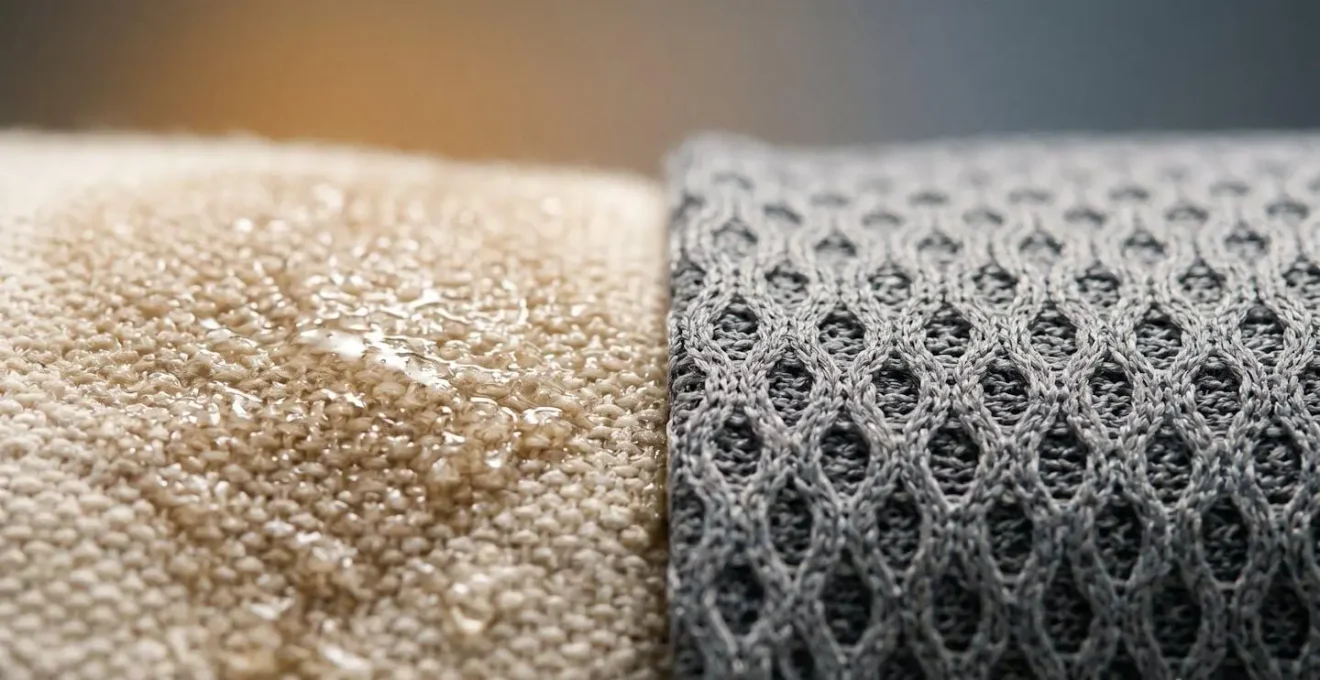
The discomfort you feel in your yoga practice is not a lack of fitness, but a failure of material science.
- Cotton acts like a sponge, absorbing sweat and becoming heavy, while performance fabrics are engineered to move moisture away from your skin.
- Fabric quality is measurable through metrics like GSM (grams per square meter), which determines opacity and durability, separating a £15 pair of leggings from a £60 investment.
Recommendation: Shift your focus from brand labels to fabric specifications. Understanding the difference between wicking, breathability, and knit construction is the key to buying yoga wear that performs.
That familiar feeling: twenty minutes into a vinyasa flow, your cotton t-shirt is a heavy, damp sheet clinging to your skin. Meanwhile, the practitioner next to you moves with ease, their apparel seemingly untouched by sweat. This isn’t a difference in effort; it’s a difference in engineering. The frustration of wearing the wrong clothes to yoga—constantly adjusting, feeling restricted, and ending up soaked—is a universal experience for those new to the practice. Many assume any stretchy clothing will do, only to find their comfort and focus compromised.
The common advice is to simply « avoid cotton » and « buy moisture-wicking clothes, » but this guidance is superficial. It doesn’t explain the mechanics of why cotton fails so spectacularly or what « moisture-wicking » actually means from a technical standpoint. It leaves you standing in a store, staring at a wall of leggings, with no real criteria to distinguish high-performance gear from fast-fashion activewear destined to become transparent after a few washes. The conversation often circles around brands or aesthetics, overlooking the fundamental science of the fabrics themselves.
But what if the key wasn’t the logo on the waistband, but the very structure of the fibers? The secret to lasting comfort lies in understanding the material science behind your yoga wear. This guide moves beyond marketing buzzwords to give you a fabric specialist’s perspective. We will deconstruct the properties that define true performance apparel, from fiber technology and fabric weight (GSM) to the markers of genuine sustainability. By the end, you will be equipped to analyze, select, and invest in clothing based on technical merit, ensuring every piece you buy is an asset to your practice, not a distraction.
This detailed exploration will provide you with a clear framework for making informed decisions. By understanding the core principles of fabric performance and product longevity, you can build a functional and durable yoga wardrobe that truly serves your needs.
Summary: Understanding Performance Fabrics for a Better Practice
- What Is the Difference Between Moisture-Wicking, Quick-Dry and Breathable and Which Do You Need?
- How Tight Should Yoga Leggings Be to Support Movement Without Cutting Off Circulation?
- Is Recycled Polyester Activewear Actually Sustainable or Just Less Bad Than Virgin Plastic?
- Why Your £8 Leggings Became See-Through After 3 Washes and How to Avoid It?
- What 4 Pieces of Yoga Clothing Do You Actually Need for Year-Round Practice?
- How to Tell if a Yoga Brand’s Eco Claims Are Genuine or Just Greenwashing?
- Why Buying a £15 Mat Every Year Costs More Than a £60 Mat That Lasts Five Years?
- Why Does Your Cheap Yoga Mat Smell Toxic and Slip When You Sweat?
What Is the Difference Between Moisture-Wicking, Quick-Dry and Breathable and Which Do You Need?
These three terms are often used interchangeably, but they describe distinct, synergistic functions in performance fabric. Understanding them is the first step in decoding why your cotton shirt fails. Cotton is hydrophilic, meaning it absorbs water. A performance fabric is hydrophobic; its goal is not to absorb sweat, but to move it. This is the essence of moisture-wicking. It uses capillary action, where the fabric’s structure pulls sweat from your skin to the outer surface of the garment. This is where quick-dry comes in; once the moisture is on the surface, the fabric’s low absorbency and structure allow it to evaporate rapidly. In fact, research demonstrates that polyester fabrics can wick moisture away up to 50% faster than cotton, preventing that soaked, heavy feeling.
Breathability, on the other hand, refers to the fabric’s ability to allow water vapor (and air) to pass through it. A fabric can be waterproof but not breathable (like a plastic bag), leading to a clammy, greenhouse effect. In yoga, breathability is crucial for managing your skin microclimate—the thin layer of air between your body and your clothes. A breathable fabric helps regulate temperature by letting heat and humidity escape, keeping you comfortable even during strenuous practice.
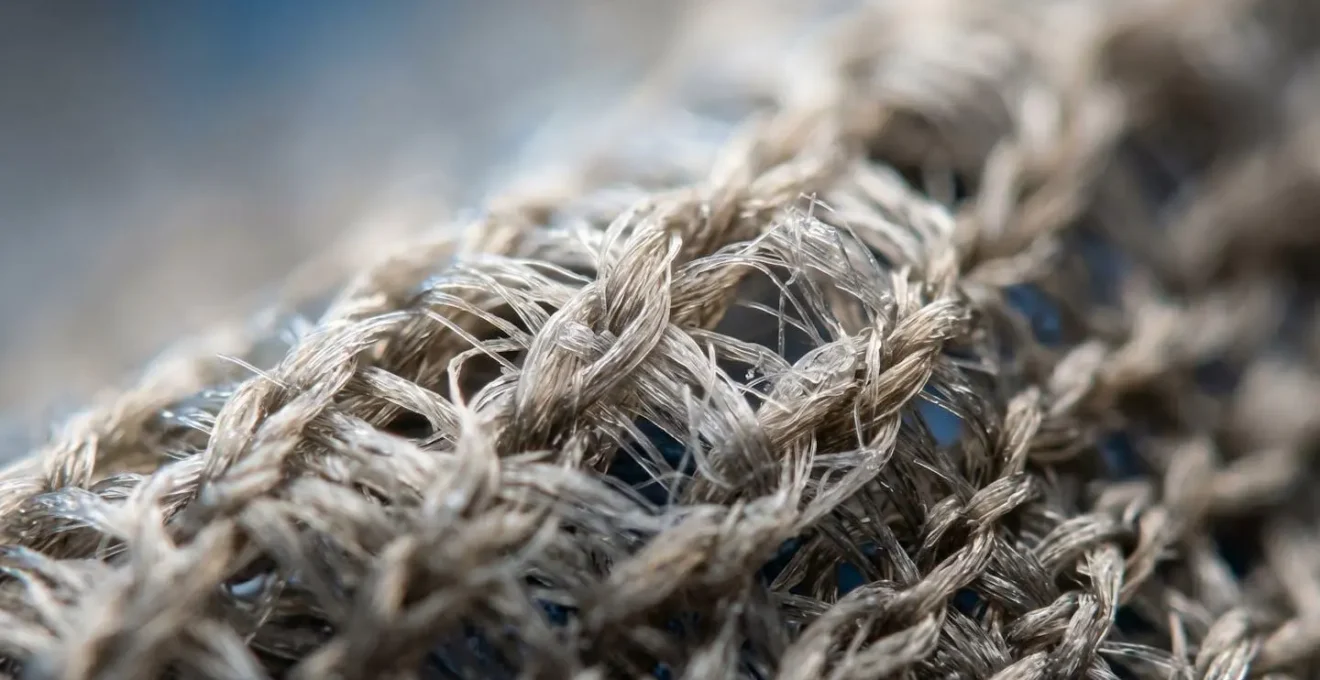
While synthetics like polyester and nylon excel at this, some natural fibers are also highly technical. Merino wool, for example, is an exceptional performance material. It can absorb up to 30% of its own weight in moisture vapor before it even begins to feel wet, trapping it within the fiber’s core. This unique property keeps the fabric surface feeling dry against the skin, making it an excellent choice for practices where you might move between hot and cool environments, as it provides both warmth and moisture management.
For a dynamic, sweaty yoga practice, you need all three: a moisture-wicking fabric to pull sweat off your skin, a quick-drying surface to get rid of it, and a breathable structure to let heat and vapor escape. This combination is what keeps you feeling dry, light, and comfortable.
How Tight Should Yoga Leggings Be to Support Movement Without Cutting Off Circulation?
The perfect fit for yoga leggings is a technical balance between compression and freedom. They should feel like a ‘second skin’—supportive but not restrictive. The right level of compression enhances proprioception (your sense of body position) and can support blood flow, but too much can do the opposite, cutting off circulation and hindering movement. A key indicator of a poor fit is when the waistband digs in, creating a « muffin top, » or when you see red marks on your skin after taking them off. This indicates the fit is too tight, potentially restricting both your diaphragm’s movement during deep breathing and your circulation.
Conversely, leggings that are too loose will slip, bunch up, or require constant adjustment, which is a major distraction during practice. The waistband should sit securely on your waist or hips without sliding down when you fold forward, and the fabric around the knees and seat should not become baggy after a few movements. This is a test of the fabric’s recovery—its ability to return to its original shape after being stretched, a quality determined by a high percentage of elastane (or Spandex/Lycra).
The best way to determine the correct fit is not by size label, but by a functional movement test. Brands vary, so what works in one may not in another. Performing a series of yoga-specific movements in the fitting room is the only way to be certain. A good pair of leggings will move with you seamlessly, providing gentle support without you ever feeling constricted. The fabric should stretch in all directions (four-way stretch) and feel smooth against the skin, with no chafing from the seams.
Fitting Room Test Protocol for Yoga Leggings
- Perform a deep squat: Check for four key factors: fabric opacity (no see-through), waistband roll-down, seam strain, and freedom of movement in hips and knees.
- Forward fold test: Bend forward and touch your toes to verify that the waistband stays in place and the fabric doesn’t become transparent when stretched over the seat.
- High lunge position: Step into a deep lunge to test range of motion in the hip flexors and ensure the gusset (if present) allows unrestricted movement without pulling.
- Fabric recovery check: After stretching, release and observe if the fabric returns to its original shape within 30 seconds, indicating good elastane recovery and avoiding baggy knees.
Ultimately, your leggings should feel like an empowering layer of support that allows you to forget you’re wearing them and focus entirely on your practice.
Is Recycled Polyester Activewear Actually Sustainable or Just Less Bad Than Virgin Plastic?
Recycled polyester (often called rPET), made from post-consumer plastic bottles, is heavily marketed as a sustainable alternative to virgin polyester. On the surface, the logic is sound: it diverts plastic from landfills and requires less energy and water to produce than its virgin counterpart. It is undeniably a step in the right direction and represents ‘less bad’ consumption. However, the full story is more complex, and rPET is not a perfect solution. The most significant hidden issue is microplastic shedding. Synthetic fabrics, whether virgin or recycled, release tiny plastic fibers into waterways with every wash.
Disturbingly, recent evidence suggests recycled polyester may be a worse offender than virgin material. The mechanical recycling process can shorten the polymer chains in the plastic, making the resulting fibers weaker and more prone to breaking. In fact, a 2024 study by the Changing Markets Foundation found that some recycled polyester fabrics can shed up to 55% more microfibers than their virgin equivalents. This means that while we are solving one problem (plastic bottle waste), we may be exacerbating another: the pervasive and harmful pollution of our oceans and water systems with microscopic plastic particles.
So, what is a conscious practitioner to do? The key is to think in terms of a material hierarchy. Recycled synthetics are a better choice than virgin synthetics, but plant-based or certified natural fibers often represent a more truly sustainable option. When you do opt for synthetics, look for those certified by credible third parties like bluesign® or the Global Recycled Standard (GRS), as these standards regulate chemical use and verify recycled content. The following table provides a clear hierarchy to guide your choices.
This table outlines a hierarchy for choosing materials, from the most sustainable to the least, based on a lifecycle perspective that includes biodegradability and pollution potential.
| Tier | Material Category | Examples | Sustainability Profile |
|---|---|---|---|
| Tier 1 | Plant-based, biodegradable, low-water fabrics | Tencel™ Lyocell, Hemp | Highest: Biodegradable under right conditions, low water use, regenerative potential |
| Tier 2 | Certified natural fibers | Organic Cotton (GOTS), RWS Merino Wool | High: Certified farming practices, biodegradable, but higher water use for cotton |
| Tier 3 | Certified recycled synthetics | bluesign® or GRS certified rPET, Recycled Nylon | Moderate: Reduces virgin plastic use but sheds microplastics, chemical screening required |
| Tier 4 | Virgin synthetics | Standard Polyester, Standard Nylon | Lowest: Petroleum-based, non-biodegradable, contributes to microplastic pollution |
Ultimately, being a sustainable consumer means moving beyond the simple ‘recycled’ label and considering the entire lifecycle of a garment, from fiber creation to its end-of-life impact.
Why Your £8 Leggings Became See-Through After 3 Washes and How to Avoid It?
The dreaded see-through moment in a forward fold or deep squat is a direct result of low-quality fabric construction. The primary technical metric that determines a fabric’s opacity and durability is its weight, measured in Grams per Square Meter (GSM). Fast-fashion activewear, like those £8 leggings, is often made from a thin, single-knit fabric with a very low GSM. While it feels soft and stretchy in hand, it lacks the density to remain opaque when stretched. A low GSM means fewer fibers are packed into each square meter, so when you move, those fibers pull apart, revealing what’s underneath.
For squat-proof opacity in activewear, you should be looking for a fabric with a GSM in the range of 220-280. Fabrics below 200 GSM are generally too thin for compressive garments like leggings. According to activewear fabric specialists, a range of 200-260 GSM is often cited as the sweet spot for a balance of coverage, compression, and comfort. Furthermore, quality leggings often use an interlock knit construction, which is a variation of a rib-knit. It’s essentially two layers of fabric knitted together, making it thicker, denser, and more stable than a simple single-knit. This construction inherently provides better coverage and durability.
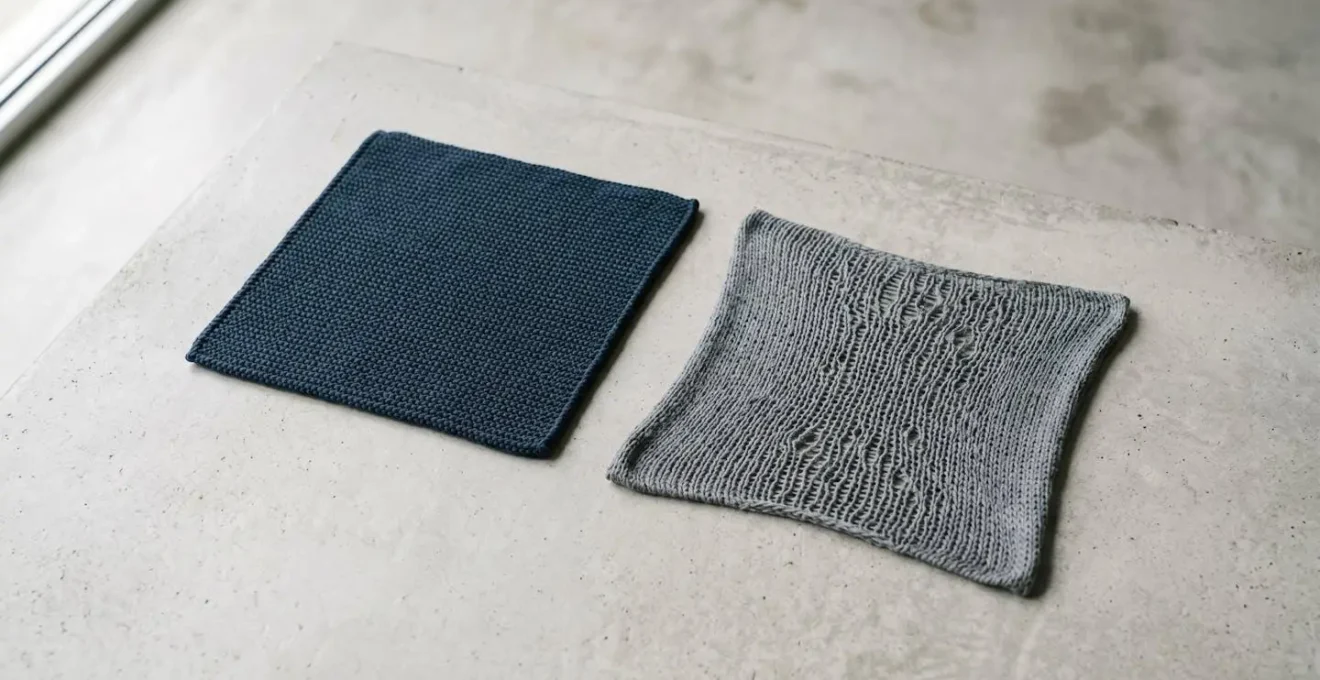
Another factor is the percentage of elastane (Spandex/Lycra). Cheap leggings may have a low elastane content (under 10%), meaning they don’t have good stretch recovery. After a few washes and wears, the fabric loses its ability to snap back into shape, becoming baggy and even more transparent. Quality leggings typically contain 15-25% elastane, ensuring they maintain their shape and opacity over time. You can test this in-store by stretching the fabric and seeing how quickly it recovers. High-quality fabric will snap back almost instantly.
- Density test: Hold the fabric up to a light. Quality leggings should have minimal light penetration even when unstretched.
- Stretch-and-recover test: Pull the fabric horizontally. It should snap back to its original shape within 1-2 seconds, indicating good spandex content (15-25%).
- Seam quality inspection: Look for flatlock seams (flat and smooth) rather than overlocked seams (bulky and raised), as they indicate higher construction quality and reduce chafing.
- Opacity under stretch: Stretch the fabric over your hand. If you can see your skin tone, the fabric has insufficient GSM or poor knit construction.
Investing in leggings with a higher GSM and a quality knit construction is not just about avoiding embarrassment; it’s about buying a garment that is engineered to perform and last, ultimately providing better value in the long run.
What 4 Pieces of Yoga Clothing Do You Actually Need for Year-Round Practice?
Contrary to the endless cycle of new activewear collections, a functional, high-performance yoga wardrobe can be built on a minimalist foundation of just four key pieces. The goal is to create a modular « capsule » system where each item serves a distinct purpose, allowing you to layer and adapt for any style of practice, in any season. This approach prioritizes quality and versatility over quantity, saving you money and reducing clothing waste. The focus should be on technical fabrics and a construction that supports movement and temperature regulation.
A well-curated yoga wardrobe is about strategic selection, not accumulation. Each piece should be an investment in comfort, performance, and durability. By choosing items based on their material science and functional design, you can create a versatile system that will serve your practice for years, freeing you to focus on what truly matters on the mat.
Here is a breakdown of the essential four-piece modular system for year-round yoga:
- The Foundation: High-Performance Leggings. This is the workhorse of your wardrobe. Look for opaque, high-GSM (220-280) leggings made from a nylon-spandex or polyester-spandex blend with 15-25% elastane. Key features must include moisture-wicking properties, four-way stretch, and squat-proof interlock knit construction. This piece is for your dynamic, sweaty practices like Vinyasa or Ashtanga.
- The Soft Layer: Relaxed-Fit Pants. For restorative, Yin, or meditation practices, comfort trumps compression. Choose relaxed-fit joggers or wide-leg pants made from a soft, breathable material like a Tencel™ Lyocell-spandex blend or organic cotton-modal. These should feel gentle against the skin and allow for total freedom of movement without any restriction.
- The Technical Top: A Fitted Tank or Tee. For active practices, a top made from the same technical, moisture-wicking fabric as your leggings is essential. A fitted design prevents the top from riding up in inversions. Look for a GSM of 180-220. A model with a built-in shelf bra is a great option to reduce layers and provide integrated support for sweaty sessions. Features like breathable mesh panels or an antimicrobial treatment add significant performance value.
- The Transitional Piece: A Lightweight Wrap or Long-Sleeve Top. This is your layering piece for warm-ups, cool-downs, and traveling to and from the studio. It needs to be functional for temperature regulation. A top made from a merino wool blend or a technical fleece is ideal. It should be lightweight enough to tie around your waist but warm enough to keep muscles from cooling down too quickly. Odor resistance is a major bonus for this item.
This minimalist approach ensures you have the right gear for any situation, from a hot yoga class in summer to a gentle restorative session in winter, without an overflowing drawer of underperforming activewear.
How to Tell if a Yoga Brand’s Eco Claims Are Genuine or Just Greenwashing?
As sustainability becomes a powerful marketing tool, the yoga apparel market is flooded with vague claims like « eco-friendly, » « conscious, » and « green. » This practice, known as greenwashing, makes it incredibly difficult for consumers to make genuinely responsible choices. The confusion is widespread; a 2022 survey found that 54% of US consumers find it difficult to tell if a fashion product is truly eco-friendly. The key to cutting through the noise is to demand specificity and look for third-party verification. A brand that is genuinely committed to sustainability will be transparent and back its claims with data and certifications.
Vague language is the biggest red flag. If a brand uses terms like « natural » without defining the material or « sustainable » without explaining its practices, be skeptical. True sustainability is complex, involving everything from raw material sourcing and water usage to dyeing processes, factory labor conditions, and end-of-life solutions. A brand that focuses on one small positive attribute (e.g., « shipped in a recycled mailer ») while ignoring the petroleum-based origin of its main product is a classic greenwashing tactic. Look for brands that publish detailed annual impact reports with measurable data on their progress toward specific goals.
The most reliable way to verify a brand’s claims is to look for credible, independent, third-party certifications. These organizations have rigorous standards and audit the entire supply chain to ensure compliance. Learning to recognize these logos is like learning to read the ingredients list on food—it empowers you to make an informed choice based on facts, not marketing. The table below breaks down some of the most important certifications in the textile industry.
Action Plan: The Greenwashing Red Flag Checklist
- Vague Language: Scrutinize terms like ‘eco-friendly’, ‘green’, or ‘sustainable’ that are not supported by specific data or certifications.
- Misleading Focus: Be wary of brands that heavily promote one small positive attribute (like recycled packaging) while their core product remains unsustainable.
- Lack of Certification: Check for the absence of verifiable, third-party certifications like GOTS, bluesign®, or GRS. Genuine claims are almost always backed by these standards.
- No Data or Transparency: A truly sustainable brand will publish detailed reports with metrics on water use, carbon emissions, and waste. If this information is missing, it’s a major red flag.
- Ignoring End-of-Life: Does the brand offer a take-back or repair program? A lack of responsibility for what happens to the garment after its useful life is a sign of an incomplete sustainability strategy.
This checklist provides a powerful tool for auditing a brand’s claims before you purchase. For a deeper dive, the following table explains what key certifications actually mean.
| Certification | What It Tests | Scope | Best For |
|---|---|---|---|
| GOTS (Global Organic Textile Standard) | Organic farming, chemical restrictions, wastewater treatment, labor criteria | Entire supply chain from farm to finished product | Organic fiber authenticity + ethical production |
| OEKO-TEX® Standard 100 | Harmful substances (PFAS, formaldehyde, heavy metals, azo dyes) | Finished textile products | Consumer safety and non-toxic materials |
| bluesign® | Chemical inputs, water/air emissions, energy use, worker safety | Entire manufacturing process from raw materials to production | Sustainable textile production + clean chemistry |
| GRS (Global Recycled Standard) | Recycled content verification, chain of custody | Traceability of recycled materials | Confirming genuine recycled content |
| Fair Trade Textile Standard | Living wages, worker empowerment, safe conditions | Labor and social compliance | Ethical treatment of garment workers |
Your purchasing power is a vote for the kind of industry you want to support. By demanding transparency and verification, you can help drive the market toward genuine sustainability.
Why Buying a £15 Mat Every Year Costs More Than a £60 Mat That Lasts Five Years?
The allure of a £15 yoga mat is understandable, especially for beginners. However, this initial saving is often a false economy. The true cost of a product is not its ticket price, but its cost-per-use over its lifespan. Cheap yoga mats are typically made from PVC (polyvinyl chloride), a low-durability material that quickly compresses, tears, and loses its grip. With regular practice (2-3 times per week), such a mat rarely lasts more than a year before it becomes unusable and unsafe, forcing you to buy another. Over five years, you will have spent £75 and sent five non-biodegradable plastic mats to a landfill.
In contrast, a high-quality £60 mat made from durable materials like natural rubber or high-density PU (polyurethane) is engineered for longevity. These materials offer superior grip, cushioning, and resilience. With proper care, a premium mat can easily last five to ten years. This long-term durability drastically reduces its cost-per-use, making it the more financially savvy and environmentally responsible choice. The initial higher outlay is an investment in performance, safety, and sustainability that pays dividends over time.
Case Study: Cost-Per-Use Calculation for Yoga Mats
A £15 cheap PVC yoga mat typically lasts 10-12 months with regular use (2-3 times per week) before it starts to tear or compress. This equates to approximately 100-150 uses, resulting in a cost-per-use of £0.10-£0.15. In contrast, a £60 natural rubber or high-density PU mat can last 5-10 years with proper care, equating to 500-1,500 uses. This results in a cost-per-use of £0.04-£0.12. Over a 5-year period, replacing cheap mats annually costs £75, while the single premium mat investment of £60 saves money and prevents 5 mats from entering a landfill.
Of course, realizing this long-term value depends on proper care. Protecting your investment is crucial to maximizing its lifespan. Simple maintenance habits can double the life of a premium mat.
- Cleaning protocol: Use a gentle, pH-neutral cleaner diluted in water. Avoid harsh chemicals or alcohol-based sprays that degrade natural rubber or PU. Wipe down after every few uses and let it air-dry completely before rolling.
- Storage method: Always roll your mat, rather than folding, to prevent permanent creases. Store it in a cool, dry place away from direct sunlight, which can cause materials to become brittle.
- Rotation strategy: If you practice more than four times a week, rotating between two mats allows each one to fully decompress and air out, extending the life of both.
- Transport carefully: Use a dedicated mat bag or strap to protect it from scrapes and exposure to extreme temperatures in a car.
By shifting your mindset from initial price to long-term value, you not only make a smarter financial decision but also a more sustainable one.
Key Takeaways
- Performance is engineered: Comfort in yoga relies on technical fabric properties like moisture-wicking and breathability, not brand names.
- Quality is measurable: Use metrics like GSM (Grams per Square Meter) and elastane percentage to assess opacity, durability, and stretch recovery before you buy.
- Think in cost-per-use: A higher initial investment in quality apparel and gear almost always results in a lower long-term cost and less environmental waste.
Why Does Your Cheap Yoga Mat Smell Toxic and Slip When You Sweat?
That distinct, chemical « new shower curtain » smell from a cheap yoga mat is a major red flag. It’s the scent of Volatile Organic Compounds (VOCs) off-gassing from the material, which is almost always PVC (polyvinyl chloride). PVC is a rigid plastic made soft and flexible for yoga mats through the addition of plasticizers, most notoriously phthalates. These chemicals are not chemically bonded to the PVC and can leach out over time, not only creating the toxic smell but also potentially being absorbed through your skin during practice.
The second critical failure of a cheap PVC mat is its performance under pressure: it becomes treacherously slippery the moment you start to sweat. This is due to its material structure. Most cheap mats have a closed-cell surface. This means the surface is non-porous and acts like a barrier. While this makes it easy to wipe clean, it also means that sweat has nowhere to go. It simply pools on the surface, creating a slick layer between your hands or feet and the mat, destroying your grip and making poses like Downward-Facing Dog a constant struggle to maintain.
In stark contrast, high-performance mats are often made from materials with an open-cell structure, like natural rubber or specially engineered PU (polyurethane) surfaces. An open-cell mat acts more like a sponge, with millions of microscopic pores that absorb moisture. When you sweat, the moisture is wicked away from the surface into the mat itself, keeping the top layer dry and grippy. This is why premium mats often feel ‘grippier the wetter they get’—your sweat actually activates the grip mechanism rather than compromising it. This superior engineering is what you are investing in: a stable, safe, and non-toxic foundation for your practice.
Choosing a mat is not just about color or price; it’s a decision about your health and safety. Investing in a non-toxic, high-grip mat made from natural rubber or PU is a direct investment in a more stable, focused, and enjoyable practice.