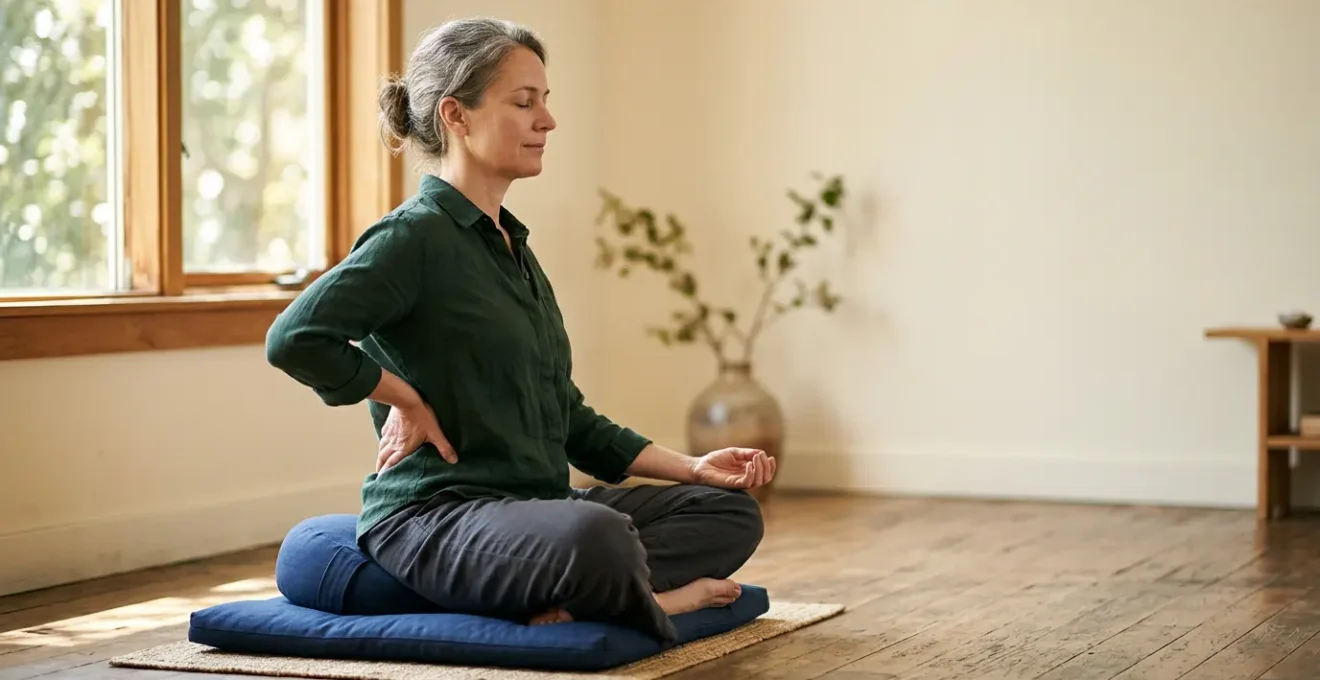
Back pain during meditation isn’t a sign you’re « doing it wrong »; it’s a sign your cushion is calibrated incorrectly for your specific biomechanics.
- Your cushion’s primary job is to create a precise forward pelvic tilt, not just to elevate you off the floor.
- The filling (e.g., buckwheat) and foundation (the zabuton) are non-negotiable parts of spinal support, not optional comfort accessories.
Recommendation: Stop blaming your body. Start treating your meditation cushion like a technical tool and diagnose its height, filling, and setup using the biomechanical principles in this guide.
You followed the advice. You bought a zafu, placed it on the floor, and settled in for a peaceful session. But ten minutes in, a familiar, dull ache begins to creep into your lower back, growing from a distraction into a full-blown reason to stop. This is a common and deeply frustrating experience for many meditators. The prevailing wisdom suggests the problem is your posture or lack of flexibility, but this often misses the crucial point: the cushion itself is not a passive comfort item, but a precision tool for spinal alignment.
The issue isn’t that you’re sitting, but how your body is being supported—or unsupported. The pain is a data point, signaling a fundamental mismatch between your unique anatomy and the specifications of your seating equipment. It’s a problem of ergonomics, not effort. Thinking your cushion is just a small pillow is like thinking a running shoe is just a foot covering; the specific design, materials, and setup determine whether it supports performance or causes injury.
This guide reframes the conversation. We will move beyond the generic advice to « sit up straight » and instead delve into the biomechanics of seated meditation. We will treat your zafu and zabuton as a technical system that can be diagnosed, adjusted, and optimized. By understanding the anatomical principles at play, you can transform your cushion from a source of frustration into the key to a sustainable, pain-free practice.
This article provides a complete diagnostic framework to identify the root cause of your discomfort and build a seating arrangement that truly supports your spine. Explore the sections below to systematically troubleshoot your practice.
Summary: Why Does Your Back Ache After 10 Minutes of Meditation Despite Sitting on a Cushion?
- Why Sitting Perfectly Still Damages Your Spine More Than Moving Incorrectly?
- How Do You Know if Your Meditation Cushion Is Too High, Too Low or Just Right?
- Buckwheat, Kapok or Memory Foam: Which Zafu Filling Suits Longer Meditation Sessions?
- Do You Need Both a Zafu and a Zabuton or Is One Cushion Enough?
- How Do You Set Up Your Zafu Differently for Cross-Legged Versus Kneeling Meditation?
- When Does Your Zafu Need Refilling and How Do You Know Before It Causes Problems?
- How to Choose Between a Block, a Strap or a Blanket for Your Tight Shoulders?
- What Actually Happens During Transcendental Meditation That Makes People Pay £500 for Training?
Why Sitting Perfectly Still Damages Your Spine More Than Moving Incorrectly?
The instruction to remain « perfectly still » in meditation is often misinterpreted as a command for rigid, motionless posture. From a biomechanical perspective, this is one of the most damaging things you can do to your spine. The human spine is not designed for static load-bearing. It thrives on movement, which allows for the circulation of synovial fluid that nourishes the intervertebral discs. When you lock your body into a single, fixed position, you prevent this vital process.
This concept is known as dynamic stillness. A healthy seated posture is not frozen; it involves constant, unconscious micro-movements as your body breathes and balances. Attempting to suppress these movements creates muscular tension and, more critically, places sustained, uneven pressure on your spinal discs. As research published in the PM&R Journal highlights, this prolonged static load leads to an increase in intra-discal pressure, which is a direct precursor to disc bulges and herniations. The dull ache in your back is your body signaling that your discs are being compressed and deprived of nourishment.
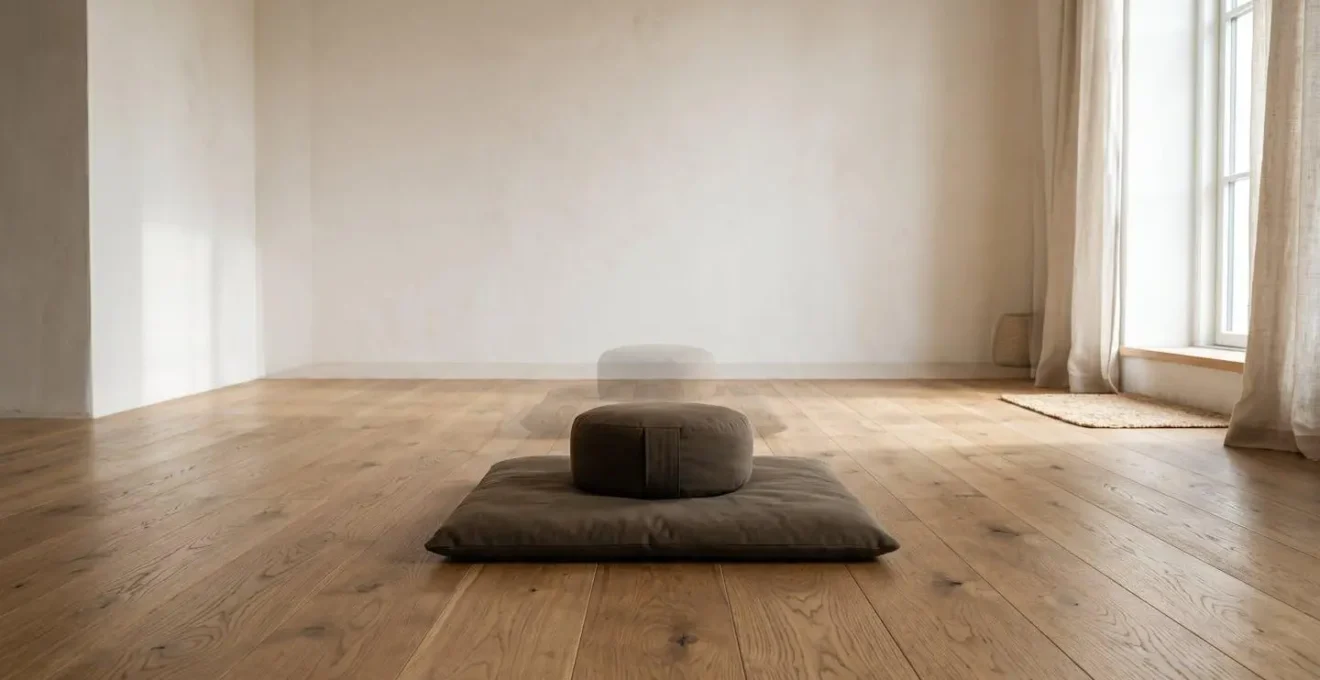
Therefore, the goal is not absolute rigidity but an effortlessly stacked spine that can subtly move with the breath. Your meditation cushion and setup are the foundation that makes this possible. If your setup forces you to use muscular effort to stay upright, you are creating the very static tension that leads to pain and injury. The ache is not a sign of failure, but a sign that your setup is preventing your spine from achieving this natural, dynamic equilibrium.
How Do You Know if Your Meditation Cushion Is Too High, Too Low or Just Right?
Finding the correct cushion height is the single most critical factor in achieving a sustainable seated posture. A common piece of advice is that a cushion is « too high can cause strain on your hips » and one that is « too low can cause strain on your knees, » but this is too simplistic. The right height is a precise calibration that creates an anterior pelvic tilt—a slight forward rotation of the pelvis that allows your spine to stack naturally without muscular effort. An incorrect height forces your body into compensation patterns that result in back pain.
The difference between a supportive height and a problematic one can be as little as half an inch. Instead of guessing, you need a clear diagnostic method. The goal is to find the sweet spot where your hips are sufficiently elevated so your knees can rest comfortably below them, creating a gentle downward slope for your femurs. This position takes the strain off your hip flexors and allows your lumbar spine to maintain its natural curve.
Action Plan: Three-Step Diagnostic Test for Cushion Height
- Sit Bone Sensation Test: Settle onto your cushion. Focus on your sit bones. If they point straight down into the cushion, your pelvic alignment is likely correct. If you feel them rolling backward and your lower back slumping, your cushion is too low. If you feel your pelvis tipping excessively forward, creating a sharp arch in your lower back, your cushion is too high.
- Knee Drop & Femur Angle Check: In a cross-legged position, observe your knees. They should create a gentle downward slope from your hip joint to your knee. If your knees are « floating » in the air, your cushion is too low for your current hip flexibility. If your knees are forced down toward the floor with a sharp angle at the hip, the cushion is too high, causing hip compression.
- 10-Minute Fatigue Test: Settle in for a 10-minute sit. Pay close attention to the nature of any discomfort. A dull, general muscle fatigue in the mid or upper back often suggests your cushion is too low, forcing your postural muscles to work overtime. A sharp, pinching sensation in the hips, groin, or inner thighs often means your cushion is too high, jamming the femur into the hip socket. The perfect height remains supportive and comfortable beyond the first few minutes.
This test transforms you from a passive user into an active diagnostician of your own practice. Use this feedback to add or remove filling from your cushion (if possible) or to experiment with different heights until you find the one that allows your spine to float effortlessly.
Buckwheat, Kapok or Memory Foam: Which Zafu Filling Suits Longer Meditation Sessions?
The material inside your zafu is not mere stuffing; it is an active component of your support system. Its properties directly influence stability, breathability, and the cushion’s ability to adapt to your body over the course of a sit. For longer meditation sessions, the filling’s performance under compression is paramount. Buckwheat, kapok, and memory foam offer vastly different experiences.
Buckwheat hulls are the top choice for most serious practitioners because they are highly malleable. Like firm sand, they shift and conform precisely to your anatomy, providing customized support that can be micro-adjusted with a slight shift of your weight. This adaptability prevents the build-up of pressure points. Furthermore, the space between the hulls allows for airflow, which helps keep the cushion cool and reduces a common source of distraction. Kapok is lighter but compresses more over time, while memory foam is notorious for retaining heat and « locking » you into a single position, which becomes uncomfortable during longer sits.

The following table breaks down the key performance characteristics of each material, making it clear why buckwheat is often the superior choice for those looking to sit for extended periods without compromising spinal alignment. The ability to add or remove buckwheat hulls via a zippered opening also makes it the most adjustable and durable option over the long term.
| Characteristic | Buckwheat Hulls | Kapok Fiber | Memory Foam |
|---|---|---|---|
| Malleable Support | Excellent – hulls shift for micro-adjustments during sit, conforming to body | Good – firm yet buoyant, maintains shape with regular fluffing | Limited – locks into contour, becomes uncomfortable over time |
| Compression & Airflow | Maintains airflow (stays cool), can compact during single session requiring slight shift | Compresses significantly, loses loft faster, needs regular fluffing | Retains heat (distraction factor), no airflow |
| Adjustability | Highly adjustable via zippered opening – add/remove fill easily | Difficult to adjust – requires professional equipment to restuff evenly | Not adjustable – fixed density |
| Durability | Hulls break down over time, need replacement every 1-2 years with daily use | Compresses permanently, fibers clump unevenly after extended use | Degrades with compression, loses supportive properties |
| Weight & Portability | Heavy (twice the weight of kapok), less portable | Lightweight, easy to transport | Moderate weight, portable |
Do You Need Both a Zafu and a Zabuton or Is One Cushion Enough?
For many meditators, especially in the West, the zabuton—the large, flat mat that goes under the zafu—is seen as an optional comfort accessory. This is a critical misunderstanding of its function. The zabuton is not for comfort; it is the biomechanical foundation of your entire seating structure. Meditating with a zafu directly on a hard floor is a primary cause of instability and, consequently, back pain.
Your ankles and knees are complex joints not designed to bear sustained pressure against an unyielding surface like a wood or tile floor. As DharmaCrafts notes, « A zabuton provides essential cushioning for your ankles and knees when sitting cross-legged. » Without this padding, your ankles may roll, and your knees experience pinpoint pressure. This instability at the base of your posture forces your spine to make constant, fatiguing micro-corrections to maintain balance. The back pain you feel is the end result of your spine compensating for an unstable foundation.
Case Study: The Zabuton as a Biomechanical Stabilizer
Research on Western meditation practitioners consistently shows that direct contact with hard floors leads to spinal fatigue within 10-15 minutes. The zabuton’s role is to create a stable, level, and forgiving surface. This platform prevents ankle rolling and distributes body weight evenly across the shins and feet, eliminating localized pressure points. By stabilizing the base, the zabuton allows the pelvis (supported by the zafu) to settle into its natural, neutral position. This enables the spine to stack effortlessly without the need for constant muscular compensation, dramatically increasing the duration one can sit comfortably.
In short, the zafu provides the necessary height for pelvic tilt, while the zabuton provides the necessary stability for that tilt to be maintained. They are not two separate items but two components of a single integrated seating system. For a sustainable practice, a zabuton is not an accessory; it is a necessity.
How Do You Set Up Your Zafu Differently for Cross-Legged Versus Kneeling Meditation?
The zafu is not a one-size-fits-all pillow; its function and placement change dramatically depending on your chosen posture. Using it incorrectly for your position is a direct path to joint strain and back pain. The key is to understand whether the zafu is acting as a « Pelvic Wedge » in a cross-legged posture or as a « Joint Spacer » in a kneeling posture.
In a cross-legged position (like Burmese style), the goal is to create a forward pelvic tilt. In a kneeling position (Seiza), the goal is to lift your body weight off your heels to relieve pressure on your knee and ankle joints. Each requires a different application of the same tool. Forcing a posture without the correct setup will inevitably lead to your body compensating elsewhere, usually in the vulnerable lumbar spine. The following guide provides the specific biomechanical setups for each primary posture.
Action Plan: Biomechanical Setup Guide by Meditation Posture
- Cross-Legged Setup (Burmese/Lotus): Here, the zafu acts as a Pelvic Wedge. You should sit only on the front third of the cushion. This elevated perch allows your pelvis to tilt forward, naturally creating the proper lumbar curve and enabling your spine to stack effortlessly over your hips. The primary goal is achieving this specific tilt, not simply gaining height.
- Kneeling Setup (Seiza): Here, the zafu acts as a Joint Spacer. Turn the cushion on its side (making it taller) or place it lengthwise between your legs. Straddle the cushion and rest your sit bones on top. This lifts your torso off your heels, creating space and relieving pressure on the delicate knee and ankle joints. The primary goal is creating height and separation.
- Hybrid Approach for Limited Flexibility: Do not force a standard position if your body resists it. For a kneeling posture that requires more height than a single zafu provides, create a custom solution by placing your zafu on top of one or two yoga blocks. This empowers you to build a setup that fits your unique body instead of forcing your body into a painful, standardized shape.
Understanding and applying these distinct setups allows you to use your zafu with precision, transforming it from a simple cushion into an effective ergonomic tool that supports your spine in any position.
When Does Your Zafu Need Refilling and How Do You Know Before It Causes Problems?
A meditation cushion is not a static piece of furniture; it is equipment that degrades with use. The filling, especially organic material like buckwheat hulls or kapok, compresses and breaks down over time. This gradual loss of volume and support is often so subtle that you may not notice it until the familiar back ache returns. If a previously comfortable setup suddenly starts causing pain, your first suspect should be cushion degradation, not a problem with your body.
As the cushion loses height, the carefully calibrated pelvic tilt it once provided disappears. Your pelvis starts to roll backward, your lumbar spine flattens, and your postural muscles are forced to engage to hold you upright. This is the direct cause of returning fatigue and pain. For dedicated practitioners, zafu maintenance guidelines suggest a replacement is needed about every 12 months to maintain supportive volume. However, you don’t need to wait for a full year or for pain to be your only indicator. There are early warning signs you can look for.
Learning to spot these signs allows for proactive maintenance, ensuring your practice remains supportive and pain-free. Use these simple diagnostic checks regularly:
- The Fist Test for Buckwheat Zafus: Press your closed fist firmly into the center of your cushion. If you can easily feel the floor with very little resistance, the buckwheat hulls have compressed and degraded significantly. The cushion has lost its supportive volume and requires a top-up.
- The Returning Ache Indicator: This is the most reliable signal. If your back begins to ache 10 minutes into a sit, after weeks or months of comfort in the same posture, the cushion has lost the height required to maintain your alignment. It’s the equipment, not you.
- Sensory Clues Beyond Flatness: Pay attention to other changes. Degraded buckwheat creates more fine dust when you move or adjust the cushion and loses its supportive « crunchy » sound. Degraded kapok will feel lumpy and develop permanent hollows, losing its smooth, resilient feel. These are clear signs that the filling’s structural integrity is compromised.
By regularly checking for these signs of degradation, you can address the problem before it sabotages your posture and undermines the sustainability of your meditation practice.
How to Choose Between a Block, a Strap or a Blanket for Your Tight Shoulders?
While the focus is often on the hips and lower back, unresolved tension in the upper body is a hidden cause of spinal strain. If your arms, wrists, or shoulders are not completely relaxed, that tension travels down the kinetic chain and forces your lower back to compensate. The goal is to create a seating arrangement where your hands can rest without any muscular effort. Props like blankets, blocks, and straps are not « cheats »; they are essential tools for achieving this effortless state.
The « Effortless Hands Rule » is a simple diagnostic: once seated, you should be able to completely forget about your hands and arms. If you feel any strain in your wrists, a pull in your shoulders, or the need to actively hold your hands in place, your setup needs adjustment. Each prop serves a distinct purpose in neutralizing this upper body tension, and choosing the right one depends on your specific anatomical needs.
Do not try to force your hands to rest on your knees if they don’t reach comfortably. This common mistake causes the shoulders to slump forward, rounding the upper back and putting direct strain on the lumbar spine. Use the following guidelines to select the right tool for the job:
- Use a Blanket on Your Lap: If your hands do not comfortably reach your knees when your arms are relaxed, your proportions simply require a higher resting surface. Place one or two folded blankets across your lap to raise the height, allowing your hands and wrists to rest in a neutral position and preventing your shoulders from slumping forward.
- Use Blocks Under Your Hands: If your arms tend to rotate externally in an uncomfortable way, or if your wrists bend at a sharp angle when resting on your knees, place yoga blocks under each hand or wrist. This provides a flat, stable surface that keeps the arm in a neutral alignment.
- Use a Strap Before Meditation: If your primary issue is a tendency to hunch forward from daily life (desk work, driving), use a yoga strap to perform two or three gentle chest-opening stretches before you sit. This prepares the pectoral muscles and shoulders for a more upright posture, making it easier to maintain without strain during your sit.
By addressing upper body support with the same precision as lower body support, you create a holistic system that allows the entire spine to remain neutral and relaxed.
Key takeaways
- Back pain in meditation is an ergonomic problem, not a personal failing; it signals a mismatch between your anatomy and your cushion.
- The cushion’s primary role is to create a forward pelvic tilt, allowing the spine to stack naturally. Its height is a precision setting.
- The Zafu (for height/tilt) and Zabuton (for foundational stability) are an integrated system. Using a Zafu alone on a hard floor causes instability and pain.
What Actually Happens During Transcendental Meditation That Makes People Pay £500 for Training?
While much of this guide focuses on the precise biomechanics of floor-based sitting, it is crucial to understand that this is not the only valid approach to meditation. The Transcendental Meditation (TM) tradition offers a starkly different perspective, one that provides valuable context. A core reason people invest in TM training is its radical emphasis on « effortlessness, » which extends directly to posture.
Unlike Zen or Vipassana, which place a strong emphasis on a specific, upright floor posture, the TM technique de-emphasizes physical form almost entirely. As noted in an analysis of Transcendental Meditation postural guidelines, « TM prioritizes ‘comfort’ and ‘effortlessness’ above all, often recommending sitting comfortably in an armchair with full back support. » The physical instruction is simply to sit comfortably with your head, neck, and back supported, and your feet on the floor. The practice is mental, and the body’s position is arranged to be as non-distracting as possible.
This approach highlights a fundamental divide in meditative practices. For traditions focused on mindfulness of the body and breath in a specific posture, ergonomic precision is paramount. For a practice like TM, where the focus is on transcending thought via a mantra, the body is simply put in the most comfortable, supported position possible so it can be « forgotten. » The high cost of training is not for postural instruction, but for the personalized instruction of the technique itself and the theory behind it. Understanding this distinction is liberating: if floor sitting, even with a perfectly calibrated system, remains a source of pain, it does not mean you cannot meditate. It simply means a tradition that allows for chair-based practice, like TM, may be a more suitable path for your body.
Now that you are equipped with this diagnostic framework, the next logical step is to systematically apply it. Begin by analyzing your current setup and identifying the specific biomechanical failure point that is causing your discomfort.