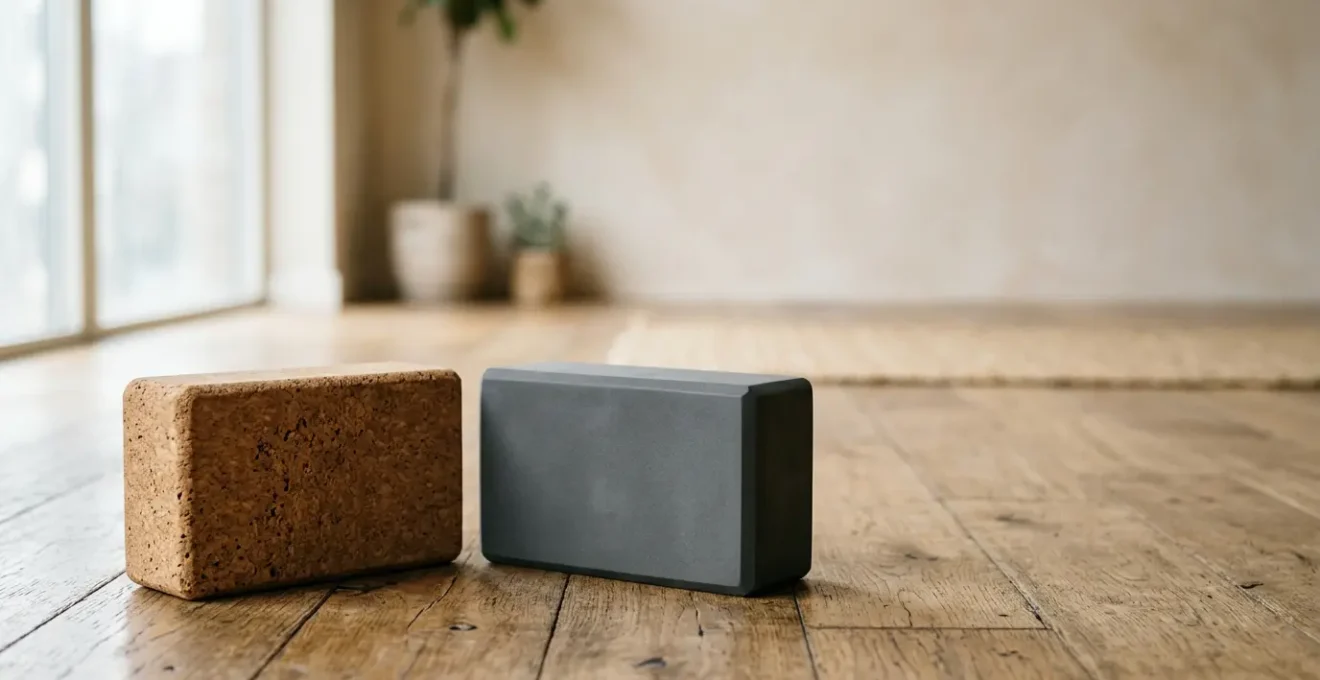
The choice between cork and foam is not about which is ‘better,’ but about understanding the specific physical feedback each material provides for your alignment goal.
- Cork redirects force, acting as a stable extension of the floor for building strength and receiving clear proprioceptive feedback.
- Foam absorbs force, providing comfortable cushioning but potentially masking misalignments and offering less stability under load.
Recommendation: Use cork for active, standing, and balancing poses where you need reliable feedback and stability. Use foam for restorative poses or when placing a block under sensitive areas like the spine or head.
Walk into any yoga studio, and you’ll see a familiar debate playing out in the prop closet: the light, squishy foam block versus the dense, solid cork block. For many practitioners, the choice is arbitrary, often based on which is lighter to carry or what the teacher grabs first. The common advice suggests foam is for beginners and cork is for the advanced, but this oversimplification misses the entire point of using a prop. The material itself fundamentally changes the conversation between your body and the pose.
Choosing a block isn’t just about « bringing the floor up. » It’s a decision about the type of physical information you want to receive. Do you need a prop that acts as a forgiving cushion, absorbing your weight and providing comfort? Or do you need a steadfast partner that offers unwavering support and communicates exactly where your energy is directed? The answer dictates not only which block to use but *how* you use it to deepen your practice rather than just compensate for limitations.
This guide moves beyond the surface-level « soft vs. hard » debate. We will explore the biomechanics of each material, understanding how cork’s force redirection and foam’s force absorption create entirely different experiences in a pose. By understanding the distinct purpose of each material, you can transform your props from simple crutches into intelligent tools for building strength, refining alignment, and unlocking a more sustainable practice.
To help you navigate this choice, this article breaks down every critical aspect, from material science to sustainable sourcing. Explore the sections below to become an expert in your own practice.
Summary: Cork vs. Foam Blocks: A Deep Dive into Material and Practice
- What Makes Cork Feel Different Under Your Hands Compared to Foam or Wood?
- Should Tall People Use Larger Blocks and How Do You Know What Size You Need?
- What Creative Block Uses Can Transform Poses You Never Thought to Prop?
- How Do You Clean Cork Blocks Without Damaging Them and How Often Is Necessary?
- How Do You Know if Your Cork Block Comes from Sustainable Harvesting?
- How to Choose Between a Block, a Strap or a Blanket for Your Tight Shoulders?
- How to Use Blocks to Improve Alignment Rather Than Compensate for Tightness?
- Why Do Iyengar Teachers Spend 10 Minutes on a Single Pose When Others Do 10 Poses?
What Makes Cork Feel Different Under Your Hands Compared to Foam or Wood?
The distinct sensation of a cork block under your hands comes down to its unique cellular structure and chemical composition. Unlike foam, which is a synthetic polymer designed to compress and absorb force, cork is a natural material made of millions of tiny, air-filled, honeycomb-like cells. This structure gives it a firm, yet slightly yielding quality. When you press into a cork block, it doesn’t « squish » like foam; instead, it redirects the force back into your hand and arm, providing clear, high-fidelity proprioceptive feedback about your alignment and weight distribution.
Foam blocks, by contrast, are designed for force absorption. When you press on foam, the material compresses significantly, creating a feeling of softness and cushioning. While this can be comfortable, it can also create instability in standing or balancing poses and mask how much weight you are truly bearing. A wooden block represents the other extreme: it is completely unyielding, offering zero compression. This can feel harsh on the joints and provides no absorptive capacity.
Furthermore, cork possesses a remarkable substance called suberin. This waxy, natural component gives cork its grip and water-resistant properties. Crucially for a yoga practice, suberin’s grip actually improves with moisture. As you sweat, the block becomes more secure, not more slippery. This is a key differentiator from foam, which can become slick when wet, or wood, which offers no change in grip. This research on cork’s moisture-responsive properties shows that it releases an organic substance that enhances grip, making it an ideal partner for dynamic or hot yoga classes.
Should Tall People Use Larger Blocks and How Do You Know What Size You Need?
While it’s a common assumption that taller practitioners automatically need larger blocks, the ideal size is more related to your body’s proportions—specifically your limb length and hand size—rather than just your overall height. The standard yoga block is 4″ x 6″ x 9″, offering three different height options. This size works well for the majority of practitioners, providing adequate support in poses like Triangle (Trikonasana) or Half Moon (Ardha Chandrasana).
The goal is to choose a height that allows you to maintain the integrity of the pose’s alignment without straining. For example, in Triangle Pose, the block under your hand should be high enough to keep both sides of your torso long and your spine straight. If you have to collapse your side-body to reach the block, it’s too low. A person with longer legs and shorter arms might need a taller block setting than a person with shorter legs and longer arms, regardless of their total height.
The material also plays a critical role in this decision. A smaller 4-inch cork block often provides more reliable stability than a larger 5-inch foam block because it doesn’t compress under weight. When you place your hand on a foam block, it can wobble or sink, compromising the steady foundation you need. A firm cork block, even at a lower height, acts as a true extension of the floor. For this reason, a standard 4″ cork block is often sufficient for most needs. Ultimately, it’s best to have a pair of blocks, as many poses benefit from symmetrical support.
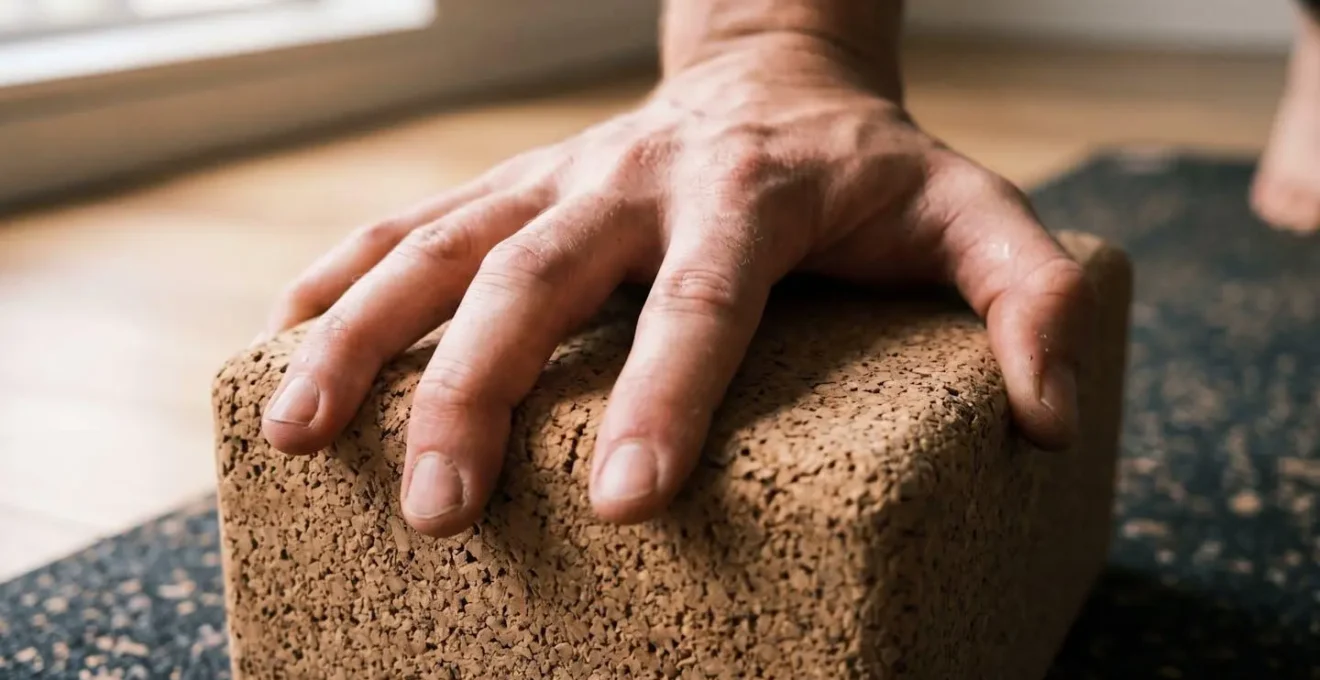
As you can see, proper hand placement and wide fingers are key to distributing weight effectively. Your block size should allow you to press down firmly without wrist discomfort, creating an active line of energy up the arm. If your hands are smaller, a narrower block might feel more secure and less cumbersome to grip.
What Creative Block Uses Can Transform Poses You Never Thought to Prop?
Yoga blocks are often perceived as passive tools for support, but their true potential is unlocked when you see them as active tools for conditioning and deepening awareness. By using the block’s weight and firmness for resistance, you can transform a simple pose into a powerful strengthening exercise. This shifts the prop’s role from a crutch that compensates for tightness to an instrument that builds active stability and control.
One of the most effective ways to use a block actively is to squeeze it. Placing a block between your thighs in poses like Chair Pose (Utkatasana) or Bridge Pose (Setu Bandhasana) instantly activates your adductor (inner thigh) muscles. This engagement creates a chain reaction, helping to stabilize the pelvis, support the lower back, and align the knees. You are no longer just holding a shape; you are actively working within it, using the block as a source of biofeedback to feel the correct muscles engage.
You can also use blocks to add load and challenge your core. By moving beyond just placing them on the floor, you can integrate them directly into your movements to build functional strength. Here are a few creative ways to use cork blocks as conditioning tools:
- Curl-Up with Weight: Lie on your back holding one or two cork blocks. As you curl your upper body forward, the weight of the blocks adds resistance, targeting your abdominals, arms, and shoulder stabilizers.
- Bridge Pose with Adductor Squeeze: Place a block between your bent knees while grounded. As you lift your hips into a bridge, focus on squeezing the block to fire up your inner thighs and glutes before slowly lowering down.
- Seated Spine Twist with Resistance: Sit tall and hold a block between your palms with arms extended. As you rotate your torso, actively press your palms into the block to engage your pectoral muscles and deepen the spinal twist.
- Elevated Plank Hold: Place both hands on blocks in a plank position. The elevation increases the range of motion for push-ups and the firm surface challenges your wrist and shoulder stability more than the floor alone.
How Do You Clean Cork Blocks Without Damaging Them and How Often Is Necessary?
One of the most practical advantages of cork is its naturally antimicrobial and antibacterial nature. The same suberin that provides grip also inhibits the growth of bacteria, mold, and mildew. This means cork blocks require significantly less frequent and aggressive cleaning than their foam counterparts. In fact, studies on cork’s antimicrobial properties demonstrate that after just 90 minutes, bacteria on its surface was reduced by over 96%. This self-cleaning property makes it an excellent choice for shared studio environments and hot yoga practices.
For routine cleaning, simplicity is key. After a moderately sweaty practice, you often don’t need to do anything at all. If you’ve had a particularly heavy sweat session, simply wipe the block with a damp cloth and let it air dry completely before storing it. Avoid using harsh chemical cleaners, oils, or abrasive sponges, as these can break down the natural cork and damage its surface. For a deeper clean, you can use a gentle, natural solution of water with a few drops of white vinegar or a specialized yoga mat cleaner designed for cork.
The frequency of cleaning depends entirely on your practice type, sweat level, and whether you practice at home or in a studio. A practitioner in a hot yoga class should wipe down their blocks after every session, whereas someone with a gentle home practice might only need to do so weekly or monthly. The key is to prevent the buildup of body oils and dirt over time, which can diminish the cork’s natural grip.
This table provides a helpful guide for determining how often to clean your cork blocks based on your specific practice habits, ensuring they remain hygienic and durable for years to come.
| Practice Type | Sweat Level | Environment | Post-Practice Wipe | Deep Clean Frequency |
|---|---|---|---|---|
| Hot Yoga | Heavy | Shared Studio | Every session | Weekly |
| Vinyasa Flow | Moderate | Shared Studio | Every session | Bi-weekly |
| Vinyasa Flow | Moderate | Private Home | 2-3 times/week | Monthly |
| Yin/Restorative | Light | Private Home | Once/week | Monthly |
| Yin/Restorative | Light | Shared Studio | Every session | Bi-weekly |
How Do You Know if Your Cork Block Comes from Sustainable Harvesting?
Choosing cork over foam is already a step towards a more sustainable practice, as cork is a natural, renewable, and biodegradable material. However, not all cork is harvested with the same level of environmental stewardship. True sustainability lies in ensuring the cork is sourced from well-managed forests where the health of the trees and the ecosystem is prioritized. The gold standard for this is cork sourced from Portugal, where strict laws protect the cork oak forests (montados).
Cork is harvested by carefully stripping the bark from the cork oak tree—a process that does not harm the tree itself. In fact, a harvested cork oak tree absorbs up to five times more CO2 than a non-harvested one as it regenerates its bark. The first harvest can only occur after a tree is 25 years old, and subsequent harvests happen only once every 9 to 12 years. This patient, cyclical process supports biodiversity and a vital local economy. Impressively, over 50% of the global cork supply comes from Portugal, which enforces these rigorous regulations.
When purchasing a cork block, you are supporting an industry that actively contributes to carbon sequestration. Research shows that for every tonne of cork harvested, the forest can sequester up to 73 tonnes of CO2. To ensure your purchase aligns with these values, it’s important to look past generic « eco-friendly » marketing claims. A truly sustainable brand will be transparent about its sourcing and production methods. Be wary of « greenwashing » and don’t be afraid to ask direct questions.
Your Action Plan: Spotting a Genuinely Sustainable Cork Block
- Origin Check: Ask if the cork is sourced from Portugal or Spain, which have established, regulated harvesting practices requiring trees to be at least 25 years old.
- Industry Byproduct: Inquire if the cork is a byproduct of the wine stopper industry. This is the most sustainable practice, as it uses the remaining material that would otherwise go to waste.
- Binding Agents: Ask what adhesives are used to fuse the cork granules. Look for brands that use non-toxic, food-grade, or low-VOC binding agents.
- Certification: Check for FSC (Forest Stewardship Council) certification or an equivalent verification of sustainable and ethical forest management.
- Harvest Cycle: Ask about the harvest cycle of their supply chain. A responsible brand should be able to confirm they adhere to the 9-12 year regeneration period.
How to Choose Between a Block, a Strap or a Blanket for Your Tight Shoulders?
When you’re dealing with tight shoulders, reaching for a prop is a smart move, but choosing the *right* prop is crucial. A block, strap, and blanket each serve a fundamentally different purpose. Understanding their unique functions allows you to address your limitation with precision, rather than grabbing the nearest object and hoping for the best. The choice depends on whether you need support and lift, extension and reach, or gentle cushioning.
A block is your tool for support and lift. When tight shoulders prevent you from reaching the floor in a pose like Triangle or Parsvottanasana (Pyramid Pose) without rounding your spine, a block brings the floor to you. A firm cork block is particularly effective here because it provides the necessary resistance to activate the shoulder stabilizers, like the serratus anterior. As one expert in Alignment-Focused Yoga Training Research notes:
For poses requiring the engagement of shoulder stabilizers like serratus anterior, pressing into a firm cork block provides the necessary resistance for muscle activation, whereas a soft blanket would not.
– Alignment-Focused Yoga Training Research, Alignment Props Training for Yoga Teachers
A strap, on the other hand, is for extension and reach. It acts as an extension of your arms. In a pose like Gomukhasana (Cow Face Pose), if your fingers can’t clasp behind your back, a strap bridges the gap. This allows you to maintain the pose’s structural integrity and work on the shoulder opening without forcing the joint. Finally, a blanket offers gentle elevation and cushioning. It’s ideal for passive openings, such as placing a rolled blanket under your spine to encourage a gentle chest opening or providing soft support under your head and neck in Savasana.
This diagnostic framework helps clarify when to use each prop to best address your specific shoulder limitation and achieve the intended benefit of the pose.
| Prop Type | Primary Function | Best For | Example Application |
|---|---|---|---|
| Block (Cork or Foam) | Support and Lift | Limited range of motion, need to elevate floor | Under hand in Triangle Pose to maintain spinal length without compression |
| Strap | Extension and Reach | Tight shoulders preventing hand-to-hand bind | Binding in Gomukhasana (Cow Face Pose) when hands cannot clasp behind back |
| Blanket | Gentle Elevation and Cushioning | Neck/cervical spine support, gentle passive opening | Under head in Savasana or rolled under shoulder blades for passive chest opening |
How to Use Blocks to Improve Alignment Rather Than Compensate for Tightness?
The most profound shift in using a yoga block is moving from passive compensation to active alignment. It’s easy to view a block as a crutch—something to lean on because you can’t reach the floor. A more powerful approach is to see it as a teacher—a tool that provides feedback and builds the very strength and awareness needed to eventually practice the pose without it. The key is to engage with the block, not just rest on it.
This means pressing down actively into the block in poses like Triangle or Side Angle. This action of pressing down creates an opposing lift up through the torso, engaging the core and stabilizing muscles. A firm cork block excels here, as it resists the pressure and sends clear feedback up the arm and into the shoulder girdle, helping you find and strengthen muscles like the serratus anterior. A soft foam block, which would simply absorb the pressure, cannot provide this same level of active feedback.
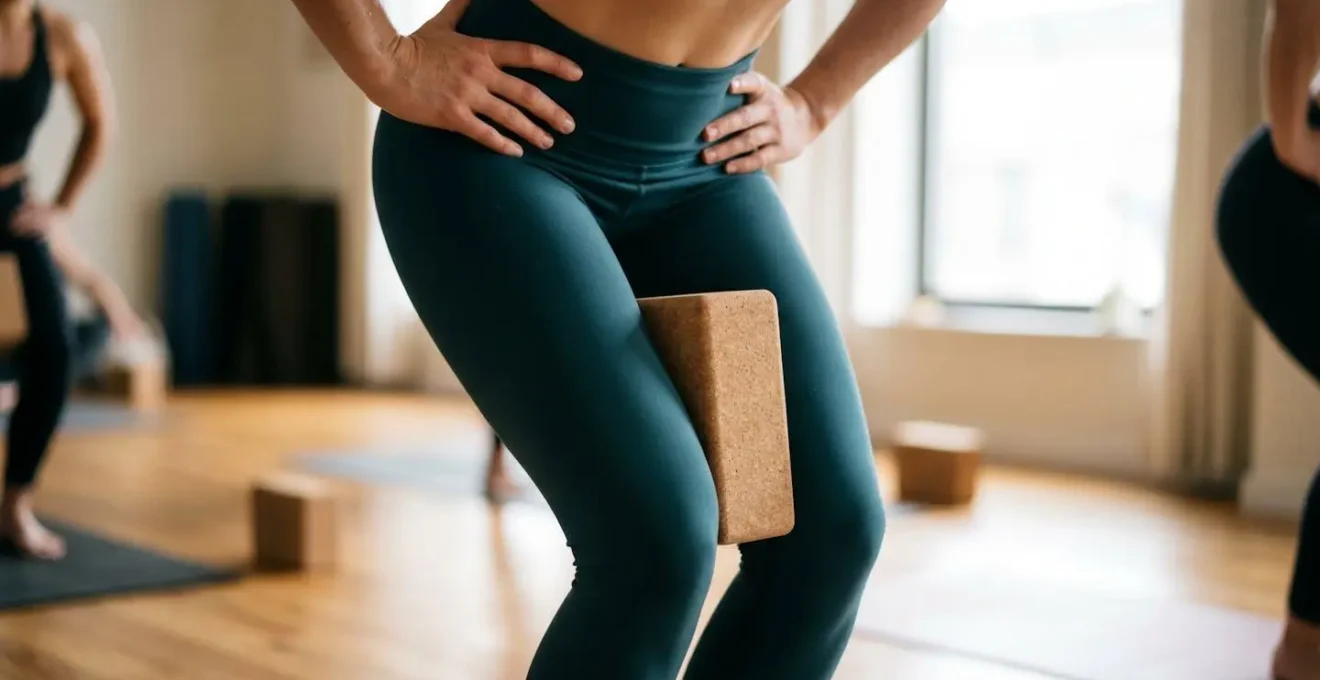
Another powerful technique is to use the block for biofeedback in a different plane. As shown here, squeezing a block between the thighs in Utkatasana (Chair Pose) or Tadasana (Mountain Pose) isn’t about just holding it there. It’s about feeling the adductors fire, which helps to internally rotate the thighs and create stability across the pelvis. This sensory information provides a real-time self-correction, teaching you what proper engagement feels like from the inside out.
You can create a progressive practice with your blocks by systematically reducing your reliance on them while increasing your active engagement. This method transforms the block from a support system into a strength-training tool:
- Stage 1 – Maximum Support: Use the block at its highest setting to bring the floor closer. Focus on maintaining the pose’s full integrity and engaging your muscles, not just collapsing onto the prop.
- Stage 2 – Reduced Support Challenge: As your flexibility improves, lower the block to its medium or lowest height. This challenges your range of motion while demanding you maintain the same quality of alignment.
- Stage 3 – Active Resistance: At the lowest height, press down firmly into the block. Transform it from a passive support into an active resistance tool that strengthens the very muscles needed for the full expression of the pose.
Key Takeaways
- Material Matters: Cork provides firm, stable feedback (force redirection), while foam offers soft cushioning (force absorption). Choose based on your pose’s goal.
- Function Over Form: Use blocks to actively engage muscles and refine alignment, not just to passively compensate for a lack of flexibility.
- Sustainability is a Choice: Opt for cork blocks from verifiably sustainable sources, like FSC-certified forests in Portugal, to support an eco-friendly practice.
Why Do Iyengar Teachers Spend 10 Minutes on a Single Pose When Others Do 10 Poses?
The practice of holding a single asana for an extended period, often with an intricate arrangement of props, is a hallmark of the Iyengar yoga method. While a vinyasa class might flow through ten poses in ten minutes, an Iyengar class might spend that same amount of time exploring the depths of just one. This approach stems from a profound pedagogical philosophy: that true understanding of a pose comes not from brief repetition, but from sustained, mindful investigation.
This methodology was born out of B.K.S. Iyengar’s own journey and his work with students facing physical challenges. He discovered that props like blocks, blankets, and chairs were not cheats, but powerful tools for making precise alignment accessible to every body, regardless of its limitations. By using a prop to support the body, the student’s mind is freed from the struggle and fear of just holding on. This mental space allows them to turn their awareness inward, exploring the subtle actions and energetic lines of the pose in minute detail.
Case Study: Iyengar’s Pedagogical Innovation
As word of B.K.S. Iyengar’s teachings spread, many individuals who were not finding relief from conventional medicine came to him. Initially, he would support his students with his own body, physically holding and adjusting them. As class sizes grew, this became impossible. He began innovating with household items—chairs, books, and blankets—to replicate that support. He realized these props could help not just those with physical ailments, but all practitioners, to deepen their sense of alignment, direction, and understanding of an asana. This systematic use of props was revolutionary, transforming yoga pedagogy by making precision and depth accessible to everyone.
Spending ten minutes in a supported pose is not a passive wait; it is an active, meditative exploration. The props create a safe and stable container where the body can learn to release chronic tension and the mind can cultivate focus and resilience. As B.K.S. Iyengar himself explained, the goal was to create a sense of ease even in difficulty:
With the use of props, Iyengar found that his students were able to overcome their fear, increase their confidence and sustain a sense of ease with the most difficult yoga asana – these supports helped in certain areas to get a better action and at the same time the sense of ease.
– B.K.S. Iyengar, Iyengar Yoga Props Philosophy
Now that you understand the distinct roles of cork and foam, the principles of sustainable sourcing, and the deep philosophy behind prop usage, you are empowered to make an intelligent choice. Your next step is to observe in your own practice: in which poses do you need the unwavering feedback of cork, and where would the gentle cushion of foam serve you better? Start applying this knowledge to transform your props from accessories into essential teachers on your mat.