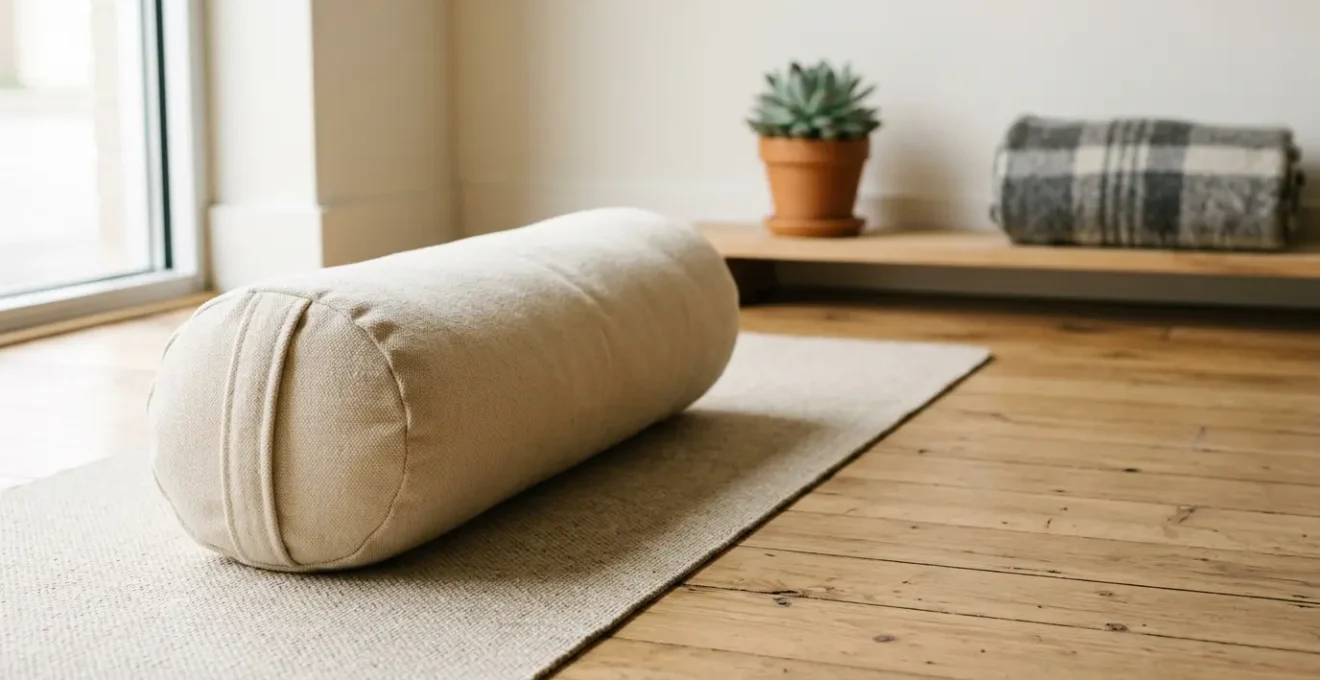
The belief that a rolled blanket can replace a yoga bolster stems from a misunderstanding of its purpose: the goal isn’t softness, but unwavering structural integrity that signals safety to your nervous system.
- A bolster’s non-compressible density provides clear proprioceptive feedback, allowing muscles to release fully. A soft blanket offers vague support, keeping the body subtly on guard.
- The shape and firmness of a bolster are engineered to unload joints and support spinal curves in a way a yielding, improvised prop simply cannot replicate.
Recommendation: Invest in a dedicated bolster not as a simple cushion, but as a specialized tool for accessing deeper physiological relaxation and true passive restoration.
It’s a question every budding restorative yoga practitioner asks: why invest in a bulky, often expensive bolster when a stack of blankets or a rolled-up towel seems to do the trick? From the outside, the logic is sound. Both options provide elevation and a degree of softness. Yet, restorative teachers remain firm in their recommendation, guiding students toward the purpose-built prop. This insistence isn’t about brand loyalty or aesthetic preference; it’s rooted in a deep understanding of biomechanics and the subtle language of the nervous system.
The common approach is to equate support with comfort, assuming that a soft, pliable surface is the ultimate goal. We might even experiment with related props like meditation cushions or floor poufs. But this overlooks the fundamental principle of restorative practice. The aim is not merely to be comfortable, but to create an environment of such profound safety and stability that the body can finally cease all work. This is where the crucial difference between a yielding blanket and a bolster with structural integrity emerges.
What if the key to unlocking deep release wasn’t the softness of the prop, but its unwavering, non-compressible support? This article deconstructs the science behind the bolster, moving beyond surface-level comfort to explore the critical roles of shape, density, and proprioceptive feedback. We will explore why a dedicated bolster is an architectural tool for the body, engineered to signal profound safety to the brain and allow for a level of passive unloading that improvised props can only ever approximate.
This guide will explore the specific ways a bolster’s design directly influences your practice. We will examine how different shapes serve distinct purposes, why firmness is more important than softness for nervous system regulation, and how to use props to finally stop « working » in your restorative poses. By understanding these principles, you’ll see why a bolster is less of a luxury and more of an essential key to the practice.
Summary: Understanding the Essential Role of a Yoga Bolster
- Round or Rectangular Bolster: Which Shape Supports Your Lower Back Better in Reclined Poses?
- How Do You Know if You Need a Firmer or Softer Bolster for Your Body?
- How Can a Bolster Transform Your Seated Forward Folds Even If You Are Flexible?
- How to Make a Home Bolster from Household Items That Actually Works?
- How Do You Store a Bolster in a Tiny Flat Without It Taking Over the Room?
- How to Position Bolsters and Blankets So You Actually Stop Working in Restorative Poses?
- How to Create Effective Restorative Poses Using Only Household Items?
- Why Does Lying Still in Restorative Yoga Feel Harder Than Holding Difficult Poses?
Round or Rectangular Bolster: Which Shape Supports Your Lower Back Better in Reclined Poses?
The first distinction you’ll notice in bolsters is their shape, primarily round (cylindrical) or rectangular. This isn’t a stylistic choice; it’s a functional one that dictates how the prop interacts with your body, especially the sensitive curvature of the lower back in reclined poses like a supported fish or Savasana.
A round bolster creates a more pronounced, specific point of contact. When placed under the knees, it encourages a natural, soft bend that helps release the psoas and lumbar spine. When used lengthwise along the spine, its curved surface opens the chest more acutely, creating a gentle heart-opener. However, for direct lower back support, its concentrated pressure can sometimes feel too intense for those with acute sensitivity.
In contrast, a rectangular bolster offers a broad, stable platform. Its flat, wide surface distributes weight more evenly, providing consistent and gentle support across the entire sacrum and lower back. This makes it the superior choice for poses like Reclined Bound Angle (Supta Baddha Konasana), where the goal is to fully support the spine and pelvis without creating a pressure point. The flat surface provides a feeling of being « held » rather than « propped up, » which is more conducive to deep relaxation.
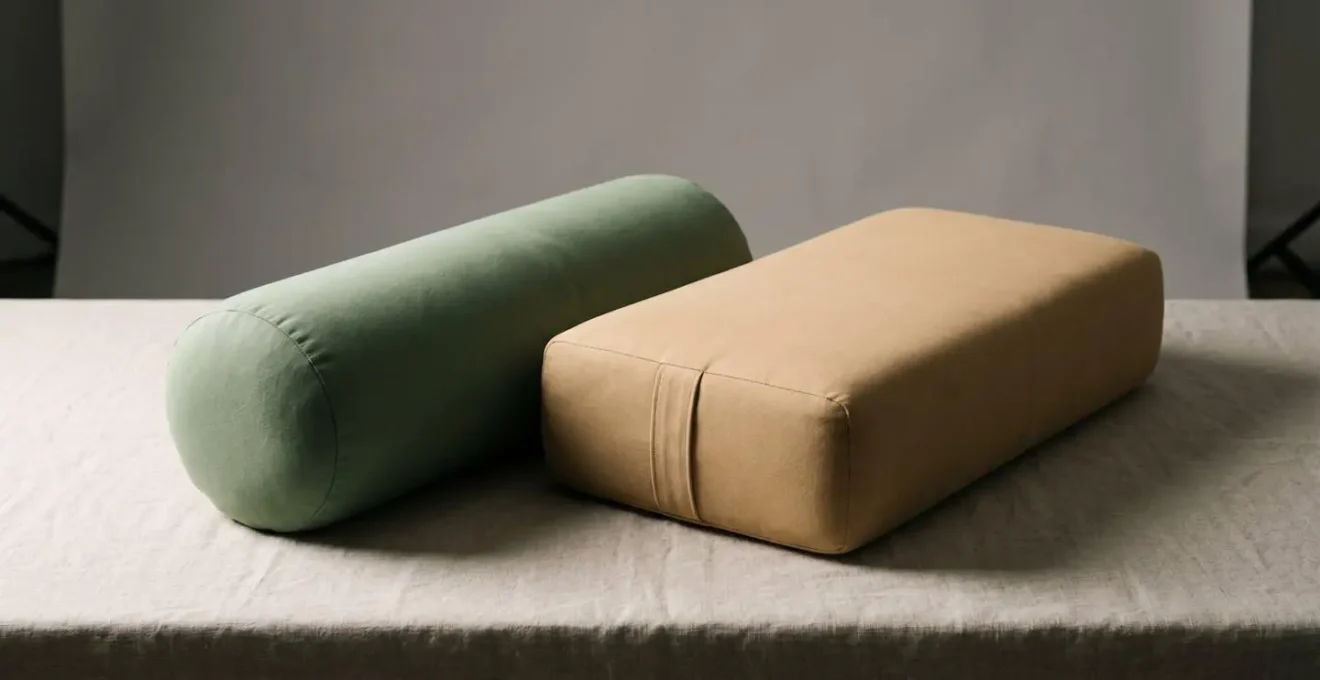
As the image highlights, the difference in surface area is key. The cylindrical bolster creates a « peak » of support, ideal for targeted opening, while the rectangular bolster creates a « plateau, » ideal for broad, stable grounding. For practitioners focused on alleviating lower back tension in passive, reclined positions, the rectangular bolster almost always provides a more complete sense of safety and release.
How Do You Know if You Need a Firmer or Softer Bolster for Your Body?
The debate between firm and soft props is where the core misunderstanding lies. We instinctively gravitate toward softness, associating it with comfort and relaxation. However, in restorative yoga, true relaxation comes from the nervous system feeling safe, and safety is communicated through stability, not mushiness. A bolster’s primary job is to provide clear, unwavering feedback to your body—a concept known as proprioception, or your body’s awareness of its position in space.
A firm, dense bolster made of cotton batting or a similar material offers non-compressible support. When you rest your weight on it, it doesn’t significantly yield or change shape. This provides your brain with consistent and reliable sensory information: « You are held. You are stable. You do not need to engage your muscles to prevent a fall. » This clear feedback is precisely what allows the muscles to switch off and enter a state of true passive release. In fact, research on yoga for proprioception shows that the practice significantly improves balance and joint position sense, an effect that is amplified by clear, stable surfaces.
A soft prop—like a pillow or a loosely packed blanket—does the opposite. It compresses under your weight, constantly shifting and providing vague, unreliable feedback. Your nervous system interprets this as instability, and your muscles remain in a low-level state of activation, subtly working to stabilize you. You may feel « comfortable, » but you are not fully surrendering. The difference is between lying on a solid floor versus a waterbed; only one signals absolute stability to your primal brain.
Yoga integrates breath control, postural alignment, and mindfulness, fostering heightened bodily awareness and improved motor execution. The yogic practice may facilitate proprioceptive adaptations, improving kinesthetic perception, static balance, and coordinative ability.
– Verma et al., Pramanik et al., Yoga for proprioception: A systematic review (ResearchGate, 2023)
Choosing a bolster, therefore, isn’t about finding the softest option. It’s about finding the one with enough structural integrity to hold your body’s weight without collapsing. For most people, this means a bolster that feels surprisingly firm to the touch. This firmness is not for harshness, but for clarity, creating the conditions for profound release.
How Can a Bolster Transform Your Seated Forward Folds Even If You Are Flexible?
Many practitioners, especially those with natural flexibility, view a bolster in a Seated Forward Fold (Paschimottanasana) as a crutch for beginners. If you can already touch your toes, why add a bulky prop? This perspective misses the transformative power of a bolster: it shifts the goal of the pose from active stretching to passive release and nervous system regulation.
Without a bolster, a forward fold is an active pose. You use your muscles to draw your torso forward, lengthening the hamstrings and spine. Even at your maximum flexibility, there is an element of effort and muscular engagement. When you introduce a firm rectangular bolster on top of your thighs, the dynamic changes entirely. You fold forward and rest your entire torso—from your lower belly to your chest—onto the prop. The bolster takes on the full weight of your upper body.
This has two profound effects. First, it allows the muscles of your back, shoulders, and even your legs to completely disengage. The pose becomes passive. The sensation is no longer a « pull » in the hamstrings but a gentle, supported « drape » of the spine. Second, the firm pressure of the bolster against your abdomen provides gentle compression. This acts as a form of interoceptive feedback that stimulates the vagus nerve, a key component of the parasympathetic « rest-and-digest » nervous system. This stimulation is a powerful antidote to stress, and according to a 2024 randomized-control experiment published in Frontiers in Psychology, breath-based yoga interventions are proven to significantly reduce stress and anxiety.
For a flexible person, the bolster isn’t about reaching further; it’s about surrendering more deeply. It allows you to stay in the pose for several minutes, not as a feat of endurance, but as a deeply calming and restorative experience. The focus shifts from physical achievement to physiological state change, which is the true essence of restorative yoga.
How to Make a Home Bolster from Household Items That Actually Works?
While a dedicated bolster is the gold standard, it is possible to create a functional substitute at home if you understand the core principle: you are trying to replicate density and structural integrity, not just shape and softness. A flimsy, lumpy roll of blankets will lead to a frustrating practice where you are constantly adjusting and unable to fully release.
The most common and effective method involves using firm, dense materials. Forget fluffy duvets or soft pillows. Your best resources are thick, tightly woven towels or firm blankets (like Mexican-style yoga blankets or wool blankets). The key is in the rolling and securing. You need to roll them as tightly as humanly possible to eliminate air pockets and create a solid, non-compressible core. Use at least 3-4 large bath towels or 2-3 firm blankets.
Case Study: The Mid-Pose Sag Principle
A popular DIY yoga bolster tutorial emphasizes using four full-sized towels as an inexpensive alternative to dense filler. The creator rolled them tightly and secured them within a firm, non-stretchy fabric cover. During testing, the creator noted that while the weight and initial firmness were good, the main challenge was preventing the edges from becoming uneven and the center from « sagging » after several minutes under body weight. The solution was to add extra filler (like polyfill) around the edges before sealing the cover. This demonstrates that the ultimate success criterion for a homemade prop is its ability to maintain consistent, non-compressible support throughout a long hold, which is the primary value of a professionally made bolster.
Once rolled, you must secure the bundle tightly with several belts, yoga straps, or sturdy rope. The straps should be cinched down to the point where the roll feels like a solid log. If you can easily squish it, it’s not tight enough. For a cover, a non-stretchy pillowcase, a small rug, or a dedicated piece of canvas fabric can be wrapped around the bundle to create a uniform surface. The final product should be heavy, solid, and maintain its shape when you press down on it firmly.
How Do You Store a Bolster in a Tiny Flat Without It Taking Over the Room?
One of the biggest practical barriers to owning a bolster is its size. In a small apartment or a multi-purpose room, a large cylindrical prop can feel like an unwelcome piece of furniture. However, with a bit of creativity, a bolster can be integrated into your living space or stored discreetly without sacrificing precious floor area.
The key is to think of the bolster as either a piece of functional decor or something that can utilize vertical or hidden space. A high-quality bolster with an attractive cover doesn’t need to be hidden away. It can be a part of your home’s aesthetic. If you choose a rectangular bolster in a neutral fabric, it can easily double as a low meditation seat, a floor pouf for extra seating when guests are over, or even a decorative cushion on a deep sofa or daybed. This approach turns a piece of yoga equipment into a stylish, multi-purpose home good.
For those who prefer to keep their practice space separate, vertical and under-furniture storage are the best options. Installing a single, sturdy floating shelf high on a wall can turn your bolster into an intentional piece of decor, keeping it off the floor and out of the way. Alternatively, heavy-duty wall hooks (like Command hooks rated for significant weight) can be used to hang the bolster by its handle behind a door or inside a closet. For rectangular bolsters, sliding it under a bed or a sofa with enough clearance is often the simplest solution.
- Functional Furniture: Use a rectangular bolster with a stylish cover as a low meditation seat, floor pouf, or decorative cushion on a sofa.
- Vertical Storage: Install high-wall shelves to display the bolster as intentional decor, or use heavy-duty Command hooks to hang it behind a door.
- Dual-Purpose Basket: Place a cylindrical bolster upright in a large, decorative woven basket along with your folded yoga blankets to create an aesthetically pleasing « yoga corner. »
- Under-Furniture Sliding: Many bolsters are designed to be low-profile enough to slide under a bed, sofa, or storage bench with adequate clearance.
- Travel/Inflatable Options: For extreme space constraints, consider a high-quality inflatable bolster that deflates for compact storage in a closet or drawer, though these may compromise on the ideal firmness.
How to Position Bolsters and Blankets So You Actually Stop Working in Restorative Poses?
Simply having the right props isn’t enough; the magic of restorative yoga happens when they are positioned so perfectly that your body has no choice but to surrender. The goal is to « meet the body where it is » and fill every single gap between it and the floor. If any part of you is « floating » in space, your muscles will remain subconsciously engaged to hold it there. This is the « work » we are trying to eliminate.
The principle is called passive unloading. In any given pose, you must scan your body and identify any areas of tension or suspension. For example, in Reclined Bound Angle Pose (Supta Baddha Konasana), your spine might be on a bolster, but are your outer thighs hovering an inch above the floor? If so, your hip adductors and abductors are still working. The solution is to slide a folded blanket or a block under each thigh until they are completely supported. You should feel the weight of your legs release fully into the props.
This requires a meticulous and honest self-assessment at the start of each pose. Pay attention to the subtle signals. A clenched jaw, furrowed brow, or shallow breathing are all signs that your nervous system does not feel 100% safe and supported. The most common areas needing extra support are the neck (with a small rolled towel), the lumbar curve (with a folded blanket), the backs of the knees, and the wrists. The setup for a single restorative pose can sometimes look like a fortress of props, and that is perfectly okay. The more completely you are held, the deeper you can release.
Your 5-Point Self-Audit for True Surrender: Checking Your Pose
- Points of Contact: Are all parts of your body that are meant to be supported making full, comfortable contact with a prop or the floor? Identify any gaps, no matter how small.
- Collect Data: Consciously scan your body from head to toe. Are you holding any residual tension in your jaw, shoulders, belly, or hips? Be brutally honest.
- Assess Coherence: Does the support feel absolutely stable, or do you sense a subtle « sinking, » shifting, or need to adjust? The support must be unwavering.
- Gauge Emotional State: Is your mind still « on alert, » scanning for discomfort? Or do you feel a profound sense of being held, safe, and able to let go completely?
- Integrate and Adjust: If the answers to #3 or #4 are no, methodically add or adjust props (e.g., tuck a small blanket in the gap) until you can answer with a definitive « yes. »
How to Create Effective Restorative Poses Using Only Household Items?
If a dedicated bolster isn’t an option, you can still access the benefits of restorative yoga by creatively and intelligently using common household items. The goal remains the same: to build stable, supportive structures that allow your body to release. This requires moving beyond a single rolled blanket and thinking like an architect, combining items to create the height and firmness you need.
Your home is filled with potential props. Firm couch cushions can serve as excellent rectangular bolsters. Stacks of hardcover books can be wrapped in a towel to create a stable, flat block. Rolled-up yoga mats, firm decorative pillows, and tightly folded blankets can all be combined to build the perfect support system for any given pose. The key is to layer and combine items to achieve non-compressible support. For example, a soft pillow on its own will collapse, but a soft pillow placed on top of a sturdy stack of books becomes a much more effective prop.
It’s about creating a « prop recipe » for each pose. Don’t be afraid to experiment and build elaborate structures. The more you can approximate the unwavering support of a real bolster, the more effective your practice will be. The focus should always be on stability over softness.
- Supported Child’s Pose: Roll a firm blanket or several towels tightly into a cylindrical shape. Place it lengthwise on your mat, kneel with your knees wide, and lower your torso onto the roll. Rest your head to one side, switching halfway through.
- Supported Reclined Bound Angle: Create a supportive ramp for your spine using two or three stacked firm couch cushions. Recline along this structure and use two smaller throw pillows or rolled towels under each outer thigh for complete hip support.
- Supported Seated Forward Fold: Place a firm couch cushion or two stacked pillows on your thighs. Fold forward and rest your torso and head on the cushion. You can add a stack of books under the cushion for more height.
- Legs Up the Couch: A simple and highly effective alternative to Legs Up the Wall. Lie on your back with your hips close to the base of your couch. Extend your legs up and rest your calves and heels on the couch seat. This provides many of the same benefits without needing any props under your hips.
Key Takeaways
- A bolster’s value lies in its structural integrity and non-compressible support, not its softness.
- Firmness provides clear proprioceptive feedback to the nervous system, signaling safety and allowing muscles to fully release.
- The goal of props is passive unloading; they must be positioned to fill every gap and eliminate any subconscious muscular work.
Why Does Lying Still in Restorative Yoga Feel Harder Than Holding Difficult Poses?
For many, the greatest challenge in restorative yoga isn’t physical, but mental. Lying perfectly still on a pile of props for ten minutes can feel infinitely more difficult than flowing through a demanding vinyasa sequence. This isn’t a sign of failure or an inability to relax; it’s a predictable and well-documented neurological phenomenon. The difficulty arises from the brain’s shift from a task-focused state to its default resting state.
In a physically challenging pose, like Warrior II or a handstand, your brain is occupied. The « task-positive network » is engaged, focused on muscular action, balance, and spatial awareness. Your mind has a clear, immediate job to do. But when you settle into a fully supported restorative pose, the external task disappears. There are no muscles to engage, no balance to maintain. As the body becomes quiet, the brain’s « default mode network » (DMN) takes over.
The DMN is associated with self-referential thought, mind-wandering, remembering the past, and planning for the future. When it activates in the stillness of a restorative pose, it can unleash a flood of thoughts: to-do lists, worries, replayed conversations, and anxieties. This is the « mental chatter » that makes stillness feel so agitating. The challenge of restorative yoga is not laziness, but the courage to sit with this internal activity without judgment and without needing to « do » something about it.
In a difficult pose (vinyasa), the brain is in a ‘task-positive’ mode, focused on balance and muscle action. In restorative stillness, the ‘default mode network’ takes over, bringing up a flood of thoughts, to-do lists, and anxieties. The challenge is not physical laziness, but mental confrontation.
– Neuroscience and yoga research synthesis, Restorative Yoga to Increase Mindfulness and Reduce Burnout (University of Louisville, 2023+)
Understanding this process can bring immense relief. The goal isn’t to force your mind to be empty, but to allow the thoughts to arise and pass while the body remains deeply nested in safety and support. Over time, as the nervous system learns that this stillness is safe, the intensity of the DMN can soften, giving way to moments of genuine peace.
Embracing restorative yoga, therefore, is a dual practice: the physical craft of building supportive structures with props, and the mental practice of allowing your nervous system to downshift. A quality bolster is your most reliable partner in this process, providing the unwavering foundation your body needs to convince your mind it is finally safe to let go.