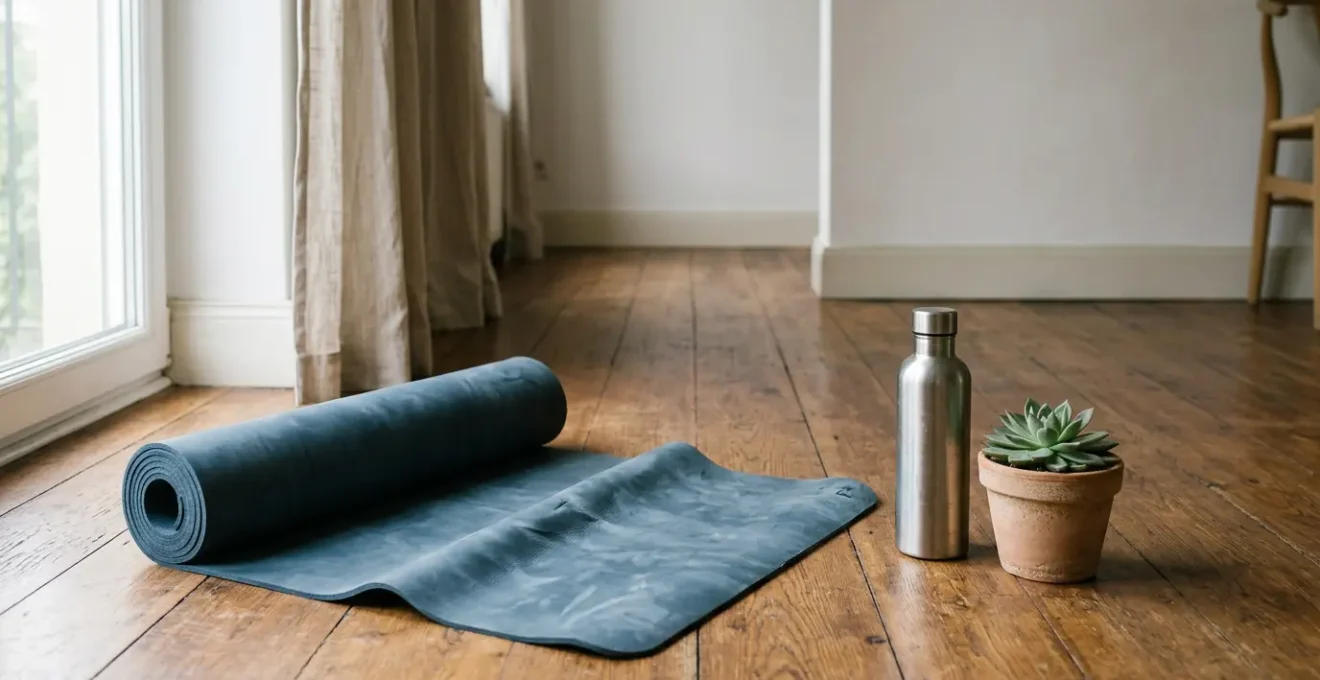
Your spiritual practice doesn’t collapse because you lack discipline; it collapses because it’s built on the unreliable foundation of motivation.
- Motivation is neurologically designed to fade with familiarity, making it a poor long-term fuel for any habit.
- Lasting practice is an architectural problem, not a personal failing. The key is to reduce friction until practicing is easier than not practicing.
Recommendation: Stop trying harder and start designing smarter. Audit and systematically remove the micro-barriers in your environment, schedule, and mindset.
You know the cycle. A surge of inspiration leads you to commit to a daily yoga, meditation, or wellness practice. You buy the new mat, download the app, and carve out the time. The first few days feel incredible—focused, alive, and virtuous. But then, a week or two later, the initial shine wears off. A busy morning, a poor night’s sleep, and you skip a day. Then another. Soon, the space you dedicated to your practice sits silent, collecting dust and a quiet sense of guilt. The common advice tells you to « be more disciplined » or « find a stronger ‘why’, » placing the burden of failure squarely on your shoulders.
But what if that’s the wrong diagnosis entirely? What if the collapse of your practice has nothing to do with a lack of sincerity or willpower? The truth is that relying on motivation is a strategy that is biochemically doomed to fail. This is not a personal failing; it is a predictable feature of our human neurology. We treat our practice like a New Year’s resolution, expecting a single moment of commitment to fuel us for months, and then feel shame when it inevitably falters.
This guide offers a different perspective. It’s time to stop acting like a struggling practitioner and start thinking like a sadhana sustainability specialist. We will shift the focus from the ‘who’ (your supposed lack of discipline) to the ‘how’ (the flawed system you’re using). You will learn to see your practice not as a test of your character, but as an elegant system to be designed, managed, and adapted. It’s about architecting your life so that practice becomes the path of least resistance, not an uphill battle against your own biology.
In the sections that follow, we will deconstruct the common failure points and provide a strategic framework for building a practice that is resilient, compassionate, and finally, sustainable. Let’s explore the blueprint for making your commitment stick.
Summary: Why Your Home Practice Collapses and How to Build a Sustainable System
- Why Does Relying on Motivation Guarantee Your Practice Will Eventually Collapse?
- How to Set Up Your Home So Practicing Becomes Easier Than Not Practicing?
- Is a 15-Minute Daily Practice Better Than a 60-Minute Practice You Skip Half the Time?
- How to Return to Practice After Missing a Week Without Shame or Starting Over?
- How Do You Know When Your Daily Practice Needs to Change and What It Should Become?
- Why Your New Year Wellness Resolutions Collapse by February Every Single Time?
- How to Practice Mindfulness While Making Tea Without Adding Any Extra Time?
- How to Build a Morning Wellness Routine That Actually Fits a 50-Hour Work Week?
Why Does Relying on Motivation Guarantee Your Practice Will Eventually Collapse?
The core reason your heartfelt commitment to a daily practice falters is that you’re using the wrong fuel. You’re running on motivation, a powerful but highly volatile and short-lived resource. Motivation is neurologically tied to novelty. As Dr. Erin Calipari of Vanderbilt University explains, the brain releases dopamine in response to new stimuli, but this response inherently diminishes with repeated exposure. In her research on novelty-based learning, she notes that
dopamine in a specific region of the brain called NAC is released after novel, neutral stimuli, and that the dopamine response decreased with repeated exposure to the same stimulus
– Dr. Erin Calipari, Vanderbilt University research on dopamine and novelty-based learning
That initial « high » of a new practice is a chemical reality, and its decline is just as real. Expecting that initial excitement to last is like expecting a firework to illuminate the sky all night.
Furthermore, the very act of forcing yourself to practice when you don’t « feel like it » depletes a finite mental resource. This concept, known as ego depletion, has been a cornerstone of psychological research for decades.
The Science of Willpower: Ego Depletion Theory
A 2024 comprehensive review by Roy Baumeister and colleagues reaffirmed that self-regulation, or willpower, acts like a muscle that draws from a limited energy pool. While the theory has evolved to emphasize that we conserve this energy rather than fully exhausting it, the practical implication remains: every act of self-control makes the next one harder. The research confirms that daily stressors and conflicts are a major cause of willpower depletion, making it even harder to show up on your mat after a tough day.
This creates a perfect storm for failure. Your brain’s novelty-seeking nature reduces your intrinsic motivation, while your daily life’s demands drain the willpower you’d need to override that apathy. The solution isn’t to « be more motivated » but to build a system that doesn’t require motivation. It requires habit, which is behavior on autopilot. But forming that habit takes time—far longer than we think. Forget the « 21-day » myth; recent research suggests it takes a median of 59-66 days for a new health behavior to become automatic. Your system needs to be robust enough to carry you through that entire period, especially on the days when motivation is nowhere to be found.
How to Set Up Your Home So Practicing Becomes Easier Than Not Practicing?
If motivation is unreliable, the most strategic way to ensure your practice happens is to make it the path of least resistance. This is an architectural problem, not a moral one. The goal is to reduce the « activation energy »—the physical and mental effort required to start—to near zero. Every tiny bit of friction between you and your mat is a reason for your depleted brain to say « not today. » Your task is to conduct a friction audit of your space and routine.
This means going beyond just having a « nice » space and moving into creating an intelligent one. A permanently rolled-out mat in a dedicated corner isn’t just a reminder; it’s a removal of the friction of unrolling it. Deciding on your practice sequence the night before removes the decision fatigue that can paralyze you in the morning. These aren’t just tips; they are strategic interventions in your environment designed to outsmart your own resistance.
A powerful, though often overlooked, technique is sensory anchoring. By adding intentional sensory cues—like a specific incense, a gentle chime, or a particular essential oil—you create a Pavlovian-style trigger. The scent or sound begins to signal to your brain and body that it’s time for practice, bypassing the need for conscious decision-making. This transforms the space from a location into a ritual trigger.

As the image suggests, the ritual itself becomes an anchor. The gentle wisp of smoke isn’t just for ambiance; it’s a cue that requires no willpower to interpret. The more you can automate the lead-up to your practice, the more likely the practice itself is to happen. Your environment should do the heavy lifting for you. Here is a concrete plan to get you started.
Your Action Plan: Designing a High-Consistency Space
- Designate and Dedicate: Find a permanent, consistent spot, even if tiny, that is free from kid and pet traffic. This spot’s only job is to be your practice space.
- Eliminate Setup Friction: Keep your mat rolled out permanently as a visual and physical commitment. If space is an issue, store it visibly and accessibly, not in a closet.
- Pre-Empt Decision Fatigue: Decide what you’re going to practice the night before. Write it on a sticky note and place it on your mat. Remove all in-the-moment choices.
- Anchor to Time: Pick a consistent time of day. Link your practice to an existing habit, like right after brushing your teeth or before your first cup of coffee.
- Implement Sensory Cues: Add one or two intentional sensory elements. Light the same incense, play the same ambient track, or use a specific mat spray. Make the space feel intentional and signal to your brain it’s time.
Is a 15-Minute Daily Practice Better Than a 60-Minute Practice You Skip Half the Time?
The answer is an unequivocal yes. This isn’t a matter of opinion; it’s a fundamental principle of neuroscience and habit formation. Your brain doesn’t form habits based on the duration or intensity of an activity, but on the consistency of its repetition. An ambitious 60-minute practice that happens only twice a week sends a weak and inconsistent signal to the neural pathways you’re trying to build. In contrast, a simple, achievable 15-minute practice performed daily sends a clear, strong, and repetitive signal that solidifies the behavior.
The « all-or-nothing » mindset is one of the greatest saboteurs of a sustainable practice. We set an ideal—the full hour, the perfect sequence, the deep meditation—and on days we can’t meet that ideal, we do nothing. This is a critical error in judgment. The goal in the first 2-3 months is not to achieve profound spiritual insight or peak physical fitness; the sole goal is to automate the behavior of showing up. Anything that serves this primary goal is a success. Anything that jeopardizes it—like an overly ambitious time commitment—is a strategic flaw.
Research consistently supports this « consistency over intensity » approach. The widely cited idea that habits form in 21 days is a vast oversimplification. In reality, it can take anywhere from 18 to 254 days for a new behavior to become automatic, with a 2024 study putting the average at 66 days. If your practice feels like a chore on day 30, you’re not failing; you’re normal. Your system must be designed to withstand that long, often uninspired, journey to automaticity. As habit formation expert Dr. Ben Singh notes from a systematic review, this is a key differentiator:
Morning practices generally proved more effective, and self-chosen habits showed better results than assigned ones. Simple actions with clear triggers become automatic more readily than complex behaviors.
– Dr. Ben Singh, University of South Australia systematic review on habit formation
Therefore, your « Minimum Viable Practice » (MVP) is your most powerful tool. What is the absolute shortest version of your practice that still « counts »? A 15-minute session? Ten sun salutations? Five minutes of seated meditation? Define it, and on low-energy or low-time days, execute that MVP without guilt. You are not « slacking »; you are strategically maintaining the chain of consistency, which is the most important metric of all.
How to Return to Practice After Missing a Week Without Shame or Starting Over?
You missed a day. Then two. Now it’s been a week, and the thought of returning to your mat is loaded with a heavy mix of guilt, shame, and the daunting feeling of « starting over from scratch. » This is a critical juncture where most practices die. The key to salvaging your commitment is to reframe this moment not as a failure, but as an inevitable and valuable part of the process. A sustainable practice is not one that is never broken; it’s one that has a resilient, low-friction protocol for resumption.
First, apply radical self-compassion. The shame you feel is a learned response, but it is not a useful one. It increases the activation energy required to return, making it even less likely you’ll start again. As a sadhana specialist, your first diagnostic step is to recognize this shame as a counterproductive emotion. Acknowledge the feeling (« I feel guilty for stopping ») and then consciously set it aside. Your practice is there to serve you, not to judge you. It will be there waiting, whether you’ve been away for a day or a year.
Second, do not « start over. » You haven’t lost all your progress. The neural pathways, the muscle memory, the mental calm—they are all still there, just a bit dusty. The idea that you’re back at square one is a cognitive distortion. To counter this, your re-entry practice should be deliberately and shockingly easy. Do not try to do the session you were doing before you stopped. Your goal is simply to break the inertia of inaction. Your re-entry protocol should be your « Minimum Viable Practice » (MVP) or even less. Can you just roll out your mat and lie on it for five minutes? Can you do a single sun salutation? The goal is not a « good » workout; the goal is to create a small, undeniable win.
Finally, treat this break as data, not a disaster. What caused the break? Was it travel? Illness? A specific project at work? A period of low energy? This is your somatic feedback loop at work. Instead of judging the break, analyze it. This information is invaluable for refining your system. Perhaps you need an even shorter MVP for travel days, or a restorative-only practice for when you’re feeling burned out. A break is an opportunity to learn about your system’s breaking points and to build in more resilience for the future.
How Do You Know When Your Daily Practice Needs to Change and What It Should Become?
A practice that is built to last is not a static monument; it is a living, breathing system that must evolve with you. The moment your practice becomes a rigid chore you perform out of sheer obligation is the moment it begins to die. The very system designed for your well-being can become a source of stress if it no longer serves your current needs. Recognizing the signs that your practice needs to change is a crucial skill for long-term sustainability. These signs are often subtle whispers before they become loud shouts of boredom or burnout.
The primary signal is a persistent feeling of dread or resistance. While some resistance is normal, a prolonged period where you consistently have to drag yourself to the mat is a red flag. Another sign is « autopilot practice »—you go through the motions, but your mind is a million miles away, and you feel no different afterward. This indicates the practice has lost its connection to your inner state. You are performing, not practicing. Finally, physical or emotional plateaus can signal a need for change. If your body feels stuck, or your meditation feels stagnant for months on end, it might be time to introduce a new stimulus.
The key to navigating this is to cultivate a deep sense of somatic listening. Your body and mind are constantly giving you feedback. The art of practice is learning to listen to that feedback and respond intelligently. This means stepping out of the « shoulds » (« I should be doing a more advanced practice by now ») and into the « what is »—what does your body actually need today? Some days it might need a strong, sweaty vinyasa flow. On other days, deep rest in the form of yin or restorative yoga might be the most profound practice you can do.

As this image beautifully portrays, the wisdom you need is already within you. The change doesn’t have to be a dramatic overhaul. It can be as simple as changing the style of yoga you practice for a month, shifting your focus from asana to pranayama, or exploring a different meditation technique. Try a new teacher online, switch your practice time from morning to evening to see how it feels, or simply give yourself a week of purely intuitive movement. The goal is to reintroduce a sense of curiosity and novelty—the very thing that sparks motivation—but this time, you’re doing it strategically to nourish your practice, not just to start it.
Why Your New Year Wellness Resolutions Collapse by February Every Single Time?
The cycle of starting and stopping a personal practice feels intensely personal, but it’s a remarkably universal phenomenon. The most visible, large-scale example of this is the New Year’s resolution. Every January, millions of people commit to new wellness goals, and every February, gyms empty out and old habits return. Understanding this macro-failure helps us diagnose our micro-failures with more compassion. This isn’t your personal flaw; it’s a predictable pattern of human behavior.
The statistics are stark and consistent. Research consistently shows that up to 80% of people fail to keep their New Year’s resolutions by the second week of February. The enthusiasm generated by a date on the calendar is simply not a strong enough foundation for lasting change. We overestimate the power of a single moment of decision and underestimate the immense gravity of our existing habits and environments. The person who goes to bed on December 31st is, for all intents and purposes, the same person who wakes up on January 1st.
Professor Bas Verplanken, a specialist in habit change, highlights this very point. He explains that for real change to occur, it often needs to be linked to a true discontinuity in life, like moving to a new city or starting a new job—events that force a reshuffling of old routines. As he puts it:
Changing from December 31st to January 1st is not a dramatic discontinuity. Many resolutions are made on December 31st, and go down the drain on January 2nd.
– Professor Bas Verplanken, Society for Personality and Social Psychology report
This insight is directly applicable to our personal practice. We often try to bolt a new, demanding habit onto a life that is already perfectly optimized for our old behaviors. We don’t change the system; we just try to jam a new component into it and hope it works. When it fails, we blame the component (our practice) or ourselves, rather than the faulty installation process. To break this cycle, we must move away from the « resolution » mindset—grand, infrequent declarations—and toward a « systems » mindset—small, daily, environmental adjustments.
How to Practice Mindfulness While Making Tea Without Adding Any Extra Time?
To break the cycle of grand resolutions and subsequent failures, the most effective strategy is to shrink the change. The answer to a lack of time for practice isn’t always to « find more time, » but to infuse the time you already have with the quality of practice. This is the art of « habit stacking » or « piggybacking »—attaching a new desired behavior to a pre-existing, automatic one. One of the most elegant ways to do this is by transforming a mundane daily ritual, like making a cup of tea or coffee, into a formal mindfulness practice.
This approach requires zero additional time in your schedule, which instantly removes one of the biggest barriers to consistency. It leverages a moment that is already happening every day. The only shift is in the quality of your attention. Instead of making tea while scrolling through your phone or planning your day, you make the process of making tea the entire focus of your awareness. This isn’t about adding a new task; it’s about going deeper into a current one.
The practice is simple. As you perform each step, bring your full sensory awareness to it. Notice the sound of the water filling the kettle. Feel the weight of the kettle in your hand. Watch the steam begin to rise. Observe the color of the tea as it infuses the water. Feel the warmth of the mug in your hands. Notice the aroma. When your mind wanders—and it will—gently guide it back to the sensory experience of the present moment. This is, in essence, the entirety of mindfulness meditation, seamlessly woven into the fabric of your day.

This technique is profoundly effective because it’s a « stealth » practice. It bypasses the part of your brain that resists « formally meditating. » There’s no mat to roll out, no special posture to hold. By linking the sacred act of paying attention to the profane act of making a beverage, you begin to dissolve the artificial boundary between your « practice » and your « life. » Every cup of tea becomes an opportunity, a small win in the project of being present.
Key takeaways
- Motivation is a short-term, novelty-driven chemical reaction; it is not a sustainable fuel for long-term practice.
- Design your environment to make practice the path of least resistance. Reduce physical and decision-making friction to zero.
- Consistency trumps duration. A short, daily practice is neurologically more effective for habit formation than a long, intermittent one.
How to Build a Morning Wellness Routine That Actually Fits a 50-Hour Work Week?
For those with demanding schedules, the idea of adding a wellness routine can feel like another impossible task on an already overflowing to-do list. The key is not to find a magical extra hour—it doesn’t exist—but to be ruthlessly strategic with the first few minutes of your day. The morning holds a unique power for habit formation, and leveraging it effectively, even for a short period, can be the difference between a practice that thrives and one that never gets off the ground.
Why the morning? Firstly, your willpower is at its daily peak. As we’ve seen, self-regulation is a finite resource that gets depleted by the countless decisions and stressors of the day. By practicing first thing, you use your premium willpower on your highest-priority internal task before the external world can drain it away. Secondly, the morning is more predictable. Fewer unexpected meetings or social obligations can derail a 6 AM practice compared to a 6 PM one. This consistency is critical. In fact, habit formation research demonstrates that morning practices show 43% higher success rates for habit formation compared to evening routines.
Building a routine that fits a 50-hour work week requires a shift from an « idealistic » to a « realistic » mindset. Your goal is not to replicate the leisurely two-hour routine of a full-time wellness influencer. Your goal is to create a short, potent, and non-negotiable sequence. This could be a 15-minute « Sadhana Stack »:
- 5 minutes: Gentle movement or stretching to wake up the body (e.g., a few cat-cows and sun salutations).
- 5 minutes: Seated breathing practice (pranayama) to calm and focus the nervous system.
- 5 minutes: Seated meditation or journaling to set an intention for the day.
This 15-minute investment compounds over time. It anchors your day in intention rather than reaction. It ensures that no matter how chaotic your work day becomes, you have already dedicated time to your own well-being. This creates a profound psychological shift. The secret is to make this sequence so achievable that it feels harder to skip it than to do it. It’s not about the duration; it’s about the act of showing up for yourself, first thing, every single day.
Your next step isn’t to try to force another practice session tomorrow morning with renewed, but ultimately fleeting, determination. Your true next step is to embrace your new role as the architect of your own practice. Take out a piece of paper and begin the strategic work of designing your own sustainable system, starting with a friction audit of your space and defining your non-negotiable Minimum Viable Practice.