
You’re in a yoga class, and the teacher quotes a beautiful, inspiring line from Patanjali’s Yoga Sutras. It resonates deeply. Later, curious to learn more, you pick up a different translation of the same text, find the same sutra, and discover it seems to say something completely different—perhaps something more complex, confusing, or even contradictory. This experience is common, and it often leaves students wondering: which version is correct? Is the text simply too ancient and obscure to be understood today? Many will tell you that « Sanskrit is a complex language » or that « it’s about the spirit of the text, » but these answers are unsatisfying and miss the point entirely.
The truth is far more interesting and useful for your practice. The variation in translations isn’t a problem to be solved; it’s a doorway to a more profound level of study. This article will not attempt to give you the « one true » translation, because one does not exist. Instead, it will equip you with a new framework for understanding these differences. We will explore the idea that each translation is not merely a dictionary-like conversion of words, but a distinct philosophical roadmap, shaped by the translator’s own lineage, understanding, and intention.
By the end of this guide, you will understand why these texts vary so widely, why your modern yoga class only quotes certain parts, and, most importantly, how to use this very diversity as a practical tool. You will learn to navigate these different maps not to find a single destination, but to chart your own, more authentic path toward integrating yoga philosophy into your life, both on and off the mat.
To illuminate this path, this article is structured to guide you from the foundational questions to practical application. The following sections will build upon each other, offering a comprehensive framework for your study.
Summary: A Scholar’s Guide to Navigating the Labyrinth of Yoga Sutra Translations
- What Are Patanjali’s Yoga Sutras and Why Should a Modern Yoga Student Care About Them?
- Which Yoga Sutra Translation Is Best for Beginners and Which for Serious Scholars?
- How Do You Actually Practice What the Sutras Teach Rather Than Just Understand It?
- Why Do Modern Yoga Classes Quote Some Sutras Constantly but Never Mention Others?
- How to Study One Sutra Per Week in a Way That Changes Your Practice Over a Year?
- What Are the 6 Limbs of Yoga Most Western Practitioners Never Explore?
- What Are the Different Levels of Samadhi and How Do Practitioners Progress Through Them?
- Why Does Your Yoga Practice Feel Empty Even When Your Poses Are Perfect?
What Are Patanjali’s Yoga Sutras and Why Should a Modern Yoga Student Care About Them?
Patanjali’s Yoga Sutras are the foundational scripture of classical Yoga philosophy. Composed of 196 short, aphoristic statements—or ‘threads’ (sutras)—this text is a masterwork on the nature of the mind and the path to liberation. As one scholarly resource notes, « The Yoga Sutras of Patanjali are short, terse phrases designed to be easy to memorize. Though brief, the Yoga Sutras are an enormously influential work that is just as relevant for yoga philosophy and practice today as it was when it was written. » This text provides the theoretical and philosophical backbone for a practice that has now been adopted by hundreds of millions worldwide.
The irony is that while over 300 million people practice yoga regularly, the vast majority engage with only a fraction of what « yoga » truly means. Modern yoga has undergone a massive transition from a comprehensive spiritual discipline to a practice primarily focused on physical postures (asanas) for health and fitness. This shift has created a profound disconnect: we have millions of people perfecting their physical alignment in Warrior II, yet they remain unaware of the rich psychological and philosophical framework from which the practice originates. The Sutras are not about achieving the perfect pose; they are about understanding and stilling the fluctuations of the mind to reveal one’s true nature.
So, why should a modern student care? Because the Sutras hold the key to transforming a physical exercise routine into a profound, life-altering practice. They provide the « why » behind the « what. » They offer a timeless map to navigate the challenges of the human condition—stress, distraction, and suffering—and point toward a state of lasting peace and clarity. Without this context, the practice of asana risks becoming just another form of physical conditioning, leaving practitioners to wonder why, despite their physical prowess, they still feel a sense of inner emptiness.
Which Yoga Sutra Translation Is Best for Beginners and Which for Serious Scholars?
This is perhaps the most common question, and it is fundamentally based on a misunderstanding. To ask « which translation is best » is like asking « which map of the mountain is best. » The answer depends entirely on your goal. Are you looking for the easiest, most direct trail? The most scenic route? Or the most challenging ascent for experienced climbers? There is no single « best » map, only the one that is most useful for your intended journey. The same is true for Yoga Sutra translations.
The sheer volume of interpretation is staggering; by the end of the 20th century, scholars had located 37 editions and 82 different manuscripts of the text, and countless more have been published since. This proliferation isn’t due to poor scholarship; it’s because the Sutras are not a standalone document. They are incredibly dense and were designed to be unpacked by a teacher and a specific commentary tradition. Each translator inevitably brings their own « philosophical lens » to the work. Some may interpret Patanjali’s system through a devotional, theistic framework (highlighting the role of Isvara or God), while others may offer a more secular, psychological, or non-theistic Samkhya-based interpretation. Each is a valid path up the mountain.
For a beginner, the « best » translation is often one that is clear, accessible, and provides extensive commentary that makes the concepts relatable to modern life (e.g., translations by Nicolai Bachman or Ravi Ravindra). The goal is to get a general lay of the land. For the serious scholar, however, the goal changes. Here, the « best » approach is not to find a single book but to engage in comparative study. A scholarly translation, like the one by Edwin F. Bryant, is invaluable because it doesn’t just present one interpretation; it presents many. It shows how different classical commentators have understood each sutra, laying bare the historical and philosophical debates. The serious scholar’s task is to sit with these contradictions, to explore the « space between the words » of different translations, and to use this inquiry to deepen their own understanding. The question is not which translation to own, but how many to compare.
How Do You Actually Practice What the Sutras Teach Rather Than Just Understand It?
Intellectual understanding of the Sutras is only the first step; a collection of maps is useless if you never set foot on the trail. The genius of yoga lies in its integration of philosophy and embodied experience. The ultimate goal is not to be able to recite the sutras, but to live them. This process of moving from conceptual knowledge to lived reality is known as embodied inquiry.
This begins by taking a single concept from the Sutras and using your asana or meditation practice as a laboratory to explore it. Consider one of the most famous sutras, II.46: « Sthira Sukham Asanam » (Posture should be steady and comfortable). A purely intellectual approach would be to debate the meaning of « steady » and « comfortable. » An embodied approach is to get on your mat and investigate it directly. In a challenging pose like Utkatasana (Chair Pose), where do you feel the effort (sthira) and where can you cultivate ease (sukham)? Can you maintain a steady breath even when your thighs are shaking? The pose becomes a direct, felt experience of balancing these two opposing qualities. This is practicing the sutra.
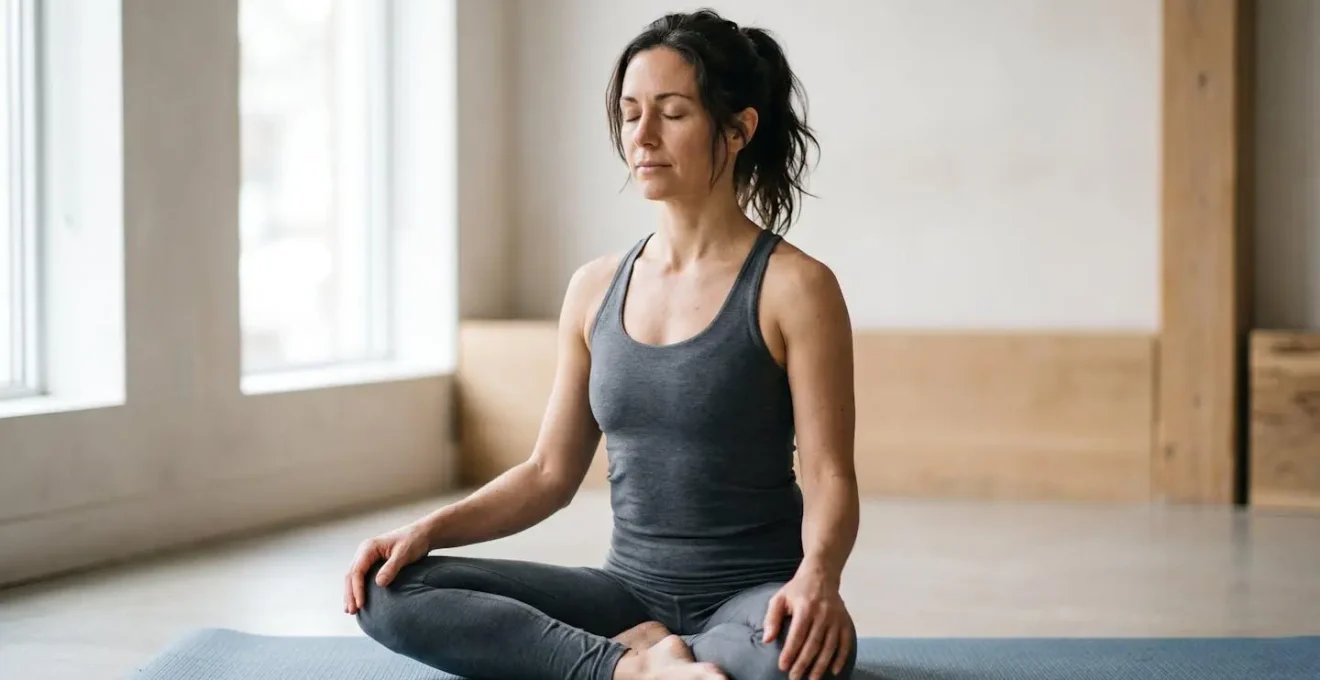
This principle applies to even the most abstract concepts. If you are studying the kleshas (afflictions) like raga (attachment), observe it during your practice. Do you feel a sense of attachment to poses you do well and aversion (dvesha) to those you find difficult? Don’t judge it; just notice it. The mat becomes a microcosm of your life, a safe container where you can observe the patterns of your mind as described by Patanjali. The synthesis of intellectual study and physical practice creates a feedback loop: the text illuminates your experience on the mat, and your experience on the mat brings the text to life in a way that no commentary ever could.
Why Do Modern Yoga Classes Quote Some Sutras Constantly but Never Mention Others?
If you’ve attended yoga classes for a while, you’ve likely heard certain « greatest hits » from the Sutras. Sutras about the definition of yoga (I.2), the nature of posture (II.46), or the ethical precepts of the yamas and niyamas are frequently quoted. Yet, vast sections of the text, particularly from the third and fourth chapters, are almost never mentioned. This is not an accident; it is a conscious or unconscious act of curation that reflects the values and anxieties of modern Western yoga.
Case Study: The Selective Adaptation of Yoga
The transformation of yoga from a spiritual path to a wellness industry has had a profound impact on how its source texts are presented. As described in analyses of modern yoga, market forces and cultural preferences have led to the highlighting of palatable, self-help-oriented sutras. Concepts that align with a therapeutic or personal growth narrative are emphasized. Simultaneously, more challenging or esoteric concepts about karma, rebirth, and, most notably, the supernatural powers (siddhis) described in Chapter Three, are downplayed or ignored entirely. This curation is a direct result of the collision between Western physical culture and the vast, complex system of Indian spirituality.
The third chapter, Vibhuti Pada, is dedicated to the fruits of concentrated meditation, which include a list of siddhis—extraordinary abilities such as knowledge of past and future, the strength of an elephant, or the ability to become invisible. These concepts are deeply uncomfortable for a modern, rational, science-oriented mindset. They don’t fit neatly into the « yoga for stress relief » or « yoga for a great workout » models. As one scholar, Dr. Ronald Steiner, notes of the text, « The fourth chapter of the Yoga Sūtra…begins describing supernatural abilities and a shift in perception (siddhi)…which is the culmination of the Yoga-path. » To ignore these sections is to ignore the text’s own stated culmination.
Therefore, the selection of sutras in a typical class is often driven by what is most palatable, marketable, and least likely to challenge the worldview of the average student. The gentle, inspiring quotes are kept; the strange, mystical, and demanding ones are quietly left behind. This creates a sanitized and incomplete version of the path Patanjali lays out, and it’s precisely why a personal, deeper study of the full text is so essential for the serious practitioner.
How to Study One Sutra Per Week in a Way That Changes Your Practice Over a Year?
The most effective way to integrate the Sutras into your life is through slow, consistent, and contemplative study. A « one sutra per week » approach is a powerful framework that avoids the trap of intellectual binge-reading and instead fosters deep, transformative insight. The key is not to conquer the text, but to allow the text to work on you over time. This requires a structured method that combines intellectual rigor with personal reflection.
The foundation of this practice is comparative contemplation. Instead of relying on a single translation, you work with three or more side-by-side. For a given week, you would read the same sutra in each version. Notice the differences in word choice. Why did one translator choose « cessation, » another « mastery, » and a third « dissolution » for the same Sanskrit word? The meaning is not in finding the « right » word, but in contemplating the field of meaning created by all of them. As the esteemed scholar Edwin F. Bryant’s work demonstrates, « By comparing and contrasting the canonical commentaries, Bryant paints a comprehensive picture of the meaning of each sutra, also clearly indicating what remains in the domain of interpretation, and what is definite. » Your weekly study becomes a micro-version of this scholarly process.
This intellectual work must be paired with journaling and embodied practice. After contemplating the different translations, write down your own understanding. How does this sutra relate to your life right now? Then, take that theme onto your mat. If the sutra is about pratipaksha bhavanam (cultivating the opposite thought), notice negative thought patterns during your practice and actively introduce positive ones. This transforms the study from a passive academic exercise into an active, personal sadhana (spiritual practice).
Your Action Plan: A Framework for Weekly Sutra Study
- Choose your focus sutra for the week. Have at least three different translations available for comparison.
- Read each version of the sutra. In a journal, note the key differences in vocabulary and the potential nuances each translation offers.
- Identify one key Sanskrit term from the sutra (e.g., Vrtti, Abhyasa, Vairagya). Do a brief exploration of its etymology and range of meanings.
- Contemplate and journal: How does this sutra’s teaching apply to your life off the mat? Where do you see this principle in action?
- Set a practical intention for your asana or meditation practice based on the sutra’s theme for the rest of the week, turning theory into embodied experience.
What Are the 6 Limbs of Yoga Most Western Practitioners Never Explore?
The feeling of emptiness in a physically advanced yoga practice often stems from a fundamental imbalance. Patanjali’s system, known as Ashtanga Yoga, consists of eight (ashta) limbs (anga). It is a holistic path where each limb supports and deepens the others. However, modern yoga has overwhelmingly focused on just two: Asana (physical postures, the third limb) and, to a lesser extent, Pranayama (breath control, the fourth limb). This leaves six other limbs largely unexplored by the average practitioner.
The first two limbs, Yama (ethical restraints) and Niyama (personal observances), form the foundational moral and ethical container for the entire practice. They are not just suggestions but the very ground upon which an authentic practice is built. The final four limbs constitute the « inner yoga » (antaranga): Pratyahara (withdrawal of the senses), Dharana (concentration), Dhyana (meditation), and Samadhi (union or enlightenment). These sequential stages map the journey from the outer world of sensory experience to the deepest states of inner absorption.

The problem is not that we practice asana; the problem is that we often practice it in isolation from the other seven limbs. It’s like trying to build a house by focusing only on the windows and ignoring the foundation, walls, and roof. Research on dedicated practitioners confirms this imbalance; one study found that while over 70% of regular Ashtanga yoga practitioners practice the four external limbs (yama, niyama, asana, pranayama) to a high degree, engagement with the internal limbs is often less consistent. Without Pratyahara and Dharana, asana can become a form of physical narcissism. Without the grounding of the Yamas and Niyamas, a powerful practice can inflate the ego rather than dissolve it. The six unexplored limbs are not optional extras; they are the very heart of the practice, providing the context and depth that turn physical movement into a spiritual journey.
What Are the Different Levels of Samadhi and How Do Practitioners Progress Through Them?
Samadhi is the eighth and final limb of Patanjali’s path, representing the culmination of all preceding practices. It is often translated simply as « enlightenment » or « union, » but this simplistic definition masks a complex and graduated process. Samadhi is not a monolithic, on/off state but a series of progressively deeper levels of meditative absorption where the distinction between the observer, the act of observing, and the object being observed dissolves. As scholar Edwin F. Bryant explains, « Patanjali’s work focuses on how to attain the direct experience and realization of the purusa: the innermost individual self, or soul. » Samadhi is the ultimate technique for achieving this realization.
Patanjali describes several layers of Samadhi. The initial stages are known as sabija samadhi, or « samadhi with seed, » because the latent impressions (samskaras) of the mind still exist. This category includes four levels of absorption, each tied to a different type of object of meditation:
- Savitarka: Absorption on a gross physical object, while still retaining awareness of its name, form, and concept.
- Nirvitarka: The next stage, where awareness of the object’s name and concept falls away, leaving only a direct perception of the object itself.
- Savichara: Shifting the focus of meditation from a gross object to a subtle one, such as the tanmatras (subtle elements like sound or touch potential).
- Nirvichara: The deepest of these four stages, where even the subtle object is perceived directly, free from time, space, and causality, leading to a state of profound clarity and bliss (ananda).
Progression through these states is the result of mastering the preceding limbs, particularly Dharana (concentration) and Dhyana (meditation). It requires unwavering practice (abhyasa) and non-attachment (vairagya). The ultimate goal is to move beyond even these profound states into nirbija samadhi, or « samadhi without seed. » This is a state of pure, content-less consciousness where all mental fluctuations and their underlying karmic seeds are extinguished. This is the state of kaivalya, or absolute freedom, the final liberation that is the ultimate promise of the yoga path. For the modern practitioner, understanding these levels shows that « enlightenment » is not a magical event but a systematic, psychological process of refining consciousness.
Key takeaways
- The diversity in Yoga Sutra translations is not a flaw, but a feature that reveals different philosophical interpretations—use it as a tool for study.
- Modern yoga often neglects the majority of the eight-limbed path, leading to a practice that can feel physically advanced but spiritually empty.
- The antidote to this emptiness is to reconnect with the full scope of yoga philosophy through consistent, comparative study (Abhyasa) while letting go of attachment to outcomes like the ‘perfect pose’ (Vairagya).
Why Does Your Yoga Practice Feel Empty Even When Your Poses Are Perfect?
The feeling of emptiness despite achieving a physically « perfect » yoga practice is a common and poignant experience. It signals a critical juncture in a practitioner’s journey: the moment when the limitations of a purely physical approach become undeniable. Your poses may be aligned, strong, and flexible, but if the practice is devoid of its philosophical heart and inner limbs, it becomes a beautiful but hollow form. The perfection of the outer shell highlights the emptiness within. This feeling is not a sign of failure; it is an invitation to go deeper.
This emptiness is a symptom of practicing asana without practicing yoga. The Sutras provide a direct diagnosis and a potent cure for this modern spiritual ailment. The solution lies in two core principles introduced early in the text: Abhyasa (consistent, diligent practice) and Vairagya (non-attachment or renunciation). The practice feels empty because there is too much attachment (the opposite of Vairagya) to a specific outcome—the perfect pose, the blissful feeling, the external validation. When the pose is achieved and the expected fulfillment doesn’t arrive, emptiness is all that remains.

The Antidote: Practice without Attachment
The Yoga Sutras teach that Abhyasa and Vairagya are the two wings of the bird of practice; both are required for flight. Abhyasa is the discipline to show up on the mat consistently. Vairagya is the wisdom to let go of the fruits of that action. It is the understanding that the purpose of the pose is not the pose itself, but the state of mind cultivated while in it. The most profound practice is often the one where you show up, do the work diligently, and expect nothing in return. This shifts the focus from external achievement to internal process, which is the only place true fulfillment can be found.
To fill the void, you must expand the definition of your « practice. » It must come to include not just asana, but the study of the Sutras, the cultivation of the yamas and niyamas in daily life, and the dedicated training of the mind through concentration and meditation. The perfect pose is just one possible translation of yoga. The feeling of emptiness is a call to explore all the others—the philosophical, the ethical, the meditative—and to finally integrate them into a unified, meaningful whole.
Begin your journey of deeper study today. Choose one sutra, find three translations, and spend a week not just reading it, but living with it, questioning it, and allowing it to inform your practice on and off the mat.