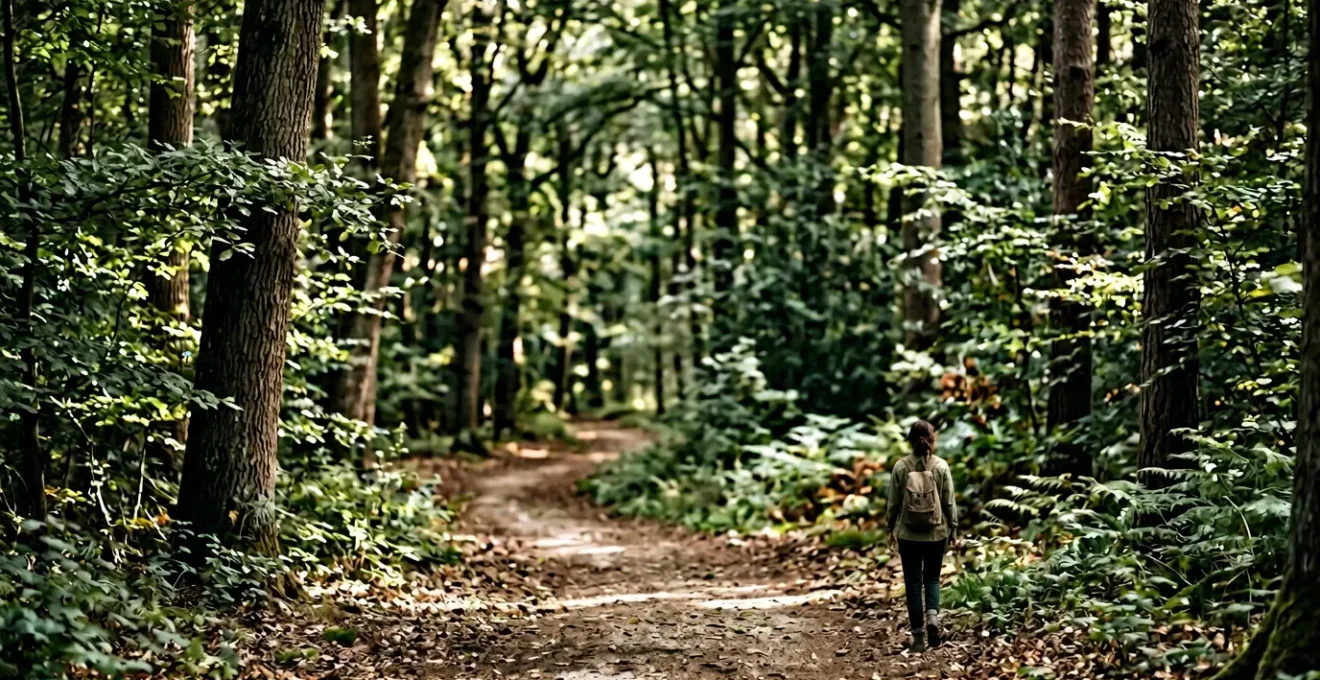
If walking meditation feels awkward, you’re not failing at mindfulness; you’re experiencing valuable bio-feedback. This discomfort often stems from a ‘stillness bias’ where the mind expects the calm of sitting, clashing with the body’s complex sensory input during movement. The key isn’t to force focus but to decode these signals, transforming the practice from a clumsy chore into a profound exploration of conscious motion.
You settle onto the cushion, and after a few minutes, the world melts away. Your breath is an anchor, the mind a calm sea. This is your sanctuary, a space of natural ease. Then, your teacher suggests a walking meditation. You stand up, and the simple act of putting one foot in front of the other feels profoundly awkward, even clumsy. The focus you held so easily in stillness shatters. Why does a practice designed for awareness feel so unnatural, so much like a performance?
For many meditators comfortable with stillness, this experience is disconcerting. You are not alone. The common advice— »just feel your feet on the ground »—often falls short because it ignores the deep-seated reason for this discomfort. We’ve implicitly trained our nervous systems to equate meditation with a lack of movement, creating what can be called a stillness bias. Any motion can then feel like a deviation, a mistake, rather than a new landscape for awareness.
But what if this awkwardness isn’t a sign of failure, but a signal of something deeper? What if it’s the very entry point to a more integrated form of practice? This article reframes that feeling of awkwardness not as a problem to be solved, but as a rich source of information. We will explore the neuro-somatic reasons why stillness can feel safer than movement, compare different entry points like Tai Chi and Qigong, and offer specific, patient techniques to transform mindless habits—from Sun Salutations to your daily commute—into genuine, flowing meditation.
Summary: Unlocking the Power of Movement in Your Meditation Practice
- Why Do Some Traditions Say Movement Meditation Goes Deeper Than Sitting Still?
- Why Does Sitting Still Make Some People More Anxious Instead of Less?
- Why Does Mindfulness Feel Like Another Thing on Your To-Do List Instead of Relief?
- How to Practice Walking Meditation in a Small Flat When It Is Raining Outside?
- Tai Chi, Qigong or Slow Flow Yoga: Which Movement Meditation Suits Beginners Over 50?
- How to Stay Present During Sun Salutations When the Sequence Becomes Mindless Habit?
- How to Add Pause Points for Internal Sensing Without Disrupting Your Vinyasa Flow?
- How to Transform Your Daily Commute Walk into Genuine Meditation Practice?
Why Do Some Traditions Say Movement Meditation Goes Deeper Than Sitting Still?
The Western perception of meditation often conjures an image of absolute stillness. Yet, many Eastern traditions, from Zen Buddhism’s *kinhin* (walking meditation) to the flowing forms of Taoism, consider conscious movement a potent, even superior, path to insight. The reason isn’t about replacing sitting but about integrating awareness into life itself. Stillness is a controlled environment; movement is the messy, unpredictable reality we inhabit. Practicing in motion is training for life off the cushion.
Scientifically, this isn’t just a philosophical stance. Movement practices are not « meditation-lite. » Research shows they actively reshape the brain. For instance, a 2024 systematic review confirms mindfulness and meditation induce neuroplasticity, strengthening neural pathways and even increasing cortical thickness. When movement is added, the benefits are compounded, engaging more of the brain’s resources.
This is because moving meditation isn’t just about mental focus; it’s a full-body dialogue. It challenges our proprioception (sense of body in space) and interoception (sense of internal states), creating a rich tapestry of sensation that is impossible to generate while sitting. As researchers have noted, practices that weave together motion and mindfulness have a unique neurological footprint.
Tai Chi and Qigong, traditional practices from China that integrate movement, breath management, and meditation, have been discovered to affect brain regions linked to motor control, balance, and emotional regulation.
– PMC Systematic Review Authors, Neurobiological Changes Induced by Mindfulness and Meditation
Ultimately, movement meditation challenges the « stillness bias » by demonstrating that awareness isn’t a fragile state that breaks upon moving. It’s a robust quality of mind that can be cultivated and sustained amidst the dynamic flow of existence, making it a powerful tool for resilience.
Why Does Sitting Still Make Some People More Anxious Instead of Less?
For many, the instruction to « sit still and be calm » is a gateway to peace. For others, it’s a trap. If you find that stillness amplifies your anxiety, you are not broken; your nervous system is simply reacting based on its own safety-detection system. The source of the awkwardness in walking may actually originate here: a deep-seated, somatic distrust of imposed stillness. To understand this, we can turn to the insights of Polyvagal Theory.
This theory proposes that our nervous system has different responses to perceived threats. When we feel safe, we are in a « ventral vagal » state—calm, connected, and social. When faced with a challenge, we might enter a « sympathetic » state (fight-or-flight). But there is a third state, the « dorsal vagal » response, which is one of freeze or shutdown. It’s a primal, immobilization response to overwhelming threat. For some, especially those with a history of anxiety or trauma, the body doesn’t differentiate between chosen stillness and this terrifying freeze state.
In this context, being forced to be still while the mind is racing with anxious thoughts can feel profoundly unsafe. The body interprets this confinement as a threat, triggering a feedback loop of more anxiety. As leading-edge trauma research explains:
For individuals with a history of trauma or high anxiety, the nervous system can interpret imposed stillness not as safety, but as the dorsal vagal freeze response—a state of immobilization in the face of perceived threat.
– Polyvagal Theory Research Consortium, Polyvagal Theory applications in trauma treatment
Movement, in this light, becomes a lifeline. A gentle, mindful walk or a slow, flowing Qigong sequence provides the nervous system with crucial evidence that it is not frozen or trapped. It proves that you have agency, that you can move, and that you are safe. This is why for some, movement isn’t an alternative to meditation; it is the prerequisite for feeling safe enough to be mindful in the first place.
Why Does Mindfulness Feel Like Another Thing on Your To-Do List Instead of Relief?
You’ve heard the promises: less stress, more presence, inner peace. So you add « Meditate for 10 minutes » to your daily to-do list, right between « Email CFO » and « Pick up groceries. » Instead of feeling relief, you feel pressure. Did I do it right? Did I focus enough? The practice, meant to be an antidote to our hyper-productive culture, becomes just another task to be optimized and completed. This is a common trap that transforms a tool of liberation into another gilded cage.
The root of this problem is a fundamental conflict between the nature of mindfulness and the mindset of modern society. Our culture conditions us to value activities based on their tangible, measurable outcomes. We work to earn money, exercise to lose weight, and study to get a grade. Mindfulness, however, has no « output » in this conventional sense. Its purpose is being, not doing. This creates a deep-seated cognitive dissonance, as explained by neuroscientists.
Modern culture has trained us to value activities based on their measurable output. Mindfulness has no ‘output,’ creating cognitive dissonance. The relief comes from the radical act of engaging in a ‘non-productive’ activity, consciously stepping outside the to-do list mindset.
– Mindfulness and Well-being Research, Cognitive neuroscience approaches to mindfulness meditation
The solution isn’t more discipline, but a radical shift in approach: from scheduled, achievement-based practice to incidental, curiosity-based awareness. Instead of carving out a formal time slot that feels like a chore, the goal is to weave micro-moments of mindfulness into things you are already doing. This dissolves the pressure and integrates awareness into the fabric of your life, rather than siloing it as another task.
You can start by shifting your focus. Instead of « I must meditate for 10 minutes, » try a gentler intention like, « I will be curious about the sensation of three breaths today. » Find moments of incidental mindfulness: notice the warmth of the water on your hands as you wash dishes, the taste of the first sip of coffee, or the feeling of your feet on the pavement as you walk to the car. By removing mindfulness from the to-do list, you allow it to become what it was always meant to be: a source of relief, not another metric of self-worth.
How to Practice Walking Meditation in a Small Flat When It Is Raining Outside?
The romantic image of walking meditation often involves a serene forest path or a sprawling Zen garden. The reality for many is a cramped apartment on a rainy day. This limitation, however, is not an obstacle but an opportunity to cultivate a more subtle and concentrated form of awareness. The practice of *kinhin*, or walking meditation in the Zen tradition, is perfectly adapted for small spaces, focusing on intense presence over a short distance.
You don’t need a long hallway. A clear path of just five to ten steps is more than sufficient. The goal is not to « go » anywhere but to explore the universe of sensation within each single step. The confinement of the space forces you to slow down and magnify your attention, turning a limitation into a tool for deepening the practice. Instead of focusing on the destination, your entire world becomes the feeling of your foot lifting, moving through space, and connecting with the floor.
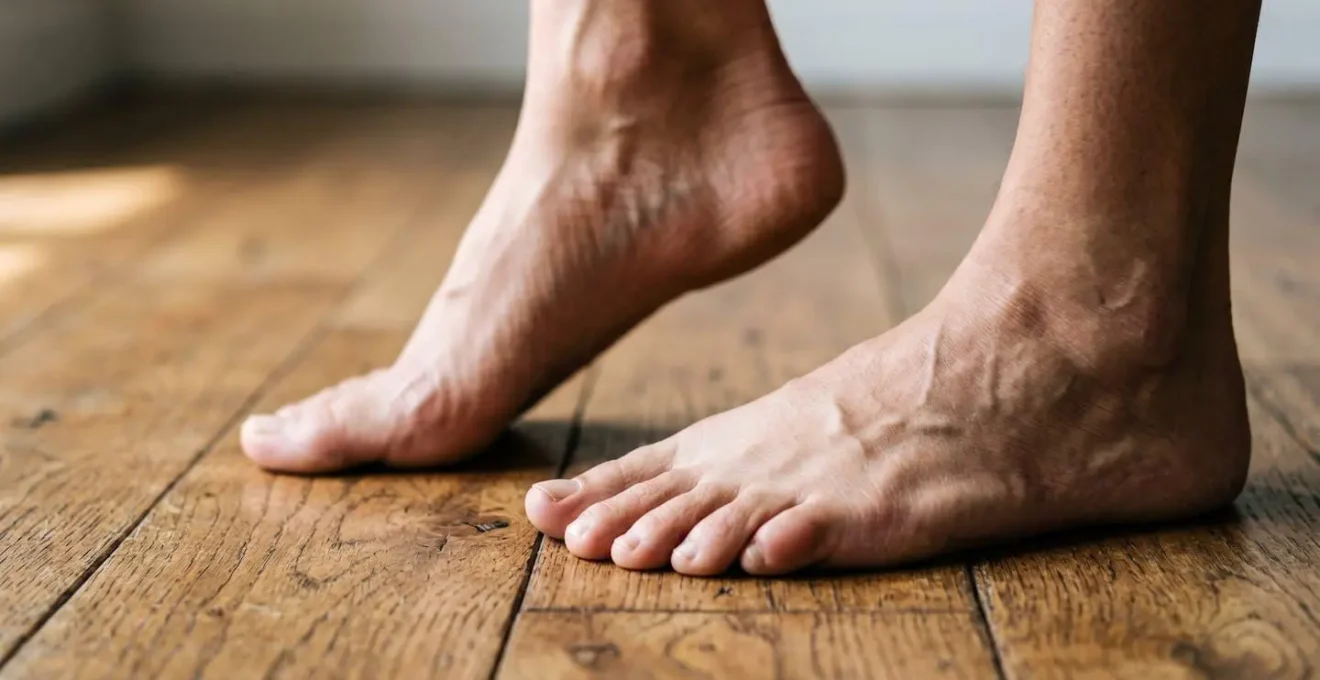
To begin, find a clear lane in your home. It could be between your sofa and the wall, or in a hallway. The key is to create a simple, uncluttered path where you can walk back and forth without thinking about navigation. The practice is about the quality of attention, not the distance traveled. Here is a simple sequence to follow:
- Establish Presence: Before you begin, stand still at one end of your path for a moment. Feel the contact of your feet on the floor. Take a few deep breaths and set the intention to be fully present for the duration of the walk.
- Walk Methodically: Begin walking very slowly. Coordinate your breath with your steps if it helps—perhaps one step on the in-breath, one on the out-breath. The primary focus is on the raw physical sensations in your feet and legs, observing them without judgment.
- Turning with Intention: When you reach the end of your path, pause. Turn slowly and deliberately. Notice the shift in balance and the different muscles involved. This turn is as much a part of the meditation as the walking.
- Concluding the Practice: When you are ready to end, stand still again for a moment. Feel the echo of the movement in your body. Acknowledge the practice and consider carrying this heightened awareness into your next activity.
This indoor practice transforms your home from a container into a cloister. It proves that the depth of your meditation is not determined by the grandeur of your surroundings, but by the precision of your attention.
Tai Chi, Qigong or Slow Flow Yoga: Which Movement Meditation Suits Beginners Over 50?
For individuals over 50 seeking to start a movement meditation practice, the landscape of choices—from Tai Chi to Yoga—can be overwhelming. The « best » practice is highly personal, but understanding the distinct focus of each can guide you to a suitable starting point. The goal is not just physical exercise but finding a modality that supports both body and mind, is sustainable, and addresses common concerns like balance, flexibility, and mental calm.
Tai Chi and Qigong, both ancient Chinese practices, are often recommended for their gentle, low-impact nature. They are particularly effective for older adults. A comprehensive review of 36 randomized controlled trials involving nearly 3,800 participants found that these practices significantly improve balance, reduce falls, enhance cardiovascular health, and boost psychological well-being. Slow Flow Yoga, while sharing a focus on breath and body, brings its own unique character to the table.
The key difference lies in their primary cognitive focus and complexity. Qigong is often the most accessible, emphasizing simple, repetitive movements synchronized with the breath. Tai Chi involves learning and memorizing longer, more complex sequences (forms), demanding greater spatial awareness. Slow Flow Yoga places its primary emphasis on the synchronicity of breath with a series of distinct postures (*asanas*). Your temperament and goals can help you choose.
To help clarify the choice, consider this comparison based on an analysis of their cognitive demands:
| Practice | Primary Cognitive Focus | Mental-Physical Ratio | Best For | Learning Complexity |
|---|---|---|---|---|
| Qigong | Simplicity & Repetition | High internal focus, simple external movements | Calming an overactive mind, lowest cognitive load | Low – Easiest to learn |
| Slow Flow Yoga | Breath-Body Synchronicity | Balanced ratio of breath and precise postures | Deepening breath awareness from a sitting practice | Moderate – Requires coordination |
| Tai Chi | Spatial Awareness & Flow | High mental focus on a complex form and internal flow | Those who enjoy memorizing sequences | High – Most demanding for beginners |
For a true beginner seeking the gentlest entry point to calm a busy mind, Qigong is often an ideal start. For those coming from a sitting meditation practice who want to explore the breath-body connection more deeply, Slow Flow Yoga is a natural bridge. For those who enjoy a mental challenge and the satisfaction of mastering a graceful, flowing form, Tai Chi offers a path of lifelong learning.
Key Takeaways
- The awkwardness you feel in walking meditation is not failure; it’s valuable somatic data revealing a ‘stillness bias’.
- For some nervous systems, imposed stillness can mimic a ‘freeze’ response, making gentle movement a prerequisite for mindful safety.
- Shift from ‘achievement-based’ scheduled meditation to ‘curiosity-based’ incidental awareness in daily activities to avoid to-do list pressure.
How to Stay Present During Sun Salutations When the Sequence Becomes Mindless Habit?
The Sun Salutation (*Surya Namaskar*) is a cornerstone of many yoga practices—a beautiful, flowing sequence that links breath and movement. But for the dedicated practitioner, a common challenge arises: the sequence becomes so ingrained that the mind checks out. It turns from a moving meditation into a mindless warm-up, an automated habit performed on autopilot. This is a classic example of the brain’s efficiency working against our intention for presence.
To break this pattern, you don’t need a new sequence; you need new ways of paying attention within the one you already know. The key is to intentionally disrupt the autopilot. Instead of trying to « focus harder, » which often creates more mental tension, you can introduce small, deliberate « glitches » into the system. These novel constraints force the mind to re-engage with the present moment and experience the familiar sequence in a completely new way.
This involves shifting your attention from the large, gross movements to the subtle, transitional moments that are typically overlooked. It’s about making the journey between the poses as important as the poses themselves. By deconstructing the flow or isolating your sensory input, you can transform a mindless habit back into a rich field of exploration.
Action Plan: Reclaiming Presence in Your Sun Salutations
- Deconstruction Method: Intentionally break the sequence. Choose one pose in the flow (e.g., Downward-Facing Dog) and pause there for three full, conscious breaths. Feel the « after-image » of the pose in your body before moving to the next one. This shatters the seamless, mindless flow.
- Sensory Round-Robin: Dedicate each full round of the sequence to a single sense. In Round 1, focus only on the sound of your breath. In Round 2, bring your entire awareness to the points of contact between your body and the mat. In Round 3, notice only the sensation of the air on your skin.
- Intentional Transition Cues: Make the transitions the main event. As you move from Plank to Chaturanga, for example, use a silent verbal cue like, « Now, I feel my core engage as I lower. » This transforms the mindless « in-between » moments into deliberate, mindful actions.
- Embrace Micro-Pauses: Instead of flowing continuously, find moments to pause for a single exhale. For instance, hold completely still for the full duration of your exhale while in a lunge, feeling the pose deepen, before continuing the flow on the inhale.
- Reverse the Flow: If you are very familiar with the sequence, try performing it in reverse (where safe and possible). This completely short-circuits the brain’s automatic pattern recognition and demands 100% of your attention.
By using these techniques, you are not just performing a Sun Salutation; you are actively investigating it. You are using the familiar structure as a laboratory for your own awareness, ensuring the practice remains a source of presence rather than a mindless routine.
How to Add Pause Points for Internal Sensing Without Disrupting Your Vinyasa Flow?
In a dynamic Vinyasa class, the continuous flow of movement can be exhilarating, but it can also feel like there’s no time to « go inside. » The emphasis on synchronizing breath with movement can sometimes leave little room for the deep, internal sensing—or interoception—that is at the heart of meditation. The challenge is to find moments of stillness and reflection without losing the rhythm of the class or disrupting the flow. The secret is not to stop the flow, but to find the pauses that already exist within it.
These pauses are not full stops but « micro-moments » of heightened awareness. Instead of thinking of a pause as an absence of movement, reframe it as a moment of deep listening. It’s about learning to feel the echo of a pose, the subtle shift of balance, or the turn of the tide from inhale to exhale. This requires a shift in perspective, from a goal-oriented mindset (« getting to the next pose ») to a process-oriented one (« feeling this exact moment of transition »).
You can cultivate this by subtly altering how you approach the practice, using techniques that are almost invisible to an outside observer but transform your internal experience. Here are three ways to weave internal sensing into a continuous flow:
- Make the Transition the Pause: The moment of greatest instability is often the richest for proprioceptive feedback. Instead of rushing through the transition from Warrior II to Triangle, for example, slow it down and pause for a split second right in the middle. Feel the exact moment your weight shifts and your balancing muscles fire. The transition itself becomes the point of mindful inquiry.
- Use the Full Exhale as a Pause Point: Your breath provides a natural, rhythmic opportunity for stillness. In any given pose, decide to remain completely motionless just for the duration of one complete exhalation. As you breathe out, feel the body gently release and settle. This creates a breath-centered moment of deep sensing without breaking the overall pace.
- Introduce Micro-Pulsing Within Poses: Instead of holding a pose rigidly, introduce a tiny, almost imperceptible rhythmic pulse. In Warrior II, you might add a gentle, half-inch pulse in your front knee, synchronized with your breath. Each pulse acts as a mini « check-in, » a moment to feel the engagement in your legs and the grounding through your feet. This cultivates interoceptive awareness, the foundational skill of sensing the body’s internal state.
By integrating these subtle techniques, you can transform a fast-paced Vinyasa class into a profound internal journey. You learn to surf the wave of the flow while simultaneously diving deep into the ocean of your own sensory experience.
How to Transform Your Daily Commute Walk into Genuine Meditation Practice?
The idea of transforming a mundane daily commute into a spiritual practice is appealing, but the reality can be daunting. The constant sensory input of a busy street—traffic noise, crowds, and unexpected obstacles—seems like the antithesis of a calm, meditative state. Attempting to maintain unbroken mindfulness for a 20-minute walk is an unrealistic goal that often leads to frustration and a sense of failure. The key to success is not to attempt constant mindfulness but to practice sustainable mindfulness intervals.
Instead of trying to be mindful for the entire walk, you give yourself « micro-doses » of awareness. This approach is more realistic, less pressure-filled, and ultimately more effective for building the muscle of attention in a distracting environment. You are not trying to block out the world; you are learning to consciously choose what you pay attention to, for short, manageable periods.
The practice shifts from a rigid « meditation » to a playful « curiosity practice. » Set a simple goal: to notice one thing on your route that you have never observed before. It could be the pattern of bricks on a building, the way the wind feels at a certain street corner, or the specific sound a traffic light makes. This reframes the walk from a task (getting from A to B) to an exploration. Here’s a practical way to structure it:
- Practice Mindfulness Intervals: Walk normally for the first three minutes, letting your mind wander as it usually does. Then, for the next 60 seconds, intentionally choose a single sensory anchor. It could be the feeling of your feet on the pavement, the sounds of the city, or the colors of the cars passing by. After that minute, release the focus and walk normally again. Repeat this cycle.
- Use External Anchors: In a busy environment, internal anchors like the breath can be easily lost. Use the environment itself as your anchor. For one minute, focus only on noticing the color red. For the next, focus on the sensation of wind on your skin. These external anchors are robust enough to cut through the noise.
- Build Awareness Gradually: Start with just one or two 60-second intervals on your commute. The goal is to finish feeling successful and curious, not exhausted and defeated. Over time, you can gradually increase the duration or frequency of the intervals as your capacity for sustained attention grows naturally.
This approach respects the reality of a busy life and a busy world. It acknowledges that our attention is a finite resource. By practicing in these short, intentional bursts, you build a resilient form of mindfulness that can be deployed anywhere, anytime, transforming the most mundane parts of your day into opportunities for genuine presence.
Start today. On your next walk, whether it’s to the corner store or the train station, decide to be curious for just 60 seconds. Don’t try to be a meditator; just be an observer. This is the first, most powerful step in transforming your daily commute from a mindless rush into a profound and restorative practice.