In summary:
- Mindfulness can trigger anxiety because a chronically stressed nervous system misinterprets stillness as a threat.
- The solution isn’t trying harder, but integrating « micro-doses » of awareness into existing daily routines like making tea or commuting.
- Shift the goal from achieving a « clear mind » to simply noticing your experience—including frustration—with self-compassion.
- Success is measured not by perfect meditation sessions, but by real-world changes like a shorter « stress hangover » and better listening.
You’ve read the articles, downloaded the apps, and dutifully tried to “just sit and breathe.” Yet, instead of the promised calm, you feel a rising tide of anxiety, a mental to-do list screaming for attention, or the nagging sense that you’re “failing” at relaxing. For many stressed professionals, the well-intentioned advice to practice mindfulness backfires, becoming yet another metric of self-improvement to fall short on. It’s a frustrating paradox: the supposed cure for stress feels like another source of it.
The common approach often revolves around carving out dedicated time, following guided meditations, and focusing intently on the breath. While these methods can be effective, they overlook a crucial piece of the puzzle. They don’t address *why* sitting still can feel so agitating or why trying to be « present » feels like an impossible task when your mind is racing. The pressure to perform mindfulness perfectly transforms it from a tool of liberation into a cage of self-criticism.
But what if the entire framework is wrong? What if the key isn’t about adding another formal practice to your already packed schedule, but about fundamentally shifting your approach? This guide proposes a more realistic, unburdening path. It’s not about achieving a state of perfect Zen-like silence. It’s about learning to work *with* your nervous system, not against it, by repurposing moments you already have throughout your day.
We will explore the neuroscience behind why traditional mindfulness can increase anxiety, offer pragmatic ways to integrate awareness into daily actions without adding any extra time, and provide tools to dismantle the perfectionism that sabotages your efforts. This is about transforming mindfulness from a chore into a genuine, accessible form of relief.
Summary: A Practical Guide to Reclaiming Your Calm
- Why Does Sitting Still Make Some People More Anxious Instead of Less?
- How to Practice Mindfulness While Making Tea Without Adding Any Extra Time?
- Headspace, Local Classes or MBSR Course: Which Mindfulness Path Suits a Sceptical Beginner?
- When Trying to Be Mindful Perfectly Becomes Another Source of Self-Criticism
- How Do You Know if Your Mindfulness Practice Is Actually Working After 3 Months?
- How to Build a 5-Minute Daily Practice That Prevents Stress from Accumulating?
- How to Transform Your Daily Commute Walk into Genuine Meditation Practice?
- Why Does Your Relaxation Savasana Feel More Anxious Than Your Morning Commute?
Why Does Sitting Still Make Some People More Anxious Instead of Less?
If you’ve ever sat down to meditate only to feel your heart rate climb and your thoughts spiral, you are not alone, and it’s not a personal failing. It’s a physiological response. For a brain and body accustomed to high-stress environments and constant stimulation, the sudden removal of external distractions can be profoundly unsettling. Your nervous system, hardwired for threat detection, can misinterpret this abrupt quiet as a danger signal, triggering a low-grade fight-or-flight response. The very act designed to calm you down ends up putting your system on high alert.
The science behind this involves a part of the brainstem called the locus coeruleus. This area is the principal site for synthesising norepinephrine, a neurotransmitter that governs our state of arousal and vigilance. In individuals with chronic stress or anxiety, this system can become hyper-responsive. As neuroscience research confirms, sustained stress responses associated with locus coeruleus-norepinephrine hyper-responsivity contribute directly to conditions like chronic anxiety and fear. When you try to be still, this over-sensitized system doesn’t power down; instead, with no external problem to solve, it turns its threat-scanning lens inward, amplifying anxious thoughts and physical sensations.
When external distractions are removed, a nervous system accustomed to constant stimulation can misinterpret the sudden quiet as a threat, triggering a fight-or-flight response.
– Neuroscience research on anxiety and stress, MDPI Molecular Basis of Anxiety review 2014-2024
Understanding this biological reality is the first step to a more compassionate practice. The goal is not to force stillness upon a resistant nervous system, but to gently retrain it. Instead of starting with ten minutes of silent meditation, which can feel like an eternity, the key is to begin with « micro-doses » of awareness integrated into activities your body already perceives as safe and routine.
How to Practice Mindfulness While Making Tea Without Adding Any Extra Time?
The most effective way to begin a mindfulness practice is not to add a new task, but to repurpose an existing one. The daily ritual of making a cup of tea or coffee is a perfect opportunity. It’s a self-contained, multi-sensory event that lasts only a few minutes, providing a structured container for your attention. The goal isn’t to do it perfectly or achieve enlightenment over a kettle; it’s simply to anchor your awareness in the physical sensations of the moment, offering a brief respite from the endless stream of mental chatter.
Instead of scrolling through your phone or running through your morning’s agenda while the kettle boils, try a simple « Five Senses » ritual. This isn’t about adding time; it’s about changing the quality of the time you’re already spending. It gently guides your focus away from abstract worries and grounds you in the tangible reality of the present. This practice helps to signal to your nervous system regulation that it’s safe to be present.

As you can see in this moment of quiet, the focus is on the simple, tactile experience. You can bring this level of awareness to your own routine with the following steps:
- Sound: Notice the sound of the kettle starting to boil, the bubbling water, and the distinct click as it finishes. Pay attention to the clink of the mug and the splash of water.
- Sight: Watch the steam rising from the kettle and the mug. Observe the colour of the tea as it infuses the water, noticing how the hues change and deepen.
- Smell: As the tea steeps, consciously breathe in its aroma. Let the scent be an anchor, pulling your full attention to this single sensory experience.
- Touch: Feel the comforting warmth of the mug in your hands. Notice its weight, the texture of the ceramic, and the heat radiating into your palms.
- Taste: Take the first sip with intention. Notice the temperature on your tongue, the complex flavours, and the lingering aftertaste.
Headspace, Local Classes or MBSR Course: Which Mindfulness Path Suits a Sceptical Beginner?
Once you’ve decided to explore mindfulness more formally, the sheer number of options can be overwhelming and become another source of decision fatigue. From sleek apps promising calm in 10 minutes to intensive, clinically-backed courses, the right path depends entirely on your personality, budget, time constraints, and what you’re hoping to achieve. For the sceptical but curious professional, understanding the key differences is crucial to making a choice that you’ll actually stick with.
Apps like Headspace and Calm are fantastic for their flexibility and accessibility. They are designed for the time-poor individual, offering structured, bite-sized courses that can be done anywhere. They excel at teaching the basics in a non-intimidating way. However, they lack the accountability and personalised feedback of in-person guidance. Local meditation classes fill this gap, providing a sense of community and the chance to ask questions in real-time. The fixed schedule can be a powerful motivator for those who struggle with self-discipline.
At the other end of the spectrum is the Mindfulness-Based Stress Reduction (MBSR) course. This is the gold standard, an 8-week, evidence-based program often recommended by the NHS for chronic stress and anxiety. It’s a significant commitment of time and money, but it offers the most profound, science-backed intervention. Choosing the right entry point is about being realistic. If a £400, 8-week course feels too daunting, it’s better to build consistency with a £10/month app than to do nothing at all.
To help clarify these options, this comparison table breaks down the key features of each path, as detailed in a recent comparative analysis.
| Option | Best For | Cost (2024) | Time Commitment | Key Strengths |
|---|---|---|---|---|
| Headspace App | Tech-savvy, time-poor professionals | $12.99/month or $69.99/year | 5-20 min/day, flexible | Structured courses, beginner-friendly interface, 4.8/5 rating |
| Calm App | Those prioritizing sleep and relaxation | Similar pricing to Headspace | 3-25 min sessions, flexible | Extensive sleep stories, breathing animations, 4.8/5 rating |
| Local Meditation Classes | Those needing community accountability | Variable, mid-range | 1-2 hours/week, fixed schedule | In-person support, social connection, real-time guidance |
| MBSR 8-Week Course | Seeking evidence-based clinical intervention | Significant investment (varies by provider) | 2.5 hours/week + daily home practice | Science-backed, often NHS-recommended, proven effectiveness for chronic stress/anxiety |
When Trying to Be Mindful Perfectly Becomes Another Source of Self-Criticism
For high-achieving professionals, the biggest obstacle in mindfulness isn’t the technique; it’s the mindset. We bring the same results-driven, perfectionistic attitude that serves us well in our careers to the meditation cushion, and it’s a recipe for failure. When our minds wander (which they are biologically programmed to do), we label it as a mistake. When we don’t feel instantly calm, we see it as a lack of discipline. Mindfulness becomes just another performance review, and the inner critic has a field day. This is the point where most people give up, concluding « it doesn’t work for me. »
The antidote to this is not more effort, but more compassion. Mindful self-compassion is the missing ingredient for a sustainable practice. It’s the radical act of treating yourself with the same kindness and understanding you would offer a friend who is struggling. It means acknowledging that learning this is hard, that minds wander, and that feeling frustrated is a normal part of the process. It reframes the « goal » of mindfulness from achieving a perfect state to simply returning your attention, gently and without judgment, again and again.
Self-compassion is simply the process of turning compassion inward. We’re kind and understanding rather than harshly self-critical when we fail, make mistakes, or feel inadequate.
– Dr. Kristin Neff, Self-Compassion official website
This isn’t just a feel-good idea; it has a measurable impact. In fact, research on perfectionism demonstrates that as self-compassion increases, the negative psychological effects of perfectionism decrease. When you notice your inner critic taking over, try this simple three-step reset adapted from the work of Dr. Kristin Neff:
- Mindfulness (Acknowledge): Notice the frustration without judgment. Silently say to yourself: ‘This is a moment of frustration’ or ‘This is hard right now’.
- Common Humanity (Normalize): Remind yourself you’re not alone. Say: ‘Many people trying to meditate feel the exact same way’ or ‘Struggle is part of learning something new’.
- Self-Kindness (Comfort): Place a hand over your heart or another soothing place. Say to yourself: ‘May I be kind to myself in this moment’.
How Do You Know if Your Mindfulness Practice Is Actually Working After 3 Months?
One of the most common reasons people abandon mindfulness is a mismatch of expectations. We anticipate a linear progression towards a blissful, stress-free state. The reality is far more subtle and non-linear. Progress isn’t measured by how long you can sit without a thought, but by small, tangible shifts in your daily life. After about three months of consistent, even if imperfect, practice, you should start looking for these real-world indicators rather than judging the quality of your formal sessions.
The first sign is often the emergence of « the gap. » This is the tiny space of awareness that opens up between a trigger—a critical email from your boss, a delayed train on your commute—and your habitual, knee-jerk reaction. You might still feel the flash of anger or anxiety, but you notice it before you act on it. This micro-second of awareness is a monumental victory. It’s the moment you reclaim your power of choice. Another key marker is increased physical awareness; you start to notice when you’re clenching your jaw or holding your breath and can consciously choose to release that tension.
Don’t expect your mind to become a tranquil pond. As a 2024 qualitative study published in Frontiers in Psychology found, the benefits of mindfulness develop gradually and can even continue to emerge long after a formal course ends. Progress is often a collection of small moments. It’s noticing the taste of your lunch instead of eating on autopilot, or fully listening to a colleague without mentally planning your reply while they’re still speaking. Look for эти subtle but profound markers of change:
- The Gap: You notice a small space between a trigger and your reaction.
- Faster Recovery: Your ‘stress hangover’ after a difficult meeting is noticeably shorter than it used to be.
- Emotional Labeling: You can mentally name an emotion (‘Ah, there’s anxiety’) rather than being completely swept away by it.
- Sensory Awakening: You genuinely notice the feeling of the sun on your skin or the changing seasons during your walk to the station.
- Improved Listening: You find yourself more present in conversations, catching your mind when it starts to wander.
How to Build a 5-Minute Daily Practice That Prevents Stress from Accumulating?
The secret to a sustainable mindfulness practice isn’t willpower; it’s clever design. For busy people, the most effective method is « habit stacking, » a concept popularised by author James Clear. Instead of trying to create a new habit from scratch, you anchor the new behaviour (a mindful moment) to an existing, deeply ingrained one. The formula is simple: « After/Before [current habit], I will [new mindful habit]. » This removes the friction of remembering to practice and integrates it seamlessly into the flow of your day.
A five-minute practice doesn’t need to be a single, unbroken session. It can be a series of one or two-minute « mindfulness micro-doses » sprinkled throughout your day. A two-minute breath awareness exercise upon waking, followed by a three-minute sensory focus while your coffee brews, already constitutes your five minutes. The key is consistency, not duration. This approach is backed by science; research published in Scientific Reports found that an intervention of just 10 minutes of daily mindfulness meditation showed significant improvements in cognitive flexibility and reduced perceived stress.
The goal is to create small pockets of pause that prevent stress from compounding. By repeatedly bringing yourself back to the present moment, even for 60 seconds, you interrupt the autopilot mode where stress and anxiety thrive. Use this habit stacking formula to design your own five-minute practice:
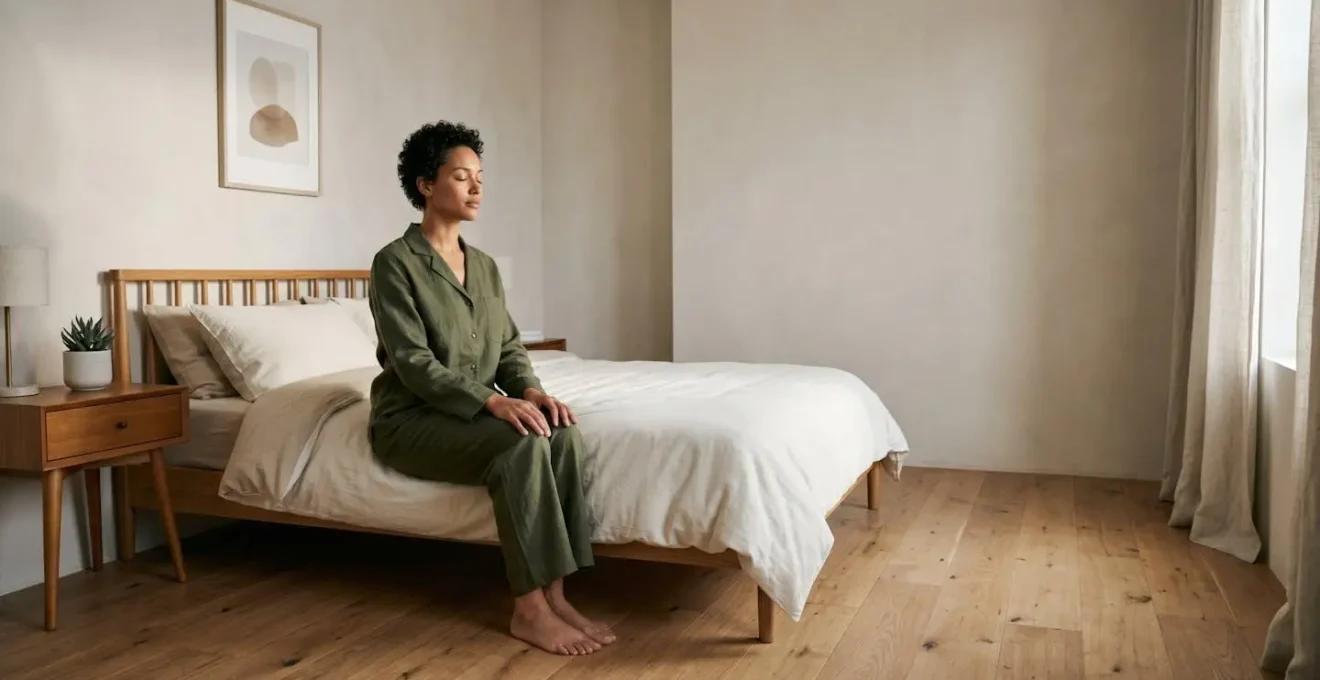
- After my morning alarm goes off, I will sit on the edge of my bed and notice the sensation of my feet on the floor for 1 minute before checking my phone.
- While the kettle boils for my morning tea, I will practice the Five Senses awareness exercise for 3 minutes.
- Immediately after sitting down at my desk, I will take three conscious breaths before opening my email.
- Before I start eating my lunch, I will take five mindful breaths to create a separation between morning stress and my break.
How to Transform Your Daily Commute Walk into Genuine Meditation Practice?
For most of us, the daily commute is dead time—a necessary evil spent on autopilot, often with headphones in to block out the world. But this walk to the train station or from the car park to the office is a golden opportunity for mindfulness practice in motion. Walking meditation isn’t about walking unusually slowly or looking beatific; it’s simply about shifting your attention from your internal world of thoughts and worries to your external world of sensory experience, one step at a time.
The beauty of this practice is that it requires no extra time and no special equipment. It transforms a mundane part of your day into a moment of grounding and presence. Instead of arriving at your destination already wound up by replaying a conversation or pre-worrying about a meeting, you can arrive feeling more centred and aware. The key is to approach it with curiosity, not judgment. Your mind will wander—to your shopping list, to a work problem—and that’s okay. The practice is simply to notice the wandering and gently guide your attention back to the physical sensations of walking.
This practice is about broadening your awareness. Instead of a laser-like focus, which can feel intense, think of it as a soft, panoramic awareness. You are simply receiving the data from your senses without getting hooked by any single piece of it. This helps train your mind to be less reactive and more observant, a skill that is directly transferable to high-pressure situations at work.
Your Action Plan: 5-Minute Urban Walking Meditation
- Grounding (Minute 1): Focus exclusively on the physical sensation of your feet connecting with the pavement. Notice the feeling of your heel striking the ground, the transfer of weight across your foot, and the final push-off from your toes. Feel the rhythm of your own gait.
- Sounds (Minute 2): Open your awareness to the full soundscape around you. Hear the traffic, distant voices, birds, the rustle of your own clothing. Receive these sounds as pure auditory information, without labelling them « good, » « bad, » « annoying, » or « pleasant. »
- Sights (Minute 3): Soften your gaze and notice the colours, shapes, and textures around you. See the light reflecting off windows, the different shades of green in a tree, the architectural details of a building. Let the visual world come to you instead of actively seeking it out.
- Sensations (Minute 4): Shift your attention to the feeling of the air on your exposed skin. Is it cool or warm? Is there a breeze? Notice the weight of your bag on your shoulder or the feeling of your coat against your arms as you move.
- Integration (Minute 5): For the final minute, try to hold all your senses in an open, gentle awareness. Simultaneously feel your feet on the ground, hear the city sounds, see the visual field, and feel the air on your skin. Experience the full panorama of walking.
Key takeaways
- The goal of mindfulness is not to stop your thoughts, but to stop being controlled by them.
- Consistency over intensity is the key; a 2-minute daily practice is more powerful than a 1-hour weekly session.
- Self-compassion is a non-negotiable part of the practice; treat your wandering mind with kindness, not criticism.
Why Does Your Relaxation Savasana Feel More Anxious Than Your Morning Commute?
You’ve made it through a dynamic yoga class. You’re physically tired but mentally buzzing. Then comes Savasana, the final relaxation pose. You lie down, and instead of blissful release, your heart starts to pound, your mind races, and you feel more agitated than you did on the packed train that morning. This experience, known as post-exertion anxiety, is surprisingly common and deeply rooted in physiology. It’s the same principle as feeling anxious in a quiet room, but amplified.
During a vigorous yoga practice, your heart rate is elevated, your muscles are engaged, and your nervous system is in an activated, sympathetic state. The sudden instruction to lie completely still and « let go » can be a shock to the system. This rapid downshift from high stimulation to total stillness can be misinterpreted by a sensitized nervous system as a threat, triggering a surge of anxiety. It’s a physiological rebound effect, not a sign that you are « bad at relaxing. »
After a dynamic yoga practice, the sudden drop in heart rate and external stimulation can be interpreted by a sensitized nervous system as a danger signal, triggering anxiety. It’s a physiological response, not a failure to relax.
– Neurobiological research on post-exertion anxiety, PNAS study on the neurobiology of stress
Rather than fighting this feeling, you can work with your body by providing it with signals of safety. This means making small modifications to your Savasana to ease the transition for your nervous system. The goal is to provide physical grounding and reduce the sense of vulnerability that can come with complete stillness and closed eyes. Try these adjustments:
- Use Weight: Ask for a folded blanket or a bolster to place over your abdomen or hips. The gentle pressure provides calming proprioceptive input, which is deeply reassuring to the nervous system.
- Bend Your Knees: Instead of lying with legs straight, try bending your knees and placing your feet flat on the floor, allowing your knees to knock in against each other. This releases the lower back and can feel more grounding.
- Keep Eyes Softly Open: If closing your eyes feels too vulnerable, don’t. Keep them slightly open with a soft, unfocused gaze on the ceiling.
- Focus on Grounding Points: Deliberately shift your attention to the solid, unmoving points of contact between your body and the floor—the weight of your heels, the back of your head, your shoulder blades.
Your journey into mindfulness doesn’t have to be another item on your to-do list. It begins not with a perfect, hour-long meditation, but with the next cup of tea you make or the next walk you take. The real practice is about reclaiming these small, scattered moments and meeting them with awareness and kindness, transforming the mundane into the meaningful. Start with one single moment today.