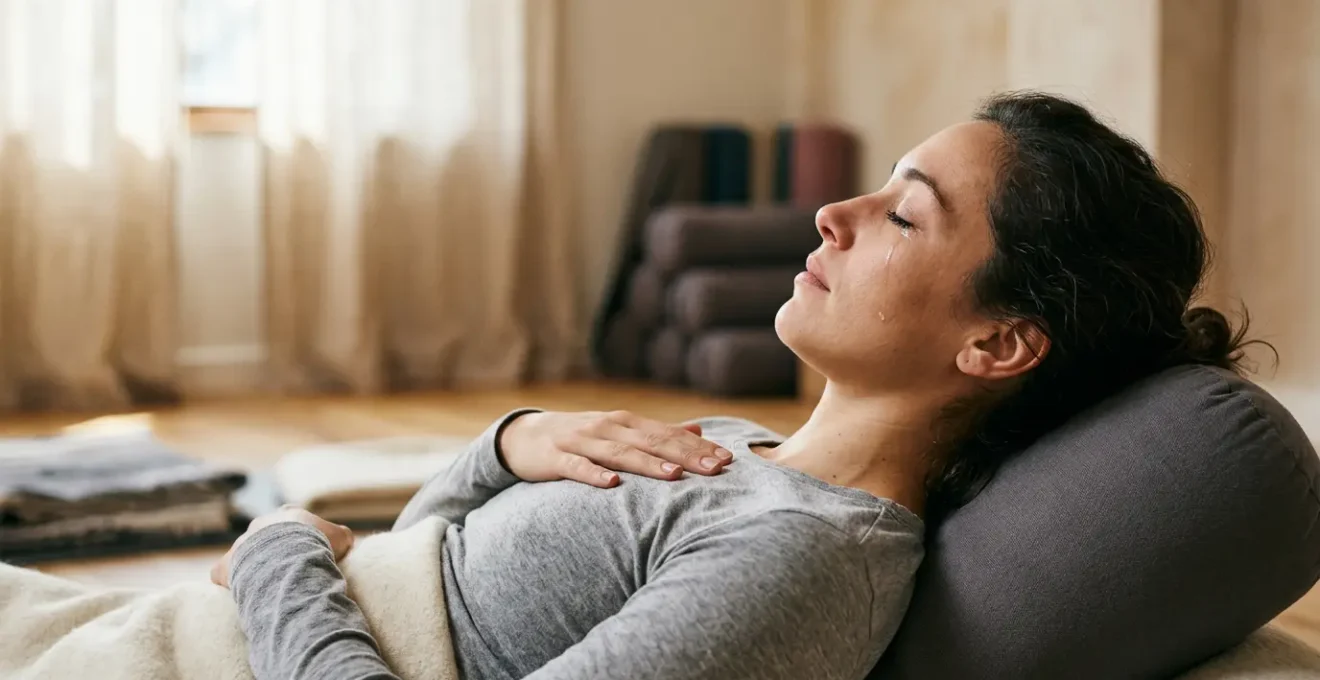
Crying in restorative yoga is not a sign that something is wrong; it’s a physiological signal that your body has finally achieved a state of profound safety, allowing accumulated stress and emotion to be processed and released.
- Your nervous system constantly scans for threat (a process called neuroception). True rest only happens when it perceives absolute safety.
- Restorative yoga, when done correctly with total support, removes the physical « work » of holding yourself up, sending powerful safety cues to your brain.
Recommendation: Instead of questioning the tears, view them as evidence that your practice is working. You are creating the conditions for your body’s innate capacity for healing to emerge.
You are settled into a nest of bolsters and blankets, perfectly supported in a restorative yoga pose. You are not sad, you are not upset, and nothing is overtly « wrong. » Yet, you feel tears welling up in your eyes, maybe even streaming down your temples. This experience is deeply confusing for many practitioners. The common advice—that you’re releasing « stored trauma » or « unprocessed emotions »—can feel both vague and slightly alarming. While there’s truth to it, it misses the most crucial part of the story: the profound shift happening within your nervous system.
The emotional release you feel is not the goal of the practice; it is a byproduct. It’s a testament to the fact that you have successfully created an environment of such deep physiological safety that your body’s guarding mechanisms can finally stand down. The tears are a sign of release, not of distress. They are the exhale your nervous system has been waiting to take, perhaps for a very long time. This isn’t about forcing a catharsis, but about understanding the science of surrender.
This article will guide you through the neuro-somatic reasons behind this phenomenon. We will explore what happens in your nervous system when you stop holding yourself up, how to use props to signal absolute safety to your body, and why the stillness of restorative yoga can sometimes feel more challenging than the most demanding active pose. By understanding the « why, » you can approach your practice with more confidence, compassion, and self-awareness.
To navigate this in-depth exploration, the article is structured to build your understanding from the ground up, from the foundational mechanics of your nervous system to the practical application in your yoga practice.
Summary: The Science and Soul of Release in Restorative Yoga
- What Happens in Your Nervous System When You Stop Holding Yourself Up?
- How to Position Bolsters and Blankets So You Actually Stop Working in Restorative Poses?
- Restorative Yoga or Yin Yoga: Which Is Better for Nervous System Recovery?
- Why 3 Restorative Poses Held for 15 Minutes Each Beat 10 Poses Held Briefly
- When in the Evening Should You Practice Restorative Yoga for Best Sleep?
- Why Your Body Goes Numb During Certain Yoga Poses and What It Might Mean
- Round or Rectangular Bolster: Which Shape Supports Your Lower Back Better in Reclined Poses?
- Why Does Lying Still in Restorative Yoga Feel Harder Than Holding Difficult Poses?
What Happens in Your Nervous System When You Stop Holding Yourself Up?
The first thing to understand is that your nervous system is a powerful, silent guardian. Through a subconscious process called neuroception, it constantly scans your internal and external environment for cues of safety or danger. According to Polyvagal Theory, this process sorts your experiences into one of three primary autonomic states: the safe and social state (ventral vagal), the fight-or-flight response (sympathetic), and the freeze or shutdown state (dorsal vagal). For most of us, modern life keeps the sympathetic system on a low-grade simmer, always ready for a perceived threat.
When you practice restorative yoga, the goal is to provide your neuroception with overwhelming evidence of safety. You are not simply resting; you are actively signaling to your body that it is safe to downregulate. As pioneering researcher Stephen Porges explains, this is not a conscious choice. Feelings of safety are a direct result of your nervous system perceiving safety cues, which then allows it to switch off threat reactions and turn on functions of health, growth, and restoration.
The moment you stop using your muscles to hold yourself in position—when the props take over 100% of the work—is the moment your brain receives a clear signal: « No effort is required. No threat is present. You can stand down. » This is the gateway to the ventral vagal state. In this state, your heart rate slows, your breathing deepens, your digestive system comes online, and the physiological backdrop for emotional processing is established. The tears are often the first physical sign that this profound internal shift has occurred.
How to Position Bolsters and Blankets So You Actually Stop Working in Restorative Poses?
The secret to signaling absolute safety to your nervous system lies in a simple but non-negotiable rule: the « No-Gap Principle. » This means that from the moment you settle into a pose, every part of your body should feel completely and utterly supported. If there is even a small gap—under your neck, behind your knees, in the curve of your lower back—your proprioceptive system will send a subtle signal to your brain, and a small group of muscles will remain engaged to « hold » you. This low-level effort, however minor, is enough to tell your neuroception that it still needs to be on guard.

As you can see in the image, true support is about eliminating every pocket of air between you and the props. This is not about comfort in the traditional sense; it’s about sensory deprivation. When the body receives zero feedback that it needs to stabilize, brace, or hold, the nervous system can finally drop into a state of deep surrender. This is the difference between simply lying on a bolster and truly practicing restorative yoga.
Your Checklist for ‘No-Gap’ Support
- Scan for Gaps: Close your eyes and mentally scan your body from head to toe. Do you feel air under your ankles, knees, wrists, or the curve of your neck? These are the primary culprits.
- Fill the Voids: Use small, folded-up blankets or towels to fill these gaps. A small roll under the neck or ankles can make a world of difference. The support should meet you; you shouldn’t have to sink into it.
- Test for Tension: Gently wiggle your fingers and toes. Can you let them go completely limp? If not, adjust your support. Try placing a blanket over your whole body for a weighted, « tucked-in » sensation that enhances feelings of safety.
- Support the Joints: In any reclined pose, ensure there is soft support directly under your knee and elbow joints. This allows the connected muscles (like hamstrings and biceps) to release fully.
- Check Your Jaw and Eyes: Are you clenching your jaw or holding tension around your eyes? An eye pillow can provide a gentle pressure that encourages these muscles to relax. This is a final, powerful cue of safety for the nervous system.
Restorative Yoga or Yin Yoga: Which Is Better for Nervous System Recovery?
While both Restorative Yoga and Yin Yoga are slow, passive practices, their underlying intentions and effects on the nervous system are fundamentally different. Understanding this distinction is key to choosing the right practice for your needs. Yin Yoga works by applying moderate, long-held stress to the deep connective tissues—the fascia, ligaments, and joints. This intentional stress (or « sensation ») is the mechanism for increasing circulation and improving flexibility in these tissues. While meditative, the practice is built around navigating sensation.
Restorative Yoga, on the other hand, has the primary goal of creating zero sensation. Its purpose is not to stretch or stress any part of the body, but to remove physical stress entirely so the nervous system can move toward a state of profound healing and rest. It is the practice of non-doing. While both practices can be beneficial, for pure nervous system recovery and downregulation, restorative yoga is the more direct path.
Research consistently shows that yogic practices can have a powerful effect on the nervous system. For instance, one study demonstrated that 12 weeks of yoga therapy showed significant improvements in heart-rate variability (HRV), a key indicator of good vagal tone and a resilient nervous system. By eliminating the ‘task’ of managing physical sensation that is present in Yin, Restorative Yoga allows 100% of your body’s resources to go toward this deep, regulatory reset, making it an unparalleled tool for combating chronic stress and burnout.
Why 3 Restorative Poses Held for 15 Minutes Each Beat 10 Poses Held Briefly
In our goal-oriented culture, it’s tempting to think that more is better—more poses, more variety. However, in restorative yoga, the opposite is true. The magic of the practice happens in the stillness and duration. Your autonomic nervous system does not have a simple on/off switch; it has a slow-turning dial. Shifting from a state of sympathetic (fight-or-flight) arousal to parasympathetic (rest-and-digest) dominance takes time.
The first 5-10 minutes in a pose are often just the « settling » period. Your body is still unwinding, your mind is processing the transition, and your neuroception is still cautiously scanning for safety. It’s only after this initial phase, in the quiet depths of a 15, 20, or even 25-minute hold, that the most profound physiological shifts occur. This is when cortisol levels measurably drop, heart rate slows, and the brain enters a more meditative state.
Jumping between ten different poses for a few minutes each might feel productive, but it keeps the nervous system in a state of transition, never allowing it to fully arrive in the ventral vagal state. Staying in one perfectly supported pose for an extended period is what delivers the deep, therapeutic benefits. In fact, research found that 15-minute mindfulness meditation sessions led to significantly greater reductions in heart rate compared to passive rest alone. Giving your body this extended time is an act of trust, allowing it to move through its natural cycles of release at its own pace.
When in the Evening Should You Practice Restorative Yoga for Best Sleep?
Timing your restorative practice can significantly enhance its benefits, especially when it comes to improving sleep quality. To understand the optimal window, we need to look at the body’s natural stress hormone rhythm. Cortisol, the primary stress hormone, naturally follows a diurnal pattern: it peaks in the morning to help you wake up and gradually declines throughout the day, reaching its lowest point in the evening to prepare you for sleep.
Practicing restorative yoga works best when you flow *with* this natural hormonal tide, not against it. The ideal time to practice is in the early to mid-evening, after your day’s major activities are done but before you feel exhausted. This is typically the period when your cortisol levels are already on a downward slope. Your practice then acts as an accelerator, helping to usher your nervous system more efficiently and completely into a parasympathetic state.
As Harvard Health research explains, when a perceived threat passes, the parasympathetic nervous system acts like a ‘brake’ to dampen the stress response. By practicing during this natural decline, you are essentially helping your body apply that brake more effectively, clearing out any residual stress from the day and paving the way for a smooth transition into deep, restful sleep. Practicing too late, when you are already overtired, can sometimes be less effective, as extreme fatigue can itself be a form of stress on the body.
Why Your Body Goes Numb During Certain Yoga Poses and What It Might Mean
Experiencing numbness or a « pins and needles » sensation in a yoga pose can be disconcerting. The most common and straightforward cause is simple physical compression of a nerve or restriction of blood flow. If you feel this, your first action should always be to gently and mindfully adjust your position or add more support to alleviate the pressure. However, sometimes the numbness has a deeper, more neuro-somatic meaning.
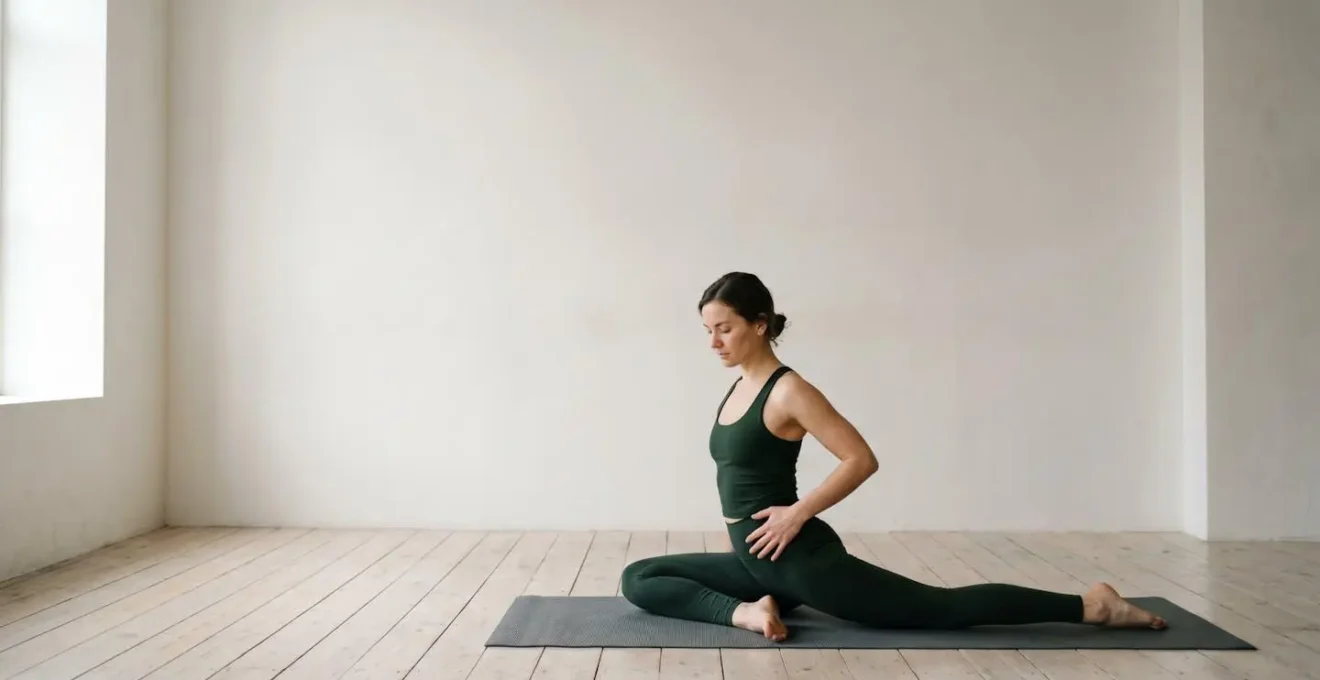
In some cases, particularly in deep hip-openers or other poses that access areas of chronic tension, numbness can be a form of dissociation. It’s a protective mechanism of the nervous system. If the sensations arising from a certain area are too intense or are subconsciously linked to old stress or trauma, the brain may choose to « turn down the volume » by creating a sense of numbness. This is a move toward the dorsal vagal state—a mild form of the « freeze » response. It’s your body’s intelligent way of saying, « This is too much, too soon. »
It is a sign to be respected, not pushed through. As Stephen Porges notes, « When the environment is appraised as being safe, the defensive limbic structures are inhibited. » If these defensive structures are being activated (even subtly as numbness), it’s a sign your neuroception does not yet feel 100% safe with the level of sensation. The solution is to back off, use more props to lessen the intensity, and reassure your body through slow, gentle breath that it is safe. This reframes numbness from a physical problem to a valuable piece of communication from your nervous system.
Round or Rectangular Bolster: Which Shape Supports Your Lower Back Better in Reclined Poses?
Choosing between a round and a rectangular bolster is less about one being universally « better » and more about matching the tool to your unique body and the specific intention of your pose. For supporting the lower back in reclined poses like Supta Baddha Konasana (Reclined Bound Angle Pose), the shape of the bolster directly influences the shape of your spine.
A rectangular bolster offers a wide, flat, and stable surface. This is often the superior choice for individuals with less flexibility in their spine, broader backs, or those prone to lower back sensitivity. The wider surface area distributes support more evenly and provides a gentler, less intense spinal extension and heart opening. It prioritizes stability and a feeling of being held securely, which can send more powerful cues of safety to the nervous system for some individuals.
A round bolster, being narrower and having a more pronounced curve, will create a deeper and more targeted spinal extension. This can be wonderful for individuals with a more flexible spine or for those specifically seeking a deeper heart-opening experience. However, for someone with a stiff or sensitive back, this more intense curve can sometimes feel precarious or create too much of a « backbend, » causing the muscles of the back to engage rather than release. If you feel like you are « perched » on top of the bolster rather than « melting » over it, a rectangular one is likely a better fit for you. The ultimate test is the ‘No-Gap Principle’: which bolster, combined with blankets, allows you to settle with zero muscular effort?
Key Takeaways
- Physiological safety precedes emotional release; the goal is to create safety, not to force a release.
- True restorative practice requires the « No-Gap Principle, » using props to eliminate any need for muscular engagement.
- Duration is key. A nervous system shift requires time; 15+ minutes in one pose is more effective than many short poses.
- Numbness can be a signal from your nervous system to reduce intensity; listen to it and adjust.
Why Does Lying Still in Restorative Yoga Feel Harder Than Holding Difficult Poses?
It is a common paradox: for many people, the profound stillness of Savasana or a long-held restorative pose can feel infinitely more challenging than a physically demanding sequence. In an active Vinyasa class, your brain is occupied. It’s busy processing proprioceptive feedback, balance adjustments, and the teacher’s cues. This is « task-positive » work. But when you remove all external tasks and lie completely still, a different neural network takes over: the Default Mode Network (DMN).
The DMN is the part of your brain associated with self-referential thought, mind-wandering, worrying about the future, and ruminating on the past. It is your brain’s « idle » state, and for most people, it is incredibly noisy. The difficulty you experience is the raw, unfiltered encounter with your own DMN. You are not « bad at relaxing »; you are simply becoming aware of the baseline level of mental chatter that is always present but usually masked by external activity.
The default mode of humans appears to be that of mind-wandering, which correlates with unhappiness, and with activation in a network of brain areas associated with self-referential processing.
– Brewer et al., PNAS – Meditation experience is associated with differences in default mode network activity and connectivity
Interestingly, this is where the practice truly begins. While the DMN is active during mind-wandering, research shows that the main nodes of the default-mode network were relatively deactivated in experienced meditators. The practice of restorative yoga is, in part, a gentle training of your attention. By repeatedly and compassionately returning your focus to the physical sensation of your breath or the points of contact between your body and the props, you are learning to quiet the DMN. The initial difficulty is a sign that you are in the right place, doing the necessary work.
Your practice is a safe container for this process. Approaching these moments of release not as something to be fixed or even understood, but simply as a sign that your body trusts you enough to let go, is the greatest practice of all. Continue to create safety, allow for time, and trust the wisdom of your own nervous system.