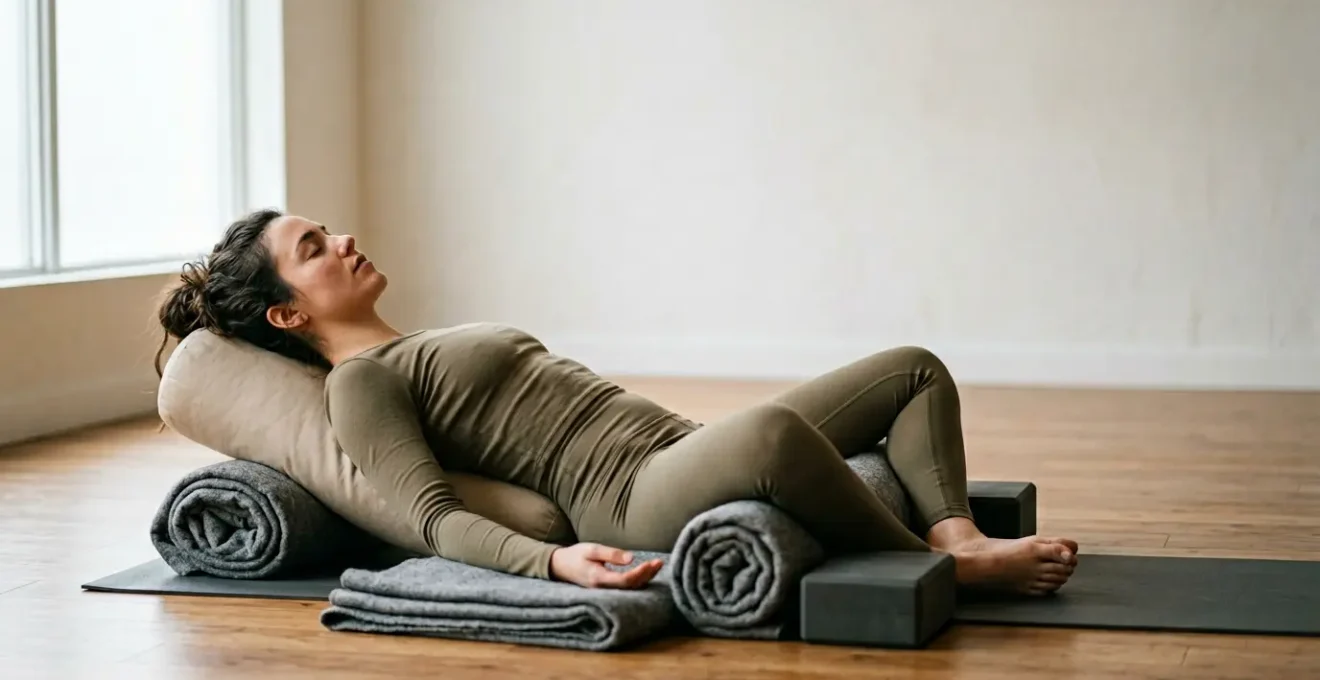
The paradox of restorative yoga is that its difficulty isn’t a sign of failure, but the very first sign of your nervous system beginning to heal and release stored stress.
- When you stop « doing, » your brain’s Default Mode Network activates, causing a surge in mental chatter.
- True relaxation is a physiological state of safety that cannot be forced; it must be allowed by fully supporting the body.
Recommendation: Instead of fighting the discomfort, learn to see it as a signal. Use props generously to create a feeling of being held, allowing your body to finally let go of its need to hold itself up.
You settle into a nest of bolsters and blankets, ready for the deep, healing rest that restorative yoga promises. The teacher’s voice is soft, the lights are low. But instead of drifting into bliss, your mind goes into overdrive. Anxious thoughts multiply, your body feels fidgety, and a strange sense of agitation bubbles up. You might even wonder if you’re « doing it wrong. » After all, holding a complex vinyasa pose feels easier than this supposed state of rest. If this experience sounds familiar, you are not alone, and you are not failing. This challenge is a profound and predictable part of the process.
Many practices focus on active stretching, like Yin Yoga, or muscular engagement. Restorative yoga, however, has a singular goal: to guide the nervous system out of a chronic state of « fight or flight » and into its « rest and digest » mode. The discomfort you feel is often the friction created as your system begins to downshift. It’s the sound of the engine powering down after running at high RPMs for too long. Understanding what is happening in your brain and body is the key to unlocking the practice, transforming it from a frustrating experience into a powerful tool for recovery.
This article will guide you through the science and soul of restorative practice. We will explore why your mind races, why longer holds are crucial, and why even tears can be a sign of profound release. By reframing the challenge not as an obstacle but as the path itself, you can learn to work with your body’s innate intelligence to find the deep, cellular rest you need.
Summary: Unlocking the Challenge of Deep Rest
- Why Does Your Mind Race More in Restorative Poses Than in Active Flow?
- What Happens in Your Nervous System When You Stop Holding Yourself Up?
- Why Forcing Yourself to Relax Can Backfire and Keep You Stuck in Stress
- Why Do Restorative Yoga Poses Make You Cry Even When Nothing Is Wrong?
- Why Three 15-Minute Poses Beat Ten 4-Minute Poses in Restorative Practice?
- When Is the Best Time to Practice Restorative Yoga for Sleep Versus Stress Recovery?
- How to Create Effective Restorative Poses Using Only Household Items?
- How Do You Go Deeper in Restorative Yoga After You Have Mastered the Basic Shapes?
Why Does Your Mind Race More in Restorative Poses Than in Active Flow?
During an active yoga flow, your brain is occupied. It’s processing a constant stream of proprioceptive feedback: signals from your muscles and joints about balance, position, and effort. It is focused on a task. The moment you become still and supported in a restorative pose, this external task disappears. Your brain, no longer occupied with holding you up, switches into its « idle » state, known as the Default Mode Network (DMN).
This network is responsible for self-referential thought, planning the future, and ruminating on the past. When it activates, it feels like someone turned on a loud, chaotic radio station in your head. It’s not that you suddenly have more thoughts; it’s that you’ve finally stopped doing other things long enough to hear them. The intensity of this mental chatter can be startling, but it’s a normal neurological function. In fact, research reveals that the Default Mode Network consumes 60-80% of the brain’s energy when we are « at rest, » highlighting how active our minds are without a specific task to focus on.
Instead of viewing this as a problem, consider it an opportunity. The racing mind is simply the backlog of unprocessed thoughts and feelings coming to the surface now that they have space. The practice isn’t about silencing the mind, but about learning to sit with the noise without becoming entangled in it. Over time, as the nervous system learns it is safe to be still, the DMN’s grip can soften, allowing for moments of true quiet.
What Happens in Your Nervous System When You Stop Holding Yourself Up?
Your body is constantly working against gravity, a low-level, chronic effort that keeps your nervous system in a state of mild activation. The purpose of props in restorative yoga is to take over this job completely. When you are fully supported, your muscles can finally stop « holding on. » This sends a powerful signal of safety to your brain, primarily through the vagus nerve.
The vagus nerve is the superhighway of your parasympathetic nervous system—the « rest and digest » system. In fact, neuroanatomical studies show that the vagus nerve carries 75% of all parasympathetic fibers, connecting the brain to all major organs. Gentle, sustained pressure on the torso from bolsters and blankets is one of the most effective ways to stimulate this nerve, signaling the body to down-regulate.
Being fully supported by props provides gentle, broad pressure to the torso, which is a primary way to stimulate the ventral vagal branch, the body’s main ‘on-switch’ for safety and relaxation.
– Dr. Arielle Schwartz, Vagus Nerve Yoga for Trauma Recovery
As this shift occurs, you may notice physical signs of release. These can include a sigh or a deep yawn, a gurgling stomach, or even small, involuntary twitches or tremors. These are not signs of restlessness but are actually manifestations of the nervous system discharging stored stress and tension. It is the physical evidence of your body moving out of a state of alert and into a state of deep, restorative ease.
Why Forcing Yourself to Relax Can Backfire and Keep You Stuck in Stress
When you feel agitated in a pose, the natural instinct is to try harder to relax. You might clench your jaw, command yourself to « just let go, » or become frustrated with your inability to find peace. This effort is what psychologist Viktor Frankl termed « paradoxical intention. » Trying to force a state of effortlessness only creates more tension, keeping your sympathetic nervous system—your « fight or flight » response—firmly in control.
Relaxation is not an action you can perform; it is the *result* of creating the right conditions. It’s like trying to grab hold of water in your hands; the tighter you squeeze, the faster it slips through your fingers. The moment you soften your hands and create a gentle cup, the water can rest there. In restorative yoga, the props are your cupped hands. Your only job is to allow yourself to be held by them.

This is where the real practice lies: in surrender. It requires letting go of the goal of « feeling relaxed » and instead shifting your focus to the raw, physical sensation of being supported. Notice the texture of the blanket on your skin, the weight of your body on the bolster, the subtle movement of your breath. By focusing on these neutral, sensory inputs, you give your mind a gentle anchor, allowing the relaxation response to arise naturally in its own time, rather than as an item on a to-do list.
Why Do Restorative Yoga Poses Make You Cry Even When Nothing Is Wrong?
It can be deeply unsettling to find tears streaming down your face in the middle of a restorative pose when, moments before, you felt perfectly fine. You might search your mind for a reason, a sad thought or memory, but often find nothing. This experience, known as somatic or emotional release, is not only normal but is a sign of profound healing.
Throughout our lives, when we experience stress, grief, or trauma and are not in a position to process it, the body often stores the emotional energy in our tissues as physical tension—a clenched jaw, tight shoulders, a guarded belly. We create a physical « holding pattern » to contain the emotion. Restorative yoga is designed to gently unravel these holding patterns. As the props support your body and the muscles finally release their chronic grip, the stored emotional energy is also released.
As somatic psychology research shows, this release of a physical pattern can cause the corresponding stored emotion to surface, even if the original trigger is long forgotten. The tears are not necessarily a sign of present-moment sadness; they are simply the energy of old, undigested experiences finally moving through and out of your system. Rather than questioning or resisting them, the invitation is to simply allow them to flow, trusting that your body is completing a long-overdue stress cycle.
Why Three 15-Minute Poses Beat Ten 4-Minute Poses in Restorative Practice?
In our fast-paced culture, it’s tempting to treat a restorative session like a checklist, moving through many different poses in a short amount of time. However, this approach completely misses the neurobiological point of the practice. The transition from the sympathetic (active) to the parasympathetic (restful) state is not like flipping a switch; it’s more like slowing down a freight train. It takes time.
Restorative yoga sessions are built around fewer yoga poses that you hold for five to 10 minutes at a time or longer. The goal is to deepen your stretch, clear your mind and sink into your body while you focus on your breath.
– Cleveland Clinic, Restorative Yoga: Benefits and Poses To Try
Most nervous system experts agree that it takes the body at least 5 to 10 minutes in a fully supported position just to begin to register safety and initiate the relaxation response. The first few minutes are often spent navigating the mental chatter of the DMN and the initial fidgetiness. It is only after this initial period that the deeper physiological shifts—a decrease in heart rate, blood pressure, and stress hormones like cortisol—can truly begin. Holding a pose for 15 minutes or more allows you to move through the initial resistance and into a state of profound, cellular-level rest.
By prioritizing duration over variety, you give your body the time it needs to complete the « unwinding » process. A practice with just three deeply held, 15-minute poses will offer exponentially more benefit for nervous system regulation than a rushed sequence of ten shorter poses. Quality of time, not quantity of shapes, is the foundational principle of effective restorative yoga.
When Is the Best Time to Practice Restorative Yoga for Sleep Versus Stress Recovery?
While restorative yoga is always beneficial, you can tailor its effects by being strategic about when you practice. The timing can optimize your body’s response depending on whether your primary goal is to improve sleep or to recover from daily or physical stress.
For stress recovery, particularly after physical exertion or a mentally demanding day, practicing in the afternoon or early evening can be highly effective. This helps to complete the stress cycle from the day’s events, down-regulating the nervous system and preventing the accumulation of cortisol. For athletes, research indicates that practicing restorative yoga within a 1-2 hour window post-exercise can significantly enhance muscle recovery and reduce inflammation. This midday « reset » can restore mental clarity and energy for the remainder of the evening without inducing sleepiness.
For improving sleep quality, the ideal time to practice is about an hour before you intend to go to bed. The practice should be done in a cool, dimly lit room to signal to your brain that it is time to wind down. This environment, combined with the parasympathetic activation from the poses, encourages the natural production of melatonin, the sleep hormone. A short, 20-30 minute sequence of gentle, supported poses like a supported child’s pose or legs-up-the-wall can act as a powerful pre-sleep ritual, preparing both mind and body for a deeper, more restful night.
How to Create Effective Restorative Poses Using Only Household Items?
You don’t need a studio full of expensive props to have a profound restorative practice. The key principle is not the prop itself, but the quality of support it provides. Your goal is to eliminate all muscular effort. With a little creativity, you can create a luxurious and effective setup using items you already have at home.
The secret is creating density and adjustability. A soft pillow might feel comfortable at first, but it will compress under your body’s weight, forcing your muscles to re-engage. Instead, think in layers and use firm objects to create a stable base. This allows your nervous system to register true, unwavering support, which is the prerequisite for letting go.

Here are some effective ways to build support using common household items:
- Firm Support: Stack a few firm books or a sturdy shoebox and cover them with a folded blanket to create a makeshift bolster for supporting your spine in a gentle backbend or your knees in Savasana.
- Soft Contouring: Roll bath towels tightly to place under your knees for lower back release or to support the natural curve of your neck. Tightly rolled towels provide more consistent support than a fluffy pillow.
- Micro-Gaps: Use small, folded items like washcloths, scarves, or even a pair of socks to fill in the tiny empty spaces. Common areas that need « micro-propping » are under the wrists in Savasana or beneath the ankle bones to prevent them from pressing into the floor.
- Weight and Grounding: A heavier folded blanket placed over your hips or abdomen can provide a grounding sensation that is deeply calming for the nervous system, mimicking the feeling of a comforting hug.
Take your time setting up. The act of building your « nest » is part of the practice. Adjust everything until you feel completely held, with no part of you bracing or straining. The more complete the support, the deeper the release.
Key Takeaways
- The difficulty of stillness is not a personal failing but a neurological sign that your body is beginning to unwind from chronic stress.
- Effective restorative practice relies on longer holds (10-15+ minutes) to allow the nervous system time to shift into a parasympathetic state.
- Complete physical support from props is non-negotiable; it’s the signal of safety that allows the mind and muscles to finally let go.
How Do You Go Deeper in Restorative Yoga After You Have Mastered the Basic Shapes?
Once you become comfortable with being still and have learned how to support your body effectively, a new layer of the practice can unfold. Going deeper in restorative yoga is not about more complex poses or more props. It’s about refining your internal awareness, a faculty known as interoception. This is the practice of sensing the subtle, internal landscape of your body.
Instead of waiting for the mind to quiet, you give it a new, more subtle job: to feel. This is a gentle, moment-to-moment investigation of sensation. You move from the macro-sensation of the pose to the micro-sensation of your inner world. This shift from thinking to feeling is the gateway to the most profound states of rest, where the body’s innate intelligence can take over the healing process.
This advanced practice involves moving beyond just noticing tension and starting to explore the texture, temperature, and location of sensations without judgment. It’s an intimate conversation with your own physiology. By developing this refined internal perception, you cultivate a deep resilience that extends far beyond your yoga mat.
Action Plan: Advanced Interoception Techniques
- Practice Titration: Intentionally shift your awareness for several breaths at a time, moving from an area that feels tense or uncomfortable to an area that feels neutral or at ease. This teaches the nervous system it doesn’t have to be « stuck » in discomfort.
- Explore Sensation Texture: When you notice a sensation, move beyond simply labeling it (« tension ») and investigate its qualities. Is it sharp or dull? Warm or cool? Vibrating or still? Get curious about its precise shape and location.
- Trace Breath as Energy: Feel the subtle pathway of your breath beyond just the lungs. Can you sense the expansion in your side ribs, your low back, or even the soles of your feet? Imagine the breath carrying nourishing energy to every cell.
- Feel Your Heartbeat: Without touching a pulse point, try to feel the subtle rhythm of your heartbeat from the inside. This is a highly refined interoceptive skill that develops with patient practice.
- Incorporate 1:2 Breathing: To directly influence your vagus nerve, gently introduce a 1:2 breathing ratio. For example, inhale for a count of four and exhale for a count of eight. Make the exhale passive and effortless.
Ultimately, learning to embrace the challenge of stillness is a radical act of self-compassion. It’s an invitation to stop fighting, to stop striving, and to simply allow yourself to be. By understanding the processes at play in your nervous system, you can meet the fidgeting mind and restless body with gentle curiosity instead of frustration, unlocking one of the most powerful tools available for your health and well-being.