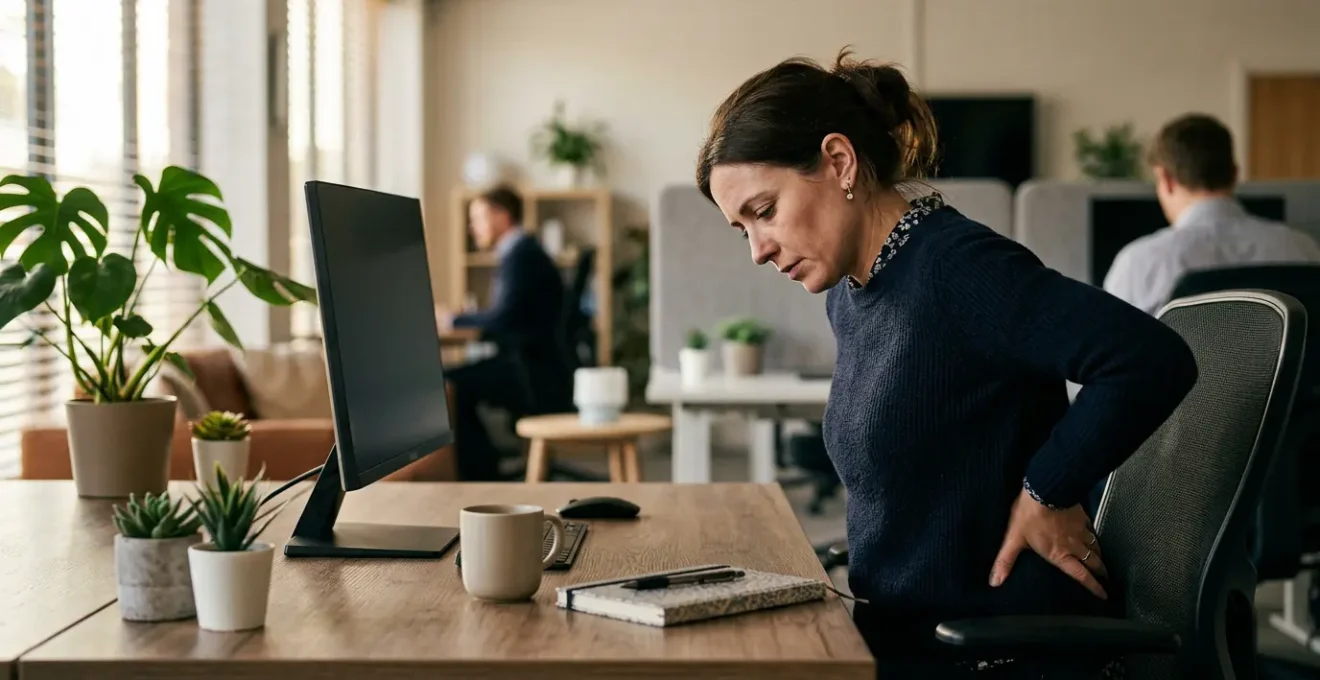
It’s the all-too-familiar story for the modern desk professional. You’ve invested in a top-of-the-line ergonomic chair, a marvel of engineering with lumbar support, adjustable armrests, and a price tag to match. You start your day sitting tall, feeling focused and supported. Yet, without fail, the 3pm slump arrives. Your shoulders round forward, your head juts out towards the screen, and a dull ache begins to spread across your neck and lower back. You’ve followed the conventional advice—you bought the chair—so why isn’t it working?
The common wisdom tells us to « sit up straight » and « invest in good equipment. » But these platitudes fail to address the fundamental misunderstanding at the heart of desk-bound pain. We’ve been taught to seek a single, perfect, static posture, believing our expensive chair can hold us there indefinitely. This belief is not just wrong; it’s the very reason you’re still in pain. Your chair is a tool, not a solution in itself, and its potential is being wasted by an outdated approach to sitting.
The real issue isn’t your chair’s quality, but the biological consequence of stillness. The problem is something called static loading, and the reason you don’t notice it happening until it’s too late is due to proprioceptive shutdown. This article will dismantle the myth of perfect posture and reveal the true culprit behind your afternoon collapse. Instead of another lecture on sitting straight, you’ll gain an investigative framework to understand why your body is failing and a practical, active system to reclaim control.
We will explore the hidden damage of sitting still, provide actionable desk-based resets, and compare the true value of different ergonomic investments. You’ll learn to identify when postural issues require medical attention and, crucially, how to retrain your body to self-correct before pain ever begins. This guide provides the missing instruction manual for your body in the modern workplace.
Contents: The Active Posture Blueprint
- Why Sitting Perfectly Still Damages Your Spine More Than Moving Incorrectly?
- How to Reset Your Spine Every 45 Minutes Without Leaving Your Desk?
- Standing Desk or Movement Routine: Which Investment Improves Posture More in 6 Months?
- When Does Poor Posture Become a Medical Issue Requiring NHS Referral?
- How to Retrain Your Body to Notice Slumping Before Pain Starts?
- How to Address Desk Worker Tension Spots in Under 10 Minutes Daily?
- 4mm or 6mm Mat: Which Thickness Protects Your Knees Without Making Balances Wobbly?
- Why Does Your Cheap Yoga Mat Smell Toxic and Slip When You Sweat?
Why Sitting Perfectly Still Damages Your Spine More Than Moving Incorrectly?
The core of the problem lies in a dangerous misconception: that there is a single « correct » posture you should hold all day. In reality, the human body is designed for movement. When you remain in one position, even a supposedly « perfect » one, you subject your spine to a relentless enemy: static loading. This is the continuous, unchanging pressure on the same muscles, ligaments, and intervertebral discs. Imagine holding a 5kg weight with your arm outstretched. Initially, it’s easy. After a few minutes, your muscles scream. Your spine experiences the same phenomenon, but the signals are more subtle until the damage accumulates.
When you sit still, your postural muscles—the small, deep muscles responsible for stability—are forced into a constant state of contraction. This restricts blood flow, preventing oxygen and nutrients from reaching the tissues and, more importantly, preventing waste products like lactic acid from being cleared. Over time, these muscles fatigue and simply give up. This is the moment your posture collapses and larger, less suitable muscles (like those in your neck and shoulders) take over, leading to tension and pain. Simultaneously, your spinal discs, which rely on movement to absorb fluid and nutrients like a sponge, become compressed and starved.
Ironically, moving frequently, even with « imperfect » posture, can be less damaging. Fidgeting, shifting your weight, crossing and uncrossing your legs—these small movements vary the load on your spine. They engage different muscle groups, promote circulation, and allow your discs to decompress and rehydrate. An ergonomic chair can support a good neutral position, but it cannot defy this biological imperative. Treating it like a static brace turns it from an asset into an accomplice in your body’s slow descent into stiffness and pain. The goal isn’t to find the perfect stillness, but to embrace a rhythm of dynamic sitting.
How to Reset Your Spine Every 45 Minutes Without Leaving Your Desk?
If static loading is the poison, then frequent, targeted movement is the antidote. The key isn’t to take an hour-long break for a workout, but to integrate « micro-resets » into your workday every 45 minutes. These are not just random stretches; they are specific movements designed to counteract the forces of sitting and reawaken the communication between your brain and your postural muscles. A micro-reset should take no more than five minutes and can be done discreetly at your desk.
The goal is to reverse the patterns of postural collapse: release the tightened muscles at the front of the body (like hip flexors and chest), activate the weakened muscles at the back (like glutes and upper back), and decompress the spine. A simple, effective routine can completely change your body’s response to a day of sitting. Consider this 5-minute sequence:
- Chin Tucks: Sit tall and, without looking down, gently draw your chin straight back as if creating a « double chin. » This activates the deep neck flexors that support your head. Hold for 5-10 seconds and repeat 10-15 times.
- Upper Trap Release: Sit on your right hand to anchor the shoulder down. Gently tilt your left ear towards your left shoulder. You can use your left hand to apply gentle extra pressure. Hold for 30-45 seconds, breathing deeply. Repeat on the other side.
- Seated Spinal Twist: With feet grounded, place your right hand on the back of your chair and your left hand on your right thigh. Inhale to lengthen your spine, and exhale as you gently twist to the right. Hold for 30 seconds.
Beyond muscular resets, it’s vital to reset your nervous system. Desk work, deadlines, and pain can trigger a low-grade stress response. A simple diaphragmatic breathing exercise can switch your body from « fight or flight » to « rest and digest » mode, easing muscle tension.

As shown, placing your hands on your lower ribcage can help you feel the movement. Inhale deeply through your nose for a count of four, feeling your belly expand into your hands. Exhale slowly through your mouth for a count of six. Repeating this just five times can have a profound calming effect, making your muscles more receptive to stretches and postural correction.
Standing Desk or Movement Routine: Which Investment Improves Posture More in 6 Months?
The standing desk has become the poster child for the « ergonomic fix. » It seems like a logical solution: if sitting is the problem, standing must be the answer. This has created a booming industry, with some reports suggesting the global standing desk market is projected to reach $12.6 billion by 2032. However, many users find themselves falling into the « ergonomic trap » once again. They trade static sitting for static standing, simply exchanging one set of problems for another. Prolonged standing can lead to foot pain, varicose veins, and lower back strain if posture isn’t actively managed.
A standing desk is a tool, not a panacea. Its primary benefit is not standing itself, but the ease with which it allows you to transition between sitting and standing. The real value comes from changing your position frequently. However, without a conscious strategy, most people simply stand in a fixed, often poor, posture for hours, leading to a different form of static loading. A 2024 Australian study even found that for some health markers, prolonged standing may offer no significant benefit over prolonged sitting.
So, where should you invest your resources? Let’s compare two scenarios over six months. In Scenario A, a professional invests £500 in a standing desk but receives no training on how to use it. In Scenario B, a professional keeps their standard desk but invests £100 in a few coaching sessions with a postural therapist and dedicates 10 minutes a day to a specific movement routine. After six months, the standing desk user (A) may have simply swapped their slumping patterns. The movement routine user (B) will have built postural endurance, improved body awareness, and developed a sustainable habit that benefits them in all aspects of life, not just at their desk. The return on investment for the movement routine is exponentially higher because it addresses the root cause—the body’s need for dynamic change—rather than just changing the scenery.
When Does Poor Posture Become a Medical Issue Requiring NHS Referral?
While most desk-related aches and pains can be managed with postural awareness and movement, there are critical moments when self-care is not enough. It is vital to recognize the « red flag » symptoms that indicate your poor posture may have progressed into a genuine medical issue requiring a professional diagnosis. Pushing through these specific types of pain can lead to more serious, long-term damage. As the UK’s Health and Safety Executive (HSE) warns, the consequences of a poor workstation setup are not trivial.
Incorrect use of DSE or poorly designed workstations or work environments can lead to pain in necks, shoulders, backs, arms, wrists and hands as well as fatigue and eye strain.
– UK Health and Safety Executive (HSE), Working safely with display screen equipment guidance
Your first port of call in the UK should always be your GP, who can assess your condition and make an appropriate referral to an NHS physiotherapist or specialist if necessary. Do not hesitate to book an appointment if you experience any of the following symptoms. These are not signs of simple muscle fatigue; they are potential indicators of nerve compression or other structural problems that need to be evaluated.
Be vigilant for these red flag symptoms, which warrant an urgent GP appointment:
- Numbness, tingling, or weakness in your hands, arms, or legs. This suggests potential nerve involvement.
- Radiating pain that travels down an arm or leg (like sciatica) and does not improve with rest or a change in position.
- Loss of bladder or bowel control. This is a medical emergency known as Cauda Equina Syndrome and requires immediate attention at A&E.
- Persistent pain that lasts for more than 6 weeks despite your best efforts with self-care, stretching, and postural corrections.
- Pain that is accompanied by other systemic symptoms like unexplained weight loss, fever, or night sweats.
How to Retrain Your Body to Notice Slumping Before Pain Starts?
The reason you can sit perfectly for an hour and then find yourself completely slumped over without noticing is a phenomenon called proprioceptive shutdown. Proprioception is your body’s sixth sense—the unconscious awareness of where your body parts are in space. When you sit still, the constant, unchanging input from your postural muscles causes your brain to start ignoring the signals. It’s like tuning out a constant background noise. Your brain effectively stops « listening » to whether you are upright, and by the time it gets a new signal—pain—the slump is already well established.
To fix this, you must actively retrain your proprioception. The goal is to re-sensitise your nervous system to the subtle cues of your posture. This isn’t about strength; it’s about awareness and building postural endurance. The forces involved are significant; biomechanical research reveals that tilting your head forward just 15 degrees more than doubles the weight your neck has to support, and at a 45-degree angle, it’s like balancing a 22kg (49lb) weight on your spine. Your body can handle this for a moment, but not for hours.
A simple yet powerful drill to recalibrate this sense is the « Wall Stand. » It provides clear, undeniable physical feedback about your alignment.
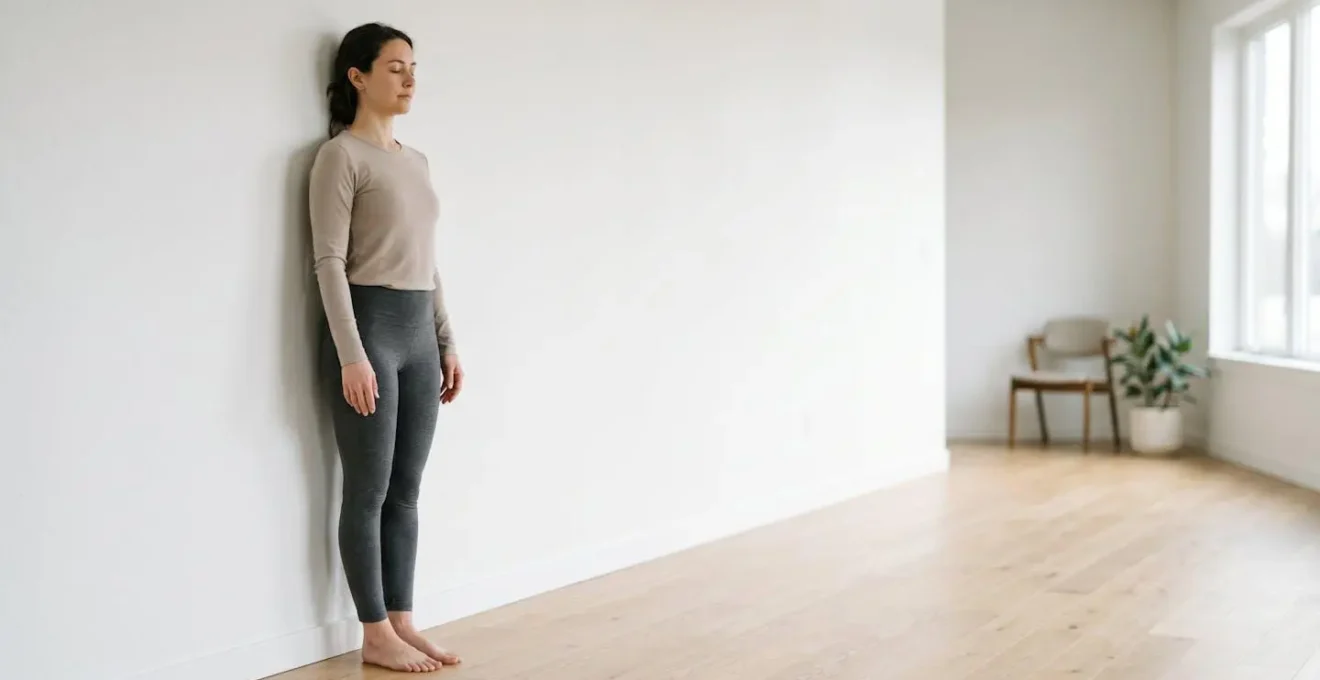
To perform this drill, stand with your back against a flat wall. Aim to make contact with the wall with the back of your head, your shoulder blades, and your tailbone. There should be a small, natural curve in your lower back (you should be able to slide a hand in). Hold this position for 60 seconds, close your eyes, and notice the sensations. Pay attention to which muscles are working. This is what neutral alignment feels like. When you step away from the wall, try to maintain this feeling. By performing this drill daily, you are giving your brain a fresh, accurate « map » of good posture, making it much quicker to detect when you start to deviate from it at your desk.
How to Address Desk Worker Tension Spots in Under 10 Minutes Daily?
Once you’ve improved your awareness, the next step is a daily maintenance routine to address the tension that inevitably builds up. Sitting creates predictable patterns of tightness and weakness. Specifically, the hip flexors and chest muscles become short and tight, while the glutes and upper back muscles become long and weak. A targeted 10-minute routine can help to reverse these effects, improve mobility, and prevent minor tension from becoming chronic pain.
This isn’t about a full-body workout; it’s a strategic intervention. Think of it as a daily audit of your body’s « tension hotspots. » By systematically checking in with these key areas, you can release strain before it becomes a problem. This daily practice is one of the highest-return investments you can make in your long-term comfort and health.
Your Daily 10-Minute Tension Audit
- Identify Target Zones: Mentally scan your body for the four primary tension spots for desk workers: the front of your hips (hip flexors), your chest/shoulders, your mid-to-upper back (thoracic spine), and the base of your neck.
- Gather Your Tools: You don’t need a home gym. Your primary tools are your own body, a wall, and perhaps a foam roller or a tightly rolled-up bath towel.
- Execute the Protocol: Match the tool to the zone. Perform Scapular Wall Slides to activate the upper back, a standing Hip Flexor Release lunge to open the hips, and Deep Neck Flexor Activation (chin tucks) to reset your head position.
- Assess Feedback: Pay close attention to the sensations. Differentiate between a ‘good’ stretch feeling and sharp, pinching pain. The goal is a feeling of release and increased range of motion, not to push through pain.
- Integrate & Schedule: The key to success is consistency. Block a recurring 10-minute slot in your calendar—either at the end of your workday or during a lunch break—to perform this audit without fail.
Key Takeaways
- Your ergonomic chair is not a passive fix; it’s a tool whose effectiveness depends on your movement.
- Static posture, not imperfect posture, is the true enemy. The body is damaged more by stillness than by movement.
- Frequent, small « micro-resets » throughout the day are more effective at preventing pain than infrequent, long breaks.
4mm or 6mm Mat: Which Thickness Protects Your Knees Without Making Balances Wobbly?
As you commit to a more active movement routine, whether it’s yoga, Pilates, or simple floor-based stretches, your equipment choices start to matter. Just as with the ergonomic chair, there’s a common misconception that « more is better » when it comes to cushioning. A thick, squishy 6mm+ yoga mat might seem like the obvious choice to protect sensitive knees, but it comes with a significant trade-off: stability. This decision directly impacts your proprioception—that crucial mind-body connection we’ve been working to retrain.
A thicker mat can feel like standing on a mattress. It dulls the sensory feedback from your feet to your brain, making it harder for your body to make the micro-adjustments needed to maintain balance. This can lead to wobbly ankles and an increased risk of falling in standing poses. A thinner, denser 4mm mat provides a more stable foundation, allowing you to feel grounded and engage the muscles of your feet and ankles properly. The choice is not about one being definitively better, but about matching the tool to the task.
| Factor | 4mm Mat (Feedback Thickness) | 6mm+ Mat (Cushioning Thickness) |
|---|---|---|
| Best For | Standing poses, balances, vinyasa flow | Restorative yoga, yin yoga, floor-based poses held for long periods |
| Proprioception | High – feet can feel floor, better micro-adjustments in balances | Lower – thicker surface dulls foot-to-floor feedback |
| Knee Protection | Moderate (density matters more than thickness) | Higher cushioning for extended kneeling poses |
| Ankle Stability | Better – firmer surface allows strong ankle engagement | Reduced – overly thick mats hinder micro-adjustments, increase wobble risk |
| Portability | Lighter, easier to carry | Heavier, bulkier |
| Material Density Note | High-density 4mm natural rubber can feel more protective than cheap ‘squishy’ 6mm PVC foam | |
Why Does Your Cheap Yoga Mat Smell Toxic and Slip When You Sweat?
The final piece of the puzzle returns to the idea of informed investment. Just as a £400 chair can’t fix a static posture, a cheap yoga mat can actively undermine your health and safety. If you’ve ever unrolled a new, budget-friendly mat and been hit with a strong chemical smell, or found yourself slipping dangerously in a simple downward dog, you’ve experienced the consequences of poor material science firsthand. This isn’t just an inconvenience; it reveals a fundamental difference in how these products are made.
The smell and the slipperiness are directly linked. Most cheap mats are made from PVC, a material that requires chemical softeners to be flexible. The « toxic » smell is the off-gassing of these chemicals. Furthermore, this manufacturing process creates a « closed-cell » surface. When you sweat, the moisture has nowhere to go. It pools on the surface, creating a treacherous, ice-rink-like film between you and the mat. This is where your investment in a quality tool pays dividends in safety and performance.
Case Study: The Material Chemistry of Grip—PVC vs. Natural Rubber
Most budget yoga mats are made from PVC (Polyvinyl Chloride) treated with phthalate plasticizers to achieve softness. These chemicals ‘off-gas’ creating the toxic smell and create a ‘closed-cell’ surface structure that doesn’t absorb moisture. When you sweat, the moisture sits on top of the closed-cell surface creating a dangerous slip hazard. In contrast, premium materials like natural rubber, cork, and TPE feature ‘open-cell’ structures that act like a sponge—absorbing sweat to maintain grip. Cork uniquely becomes grippier when wet, making it ideal for hot yoga practices.
This brings our investigation full circle. Whether it’s a chair or a yoga mat, simply buying a tool isn’t enough. The path to a pain-free body lies in understanding the ‘why’ behind the ‘what’—why static sitting is damaging, why micro-resets work, and why material science matters. It’s about shifting from being a passive consumer of ergonomic products to an active, informed manager of your own physical well-being.
Ready to move beyond passive solutions and build your own active postural system? The first step is to consistently apply these principles, starting with a daily audit of your body’s needs. Your journey to a pain-free workday begins not with a purchase, but with an action.