
Your inability to relax isn’t a willpower issue; it’s a physiological signal that your nervous system is stuck in survival mode.
- Burnout isn’t just exhaustion but an accumulation of incomplete « stress cycles » that keep your body on high alert.
- Forcing relaxation often backfires, causing more anxiety because a hypervigilant system perceives the absence of threat as dangerous.
Recommendation: True recovery starts not by trying harder to relax, but by learning to gently signal safety to your body through small, somatic practices that complete the stress cycle.
You’ve finally done it. You’ve booked the time off, switched on your out-of-office, and collapsed onto the sofa or a sun lounger. This is your moment to rest, to recharge. Yet, as the hours tick by, a familiar and frustrating tension coils in your chest. Your mind races with to-do lists, your body is thrumming with a strange, restless energy, and the very act of doing nothing feels profoundly stressful. You are exhausted, but you cannot rest. If this experience feels deeply personal, you are not alone. It’s a hallmark of burnout, a state that goes far beyond simple tiredness.
The conventional wisdom to « just switch off » or « practice self-care » feels like a cruel joke. You’ve tried the bubble baths, the digital detoxes, the mindfulness apps, only to find yourself more agitated. This isn’t a personal failure; it’s a misunderstanding of what burnout actually is. It’s not a problem of mindset that can be solved with positive thinking. It is a deep, physiological state of nervous system dysregulation. Your body has been running from a perceived tiger for so long that it has forgotten how to recognize safety.
But what if the solution wasn’t to force your mind into submission, but to gently listen to the language of your body? What if, instead of trying to silence the anxiety, you could understand its message? This article will not give you another checklist of relaxing activities that feel like chores. Instead, it will guide you through the science of why your body is resisting rest. We will explore how to differentiate burnout from exhaustion, why your best intentions often fail, and how tiny, body-led practices can begin to untangle the knots of chronic stress, allowing genuine relaxation to emerge, not as a command, but as a long-awaited exhale.
This guide offers a gentle, staged path from understanding the physiological roots of your restlessness to discovering the small, consistent actions that signal safety to your nervous system. Below is a summary of the key stages we will explore on this journey toward true recovery.
Summary: Navigating the Path from Burnout to Genuine Rest
- What Makes Burnout Different from Regular Exhaustion and Why Normal Rest Doesn’t Fix It?
- How to Start Recovery When You Are Too Exhausted to Even Do Gentle Yoga?
- Should You Rest Completely or Keep Moving Gently During Burnout Recovery?
- When Using Yoga to Recover Faster Becomes Another Form of Self-Exploitation
- Which Daily Boundaries Must Be in Place Before Burnout Recovery Can Stick?
- Why Forcing Yourself to Relax Can Backfire and Keep You Stuck in Stress
- Why Your New Year Wellness Resolutions Collapse by February Every Single Time?
- Why Does Your Relaxation Savasana Feel More Anxious Than Your Morning Commute?
What Makes Burnout Different from Regular Exhaustion and Why Normal Rest Doesn’t Fix It?
The exhaustion you feel after a long hike is a satisfying, clean tiredness. You sleep deeply and wake up restored. The exhaustion from burnout is a different beast entirely. It’s a wired, hollowed-out state where sleep brings little relief and weekends are just a buffer before the next onslaught. The key difference lies in what experts Emily and Amelia Nagoski call the stress response cycle. When you encounter a stressor—a looming deadline, a difficult colleague—your body floods with hormones like adrenaline and cortisol to help you « fight or flee. » Burnout occurs when you consistently activate this response but never complete the cycle. You deal with the email, but your body never gets the signal that the « threat » is over.
This is why normal rest, like binge-watching a series or scrolling through social media, doesn’t work. It may distract your mind, but it does nothing to release the physiological stress residue trapped in your body. In their book « Burnout: The Secret to Unlocking the Stress Cycle, » the Nagoski sisters explain, « Burnout isn’t just a lack of rest, but an accumulation of incomplete stress cycles. Normal rest like watching TV doesn’t help the body complete the physiological cycle, leaving stress residue trapped in the nervous system. » This is a global issue, with a recent BCG study showing that nearly 48% of workers around the world are struggling with burnout.
Burnout, therefore, is a state of being stuck in the middle of the stress response. Your nervous system remains on high alert, constantly scanning for threats, which is why you feel restless and anxious even when you’re « safe » at home. You are physically living in a state of chronic activation, and recovery requires practices that specifically help your body move through and complete these trapped cycles, not just more time on the couch.
How to Start Recovery When You Are Too Exhausted to Even Do Gentle Yoga?
When you are in the depths of burnout, the suggestion to « do yoga » can feel like being asked to climb a mountain. You are so depleted that even the thought of unrolling a mat is overwhelming. This is a critical moment where recovery often stalls. The very tools meant to help feel inaccessible. The answer is not to push through, but to radically scale down your expectations and start with what is known as bottom-up regulation. Instead of trying to command your mind to be calm (a top-down approach), you begin with the body’s smallest, most accessible sensations.
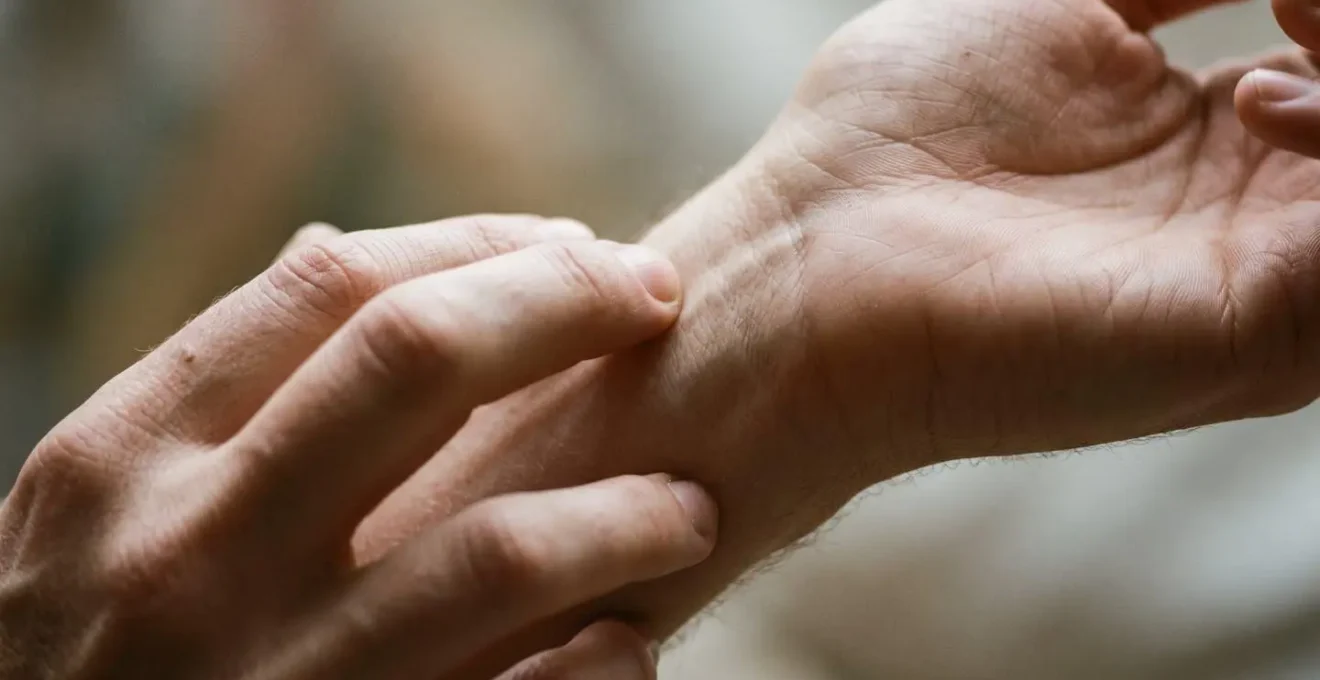
This is where the practice of « somatic tracking » becomes a lifeline. It requires almost no energy. Right now, as you read this, can you feel the weight of your body in your chair? Can you notice the sensation of your feet on the floor? Can you feel the texture of your clothing against your skin? That’s it. That’s the entire practice. By simply bringing gentle, non-judgmental attention to physical sensation for 30 seconds, you are activating the body’s innate calming pathways. It’s a micro-dose of presence that gently whispers to your nervous system, « You are here. You are safe in this moment. »
This approach bypasses the exhausted mind and speaks directly to the body. It’s not about achieving a state of relaxation, but simply about noticing what is already here. You can do this by gently rubbing your palms together, slowly stretching your fingers, or noticing the rhythm of your own breath without trying to change it. These tiny « micro-movements » and moments of sensory awareness are the first, most compassionate steps out of depletion. They are the seeds from which a larger practice can eventually grow, but for now, they are enough.
Should You Rest Completely or Keep Moving Gently During Burnout Recovery?
The paradox of burnout recovery is that while you feel deeply exhausted, complete stagnancy can sometimes keep you stuck. The key is understanding the difference between draining exercise and restorative movement. As we’ve established, burnout leaves a residue of stress hormones in the body. While passive rest is essential, gentle physical activity is one of the most effective ways to metabolize these hormones and complete the stress cycle.
In « Burnout, » Emily and Amelia Nagoski state that « Physical activity is the most efficient and effective means of completing the stress cycle. It digests adrenaline and stress hormones and resets the nervous system. » This doesn’t mean you need to run a 5k or hit a high-intensity workout—in fact, that would likely be counterproductive and further tax your system. Instead, it’s about finding movement that signals to your body that you have successfully « survived the threat. »
Think of it as gently discharging the stored-up energy. This could look like:
- A 20-minute walk outside, focusing on the feeling of your feet on the ground.
- Stretching your arms up to the ceiling and holding for a few deep breaths.
- Putting on a favorite song and dancing around your living room for three minutes.
- Shaking your hands and feet vigorously for 60 seconds to literally « shake off » the tension.
Research on stress management consistently supports the idea that regular, moderate physical activity is crucial. For instance, some evidence-based strategies suggest that even 20-60 minutes of daily activity can be a powerful tool for resetting the nervous system. The goal is not performance or fitness; the goal is physiological completion. It’s about moving your body in a way that feels good, safe, and finishes the story your stress response started.
When Using Yoga to Recover Faster Becomes Another Form of Self-Exploitation
In a culture obsessed with productivity, even our rest can become a task to be optimized. You start doing yoga not to feel, but to « fix » your burnout. You track your meditation streaks. You push for a deeper stretch. Suddenly, your recovery practice has become another item on your to-do list, another metric for success or failure. This is the ultimate paradox: using wellness as another form of self-exploitation. It’s taking the very mindset that led to burnout and applying it to the cure. With 44% of employees reporting burnout in SHRM’s 2024 research, the drive to « recover efficiently » is a widespread and dangerous trap.
The problem arises when the goal is external— »getting back to normal, » « being productive again »—rather than internal. True somatic recovery is about shifting from « doing yoga » to « being with your body. » It’s an inquiry, not a performance. The question changes from « Am I doing this pose correctly? » to « What do I feel in this shape? » The focus moves from achieving an outcome to inhabiting a process. This fundamental reorientation is what breaks the burnout cycle.
When you approach your practice with a productivity mindset, you are reinforcing the nervous system pattern of striving and achieving. Your body doesn’t learn that it’s safe to be imperfect, to be tired, to simply be. It just learns a new way to perform. The true healing happens when you give yourself permission to do a « bad » yoga practice. Maybe you lie in child’s pose for ten minutes. Maybe you just breathe. Maybe you cry. These are not signs of failure; they are signs that your body is finally getting the space it needs to process and release stored stress. The goal is to create a space of unconditional permission, where there is nothing to fix and nowhere to get to.
Which Daily Boundaries Must Be in Place Before Burnout Recovery Can Stick?
You can do all the yoga and meditation in the world, but if your life is a container with holes in it, all the energy you generate will leak right out. Boundaries are the container. They are not punishments or walls; they are the structures that create the necessary safety for your nervous system to down-regulate and heal. Without them, any recovery effort is built on sand. For a burnt-out professional, boundaries are less about aggressive confrontation and more about a gentle, consistent reclamation of your actual capacity.
The most crucial boundaries are often the internal ones—the rules of engagement you set with yourself. This means moving away from a constant state of « on-call » for work, for family, and even for your own inner critic. It starts with creating small pockets of non-negotiable time and space that are solely dedicated to non-productive rest. This isn’t « free time » you hope to get; it’s time you schedule and protect as fiercely as a board meeting.
These boundaries are what stop the accumulation of incomplete stress cycles at the source. They prevent you from taking on more than your system can handle and create the deficit in the first place. This isn’t about becoming rigid; it’s about becoming realistic and compassionate about your genuine, physiological limits. A well-placed boundary is an act of profound self-respect. It’s the daily practice that makes all other recovery practices possible and sustainable.
Your Boundary Audit: A Gentle Checklist for Reclaiming Capacity
- Identify the Leaks: For one week, gently notice where your energy goes after you’ve clocked off. Is it checking emails, ruminating about a meeting, or saying « yes » to a social event you don’t have the energy for? Just observe without judgment.
- Define a « Closing Ritual »: Create a simple 5-minute action that signals the end of your workday. This could be closing your laptop, changing your clothes, or taking a short walk around the block. This acts as a clear boundary between work-mode and rest-mode.
- Schedule « Nothing Time »: Block out at least two 15-minute slots in your daily calendar labeled « Nothing. » This time has no agenda. You don’t have to meditate or relax. You just have to honor the space and not fill it with a task.
- Practice the « Gentle No »: Identify one small, low-stakes request this week to which you can say, « Let me get back to you on that. » This creates a pause, a boundary of time, and gives you space to check in with your actual capacity before committing.
- Audit Your Inputs: Create a boundary around your attention. Designate a 30-minute « no-news » or « no-social-media » period each day, preferably at the beginning or end, to give your nervous system a break from external activation.
Why Forcing Yourself to Relax Can Backfire and Keep You Stuck in Stress
Here lies one of the most maddening paradoxes of burnout: you sit down to meditate or lie down to rest, and you feel a surge of anxiety, agitation, and panic. Your heart might race, your thoughts might spiral, and you feel even more stressed than before. This phenomenon is so common it has a name: Relaxation-Induced Anxiety (RIA). It’s not a sign that you’re « bad at relaxing. » It’s a predictable, physiological response of a hypervigilant nervous system.

For months or years, your system has been in a state of high alert, constantly scanning for the next threat. This hypervigilance has become its default setting; it feels « normal. » As researchers explain, « Relaxation induced anxiety is a paradoxical phenomenon wherein people experience a spike in their anxiety during relaxation training. » This is because, for your nervous system, the sudden absence of a problem to solve or a threat to monitor is, in itself, a threat. The quiet is disorienting. A study on the Contrast Avoidance Model from Penn State explains that for a hypervigilant nervous system, the absence of a threat can itself feel threatening. The system thinks, « It’s quiet… too quiet. I must be missing something. I must be in danger. »
Trying to force relaxation in this state is like slamming on the brakes in a car that’s been speeding at 100 mph. The result is a jolt, not a gentle stop. The key is not to force stillness, but to introduce safety signals that allow the system to slow down gradually. Instead of aiming for a silent mind, you might try listening to calming music. Instead of forcing your body to be still, you might try gentle, repetitive movements like rocking or swaying. You must coax your nervous system back to safety, not command it. Understanding RIA is a huge step in self-compassion; it reframes your « failed » attempts at relaxation as a logical, protective response of a body that is trying its best to keep you safe.
Why Your New Year Wellness Resolutions Collapse by February Every Single Time?
Every January, you set the intention: « This year, I will prioritize my well-being. » You vow to meditate daily, go to yoga three times a week, and stop checking emails after 6 PM. You are fueled by optimism and a clear vision of your future, rested self. But by mid-February, the meditation cushion is gathering dust and you’re answering emails at 9 PM again. This collapse is not a failure of discipline; it’s a failure to account for the chasm between your aspirational capacity and your actual capacity.
When you’re in a state of burnout—which 2024 workplace statistics show affects over 52% of employees—your nervous system is fundamentally depleted. It is stuck in a sympathetic (fight-or-flight) or dorsal vagal (shutdown) state. Your « actual capacity » for energy, focus, and emotional regulation is a fraction of what it normally is. However, your resolutions are made from your pre-frontal cortex, the logical, optimistic part of your brain that remembers your « aspirational capacity »—what you *could* do when you were well. This creates an impossible standard from day one.
Neuroscience shows that this gap is physiological, not psychological. As research on the nervous system in burnout demonstrates, the state of depletion is not just a feeling; it is a measurable reality in your body’s ability to function. The shift from resolution-based change (which is pass/fail and triggers shame) to experiment-based change (which is about data collection) is the key. Instead of « I will meditate for 20 minutes every day, » try « This week, I will experiment with sitting quietly for 3 minutes and see what I notice. » The second approach has no failure state. It removes the pressure that perpetuates the burnout cycle and honors your true, present-moment capacity.
Key Takeaways
- Your inability to relax is a physiological symptom of burnout, not a personal failing. It means your nervous system is stuck in « threat » mode.
- True recovery involves completing the stress cycle through gentle movement and somatic awareness, not just passive rest.
- Start with tiny, « bottom-up » practices that require almost no energy, like noticing your feet on the floor, to gently signal safety to your body.
Why Does Your Relaxation Savasana Feel More Anxious Than Your Morning Commute?
Savasana, the final resting pose in yoga, is supposed to be the reward—a moment of blissful integration. Yet for many, especially those teetering on the edge of burnout, it can be the most challenging part of the class. As you lie still, your mind can feel like a hornet’s nest, and your body can buzz with an anxiety that feels more intense than your stressful morning commute. This is not a sign that yoga isn’t « working. » It is a sign that Savasana is doing its job perfectly.
Think of your day as a process of accumulating stress. Every difficult email, every traffic jam, every moment of self-doubt adds a layer of activation to your nervous system. You power through, pushing it all down to stay functional. Then, in the forced stillness and silence of Savasana, all external distractions are removed. There is nothing left to do, nowhere to run. It is in this quiet space that your nervous system finally feels safe enough to present you with the bill for the entire day—or week. As one piece of polyvagal-informed burnout research puts it, « In the stillness of Savasana… the nervous system finally presents its bill—all the unprocessed activation and stress. » The anxiety is the backlog of incomplete stress responses finally coming to the surface to be processed.
This experience is explained by Polyvagal Theory, which maps our nervous system states. The constant striving of modern life keeps us in a state of sympathetic (fight-or-flight) activation. When that becomes unsustainable, the system can crash into a dorsal vagal « shutdown » or collapse—a state characterized by exhaustion, disconnection, and hopelessness, which are the hallmarks of burnout. As polyvagal theory research explains, burnout can represent a dorsal vagal collapse after prolonged sympathetic activation. The anxiety in Savasana is the system oscillating between these states, trying to find its way back to the safe and social (ventral vagal) state. It’s messy, uncomfortable, and absolutely essential for healing.
The path to recovery is not a straight line, but a gentle, compassionate exploration of your body’s signals. If these concepts resonate with you, the next step is to seek support from a trauma-informed yoga therapist or somatic practitioner who can guide you safely through this process.