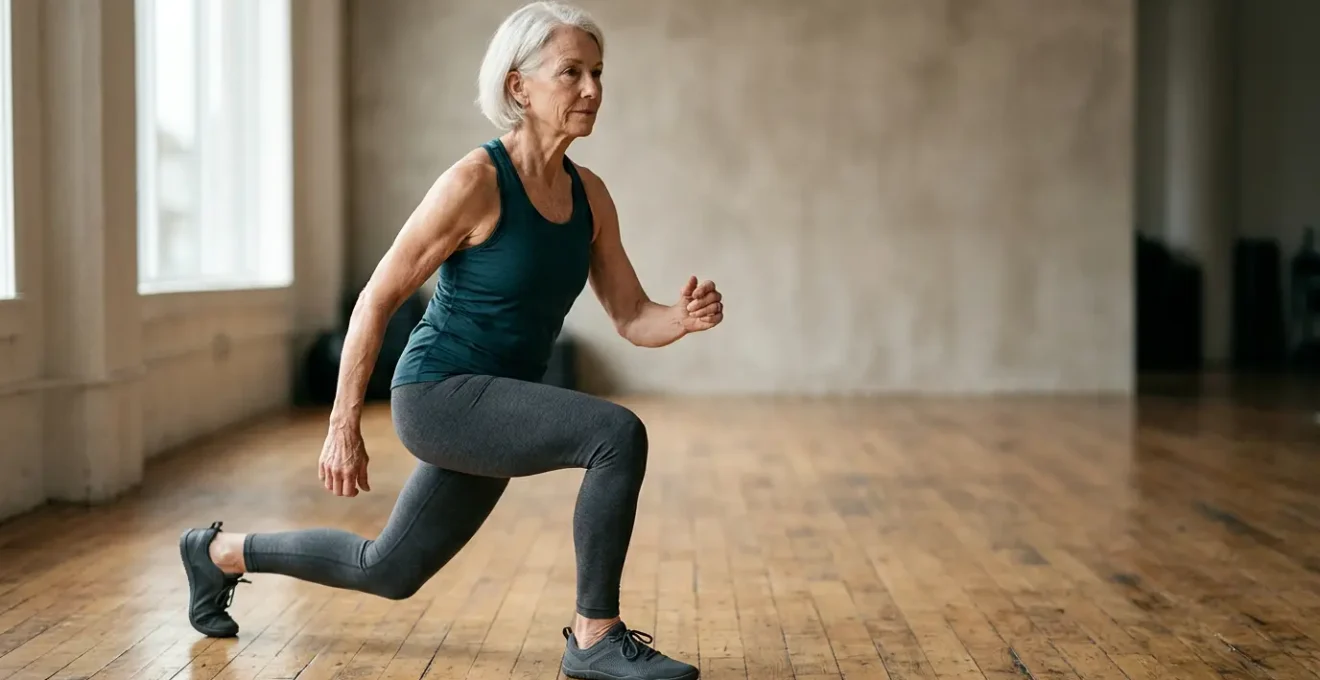
The ability to move well into your 70s and beyond is not determined by chronological age, but by the quality and consistency of your daily « movement diet. »
- Functional decline is often a result of inactivity and narrow movement patterns, not an inevitable consequence of aging.
- Specific skills like grip strength and the ability to get up from the floor are powerful predictors of long-term independence and longevity.
Recommendation: Prioritize building a rich « movement history » through consistent, varied, and intelligent daily activity to preserve functional freedom for decades to come.
It’s a scenario many of us have witnessed: a 70-year-old effortlessly gardening or playing with grandchildren, moving with a fluid grace that seems to defy their age. In the same park, a 40-year-old might groan while getting up from a bench, complaining of a stiff back or a sore knee. This paradox challenges our deepest assumptions about aging. We’ve been told that decline is inevitable, that stiffness, weakness, and loss of mobility are simply the taxes we pay for living longer. We accept that « use it or lose it » is the rule, but we rarely question *how* we should be using it.
The common advice is to stretch more, do some cardio, and maybe lift a few weights. While well-intentioned, this approach often misses the fundamental point. The true difference between the vibrant septuagenarian and the stiff quadragenarian isn’t just about exercise volume; it’s about their entire movement philosophy. It’s about the subtle, consistent « movement nutrients » they feed their bodies daily and the rich « movement history » they have built over decades. The secret isn’t in fighting aging, but in understanding the body’s remarkable capacity for adaptation at any age.
But what if the key wasn’t simply stretching, but building strength through your full range of motion? What if the most important movements for longevity weren’t found in a gym, but in the simple act of getting up from the floor? This article unpacks the science behind functional longevity. We will move beyond the platitudes to reveal the specific habits, exercises, and internal changes that separate biological age from chronological age, providing a clear roadmap to maintaining your physical freedom for life.
To navigate this exploration of lifelong mobility, we will delve into the critical factors that predict and preserve your movement capacity. This guide breaks down the science into actionable insights, showing you exactly what matters for staying active and independent for decades to come.
Summary: The Blueprint for Lifelong Functional Movement
- Which Movements at 50 Predict Whether You Will Need Help Getting Dressed at 80?
- Which Daily Movement Habits Deliver the Biggest Mobility Payoff Over 20 Years?
- Should Your Movement Practice at 60 Look Different from Your Practice at 40?
- How Long Does It Take to Recover Lost Mobility After 6 Months of Inactivity?
- Why Flexibility Without Strength and Balance Actually Increases Fall Risk in Older Adults?
- What Happens Inside Your Joints When Stiffness Creeps in After Your 40s?
- Which Floor-to-Standing Exercises Predict Longevity and How to Train Them?
- Why Does Your Shoulder Lose Mobility After 50 Even Without Injury?
Which Movements at 50 Predict Whether You Will Need Help Getting Dressed at 80?
Long before complex medical tests are needed, your own hands can tell a powerful story about your future health. One of the most surprisingly accurate predictors of long-term independence is grip strength. This simple measure is not just about hand power; it’s a proxy for your overall muscle mass, nutritional status, and neurological health. The ability to open a jar, carry heavy groceries, or hold a railing securely is a direct reflection of your body’s resilience. When grip strength falters, it’s often the first sign of systemic decline, a condition known as sarcopenia (age-related muscle loss).
The data is stark and compelling. A comprehensive 2024 meta-analysis published in Nature revealed a 16% increased mortality risk for every 5kg decrease in grip strength. This makes it a more reliable predictor of future health outcomes than even blood pressure in some populations. The logic is simple: a body that lacks the strength to grip firmly is a body that is losing its functional capacity. This loss directly impacts daily tasks like dressing, cooking, and personal care, which are the cornerstones of living independently. Maintaining it is a non-negotiable investment in your future autonomy.
Fortunately, grip strength is highly trainable. It responds robustly to specific, targeted exercises that can be integrated into any fitness routine. By focusing on this key indicator, you are not just building stronger hands; you are building a more resilient body capable of navigating the physical demands of life for decades to come.
Action Plan: Essential Daily Grip and Dexterity Exercises
- Deadlifts: Develops grip strength by requiring sustained holds of loaded barbells, training both hand musculature and total upper body integration.
- Farmer’s Carries: Hold heavy weights at your sides and walk for distance, building grip endurance essential for carrying groceries or luggage.
- Pull-ups or Assisted Pull-ups: Engage forearms and hands while strengthening major muscle groups, creating functional grip power.
- Stress Ball Squeezes: Practice daily with 10-15 repetitions per hand, holding each squeeze for 3-5 seconds to maintain finger dexterity.
- Rubber Band Finger Extensions: Place a rubber band around all five fingers and repeatedly open your hand against the resistance to balance out your grip strength training.
Therefore, viewing your grip not as a minor detail but as a vital sign for your entire system is the first step toward rewriting your aging story.
Which Daily Movement Habits Deliver the Biggest Mobility Payoff Over 20 Years?
While specific exercises are crucial, the true fountain of youth for mobility lies in the small, consistent choices you make every single day. The concept of a « movement diet » is paramount: just as your body needs a variety of nutrients from food, it requires a diverse range of movements to thrive. A 70-year-old who has spent decades walking, gardening, taking the stairs, and frequently getting up and down from the floor has built a far richer « movement history » than a 40-year-old who sits at a desk for eight hours, drives everywhere, and then tries to « make up for it » with an intense 60-minute gym session.
This isn’t just a theory; it’s backed by robust science. For instance, according to a National Institute on Aging study, there’s a 51% lower risk of death from all causes in adults over 40 who walked 8,000+ steps daily compared to those who only managed 4,000. This highlights that consistent, low-intensity activity is a powerful longevity tool. The body adapts to what you ask of it most frequently. If you consistently ask it to be sedentary, it will become exceptionally good at being stiff and weak.
20-Year Movement Habit Study: The Power of Everyday Activity
A landmark 20-year study supported by the National Heart, Lung, and Blood Institute found that women who incorporated more daily movement—including brisk walking, standing instead of sitting, and performing household chores—while limiting sedentary behaviors had a significantly greater likelihood of living without major chronic disease two decades later. This research demonstrated that consistent micro-movements integrated into daily life, rather than isolated exercise sessions alone, were key predictors of long-term health outcomes.
Integrating « movement snacks » into your day is a highly effective strategy. These are short, one-to-five-minute bursts of activity. This could mean doing a few squats while your coffee brews, performing a standing hip stretch during a phone call, or simply choosing to stand and walk around for a few minutes every hour. These small deposits in your movement bank compound powerfully over time.
As the image illustrates, incorporating movement doesn’t require a special time or place. It’s about redesigning your environment and your habits to make movement the default, not the exception. This consistent, low-grade stimulation keeps your joints lubricated, your muscles active, and your nervous system primed for action, delivering an incredible mobility payoff over the long term.
Ultimately, the most effective long-term mobility plan is the one that is woven so seamlessly into your life that you barely notice it’s there.
Should Your Movement Practice at 60 Look Different from Your Practice at 40?
Yes, absolutely. While the foundational principles of movement remain the same, the focus and priorities of your training should evolve as you age. At 40, one can often get away with a more generalized approach, focusing on building a broad base of strength and cardiovascular fitness. However, as you move into your 60s and beyond, training must become more intelligent, targeted, and specific to counteract the most common age-related declines. The goal shifts from simply being « fit » to being « capable » and « resilient. »
The primary shift is towards an increased emphasis on three key areas: balance, power, and task-specific strength. As we age, our proprioceptive abilities (the body’s sense of its position in space) can diminish, making balance training critical. This doesn’t mean just standing on one leg. It means challenging your stability in dynamic ways. Similarly, muscle power—the ability to generate force quickly—declines faster than pure strength. This is crucial for reacting to a slip or a trip to prevent a fall. Training power might involve exercises like fast step-ups or medicine ball throws, rather than just slow, heavy lifts.
This targeted approach is validated by extensive research. As experts from the Exercise and Sport Sciences Reviews journal state:
Highly mobile older adults benefit most from task-specific balance, strength, and power training at high doses performed in a periodized fashion.
– Exercise and Sport Sciences Reviews Research Team, The Interaction between Mobility Status and Exercise Prescription
This « task-specific » element is the secret sauce. Instead of just doing leg presses, a 60-year-old’s practice should include movements that mimic real-life challenges, like getting up from a low chair without using hands. This focus on functional capacity is precisely why multiple systematic reviews have demonstrated an up to 50% reduction in fall risk among older adults who engage in programs combining strength, balance, and aerobic training. Your practice at 60 shouldn’t be less intense, but it must be smarter.
By shifting your focus to what truly matters for maintaining autonomy—balance, power, and real-world strength—your 60s can be a time of building resilience, not managing decline.
How Long Does It Take to Recover Lost Mobility After 6 Months of Inactivity?
The answer to this question is deeply personal and hinges on one crucial factor: your « movement history. » Six months of inactivity will affect a former athlete differently than it will a lifelong sedentary individual, even if they are the same chronological age. This is because movement is a skill encoded in our nervous system. Years of practicing varied movements create robust motor engrams—pre-programmed neural pathways that make movements efficient and automatic. When you become inactive, these pathways don’t disappear; they just become dormant. Re-awakening them is far easier than building them from scratch.
Think of it like learning a language. If you were once fluent in Spanish but haven’t spoken it for years, you’ll regain your fluency much faster than someone starting from « hola. » Your body’s physical intelligence works the same way. The time it takes to recover is less about the duration of inactivity and more about the depth of the « movement bank account » you built beforehand. This principle is a source of immense hope, as it means past efforts are never wasted.
The physical tissues themselves tell a similar story of adaptation. During periods of inactivity, connective tissues like fascia and ligaments can become stiff and less pliable. However, these tissues are alive and constantly remodeling in response to the demands placed upon them. A gradual, progressive return to movement encourages them to become more hydrated, elastic, and resilient once again.
Recovery Timelines and the Power of Movement History
Research from the InCHIANTI longitudinal study on aging revealed a fascinating insight: decline in mobility on challenging tasks (like a 400-meter walk) can begin as early as age 20-25. This shows that your body is constantly adapting. The study emphasizes that an individual’s « movement history » is more predictive of their recovery potential than their chronological age. Those with well-established motor engrams and neuromuscular pathways from prior training recover function significantly faster after a period of detraining than those starting from a lower baseline. Your biological age, in this context, is a reflection of your training history.
While there is no universal timeline, the rule is consistent: start slowly, be patient, and trust that your body remembers how to move. The path to regaining mobility is paved with consistent, intelligent effort, and your past self has already done much of the foundational work.
Why Flexibility Without Strength and Balance Actually Increases Fall Risk in Older Adults?
In the world of wellness, « flexibility » is often held up as the gold standard for healthy aging. We are encouraged to stretch, do yoga, and lengthen our muscles. While having a healthy range of motion is important, pursuing flexibility in isolation, without a corresponding foundation of strength and balance, can be not just ineffective but outright dangerous. This creates what is known as « unstable mobility »—a body that can get into positions but lacks the muscular control to safely manage and get out of them.
Imagine a joint that is very flexible but is surrounded by weak muscles. When this joint moves towards its end range, there is no strong, stabilizing force to protect it. The nervous system perceives this lack of control as a threat, which can lead to reflexive muscle spasms or, in a worst-case scenario, a complete loss of balance. A fall is often the result of the body entering a range of motion it cannot control. True functional movement is not just about the range of motion you possess, but the range of motion you *own* with strength and stability.
This concept is what we can call the « Mobility Trinity »: Strength, Balance, and Flexibility. These three qualities are inextricably linked. You need strength to control your flexibility, and you need both strength and flexibility to have good balance. Focusing on one at the expense of the others creates a fragile system. Research confirms this deep connection, showing that these factors work in concert to keep us upright and safe.
For example, a controlled 12-week intervention study found that hip-joint mobility, dynamic balance, and lumbar strength are all positively associated with balance ability and fall prevention, with the connection being highly statistically significant. As the researchers in the Journal of Sports Science & Medicine concluded, « greater efficacy of the lumbopelvic muscles can contribute to postural stabilization. » In other words, a strong core and hips are what allow you to use your flexibility safely.
The goal, therefore, is not to become as flexible as a contortionist, but to build a body that is strong and stable through its entire usable range of motion. That is the true definition of durable, functional mobility.
What Happens Inside Your Joints When Stiffness Creeps in After Your 40s?
The feeling of morning stiffness or a creaky knee is a common complaint as we move past 40. We often blame « old age, » but what is actually happening on a physiological level? The change is less a story of simple wear and tear and more a tale of a changing internal environment. Two key players in this process are the synovial fluid and the connective tissue that make up the joint capsule and surrounding fascia.
Synovial fluid is the natural lubricant for our joints, with a consistency similar to egg whites. Its job is to reduce friction and nourish the cartilage. With inactivity, this fluid can become more viscous and « gummy. » It loses some of its lubricating quality, and the joint no longer glides as smoothly. Movement is what « stirs » this fluid, keeping it thin and effective. When we sit for long periods, the fluid thickens, leading to that familiar feeling of stiffness when we first stand up. Regular, varied movement is the only way to maintain the fluid’s optimal quality.
Simultaneously, the fibrous tissues surrounding the joint—the joint capsule, ligaments, and fascia—are undergoing their own adaptive process. These tissues are designed to be both strong and pliable. When a joint is not regularly moved through its full range, these tissues experience what’s called adaptive shortening. They literally shrink-wrap the joint, physically restricting its available space. This process is subtle but relentless. A large-scale study of over 3,500 subjects documented this effect, showing a 20-40% decrease in trunk flexibility in adults 55+ compared to their younger counterparts, a direct result of these cumulative tissue changes.
The Internal Environment: A Story of Fluid and Fiber
Research from Colorado State University’s Center for Healthy Aging explains that the aging process creates a less hospitable ‘host environment’ for our tissues if not managed. Inactivity causes synovial fluid to thicken, while the joint capsule and surrounding fascial layers, which should glide smoothly, begin to ‘stick’ together. This creates a sensation of global stiffness that feels like it’s coming from the joint but is actually a system-wide issue of underuse. Crucially, these changes are largely preventable and even reversible with consistent, full-range movement.
The feeling of stiffness is not a life sentence; it’s a message from your body. It’s asking for a more varied movement diet to keep its internal machinery well-oiled and running smoothly.
Which Floor-to-Standing Exercises Predict Longevity and How to Train Them?
Of all the functional movements we perform, one stands out as a remarkably powerful predictor of longevity: the ability to get up from the floor without using your hands for support. This single, complex action integrates the « Mobility Trinity » of balance, strength, and flexibility into one seamless sequence. It requires core stability, leg strength, hip mobility, and motor coordination. A person who can perform this movement with ease possesses a high degree of functional fitness, a key component of a long and independent life.
The Sitting-Rising Test (SRT) was developed to quantify this ability. The test is scored out of 10 points; you start standing, sit down on the floor, and then stand back up. You lose one point for each time you use a hand, knee, forearm, or the side of your leg for support. The results are astonishingly predictive. A landmark 2012 study of over 2,000 adults aged 51-80 found a 5-6 times higher risk of death over a 6.3-year period for those scoring in the 0-3 point range compared to those scoring 8-10. This test isn’t just a party trick; it’s a vital sign of your musculoskeletal health.
The good news is that this is a trainable skill. Even if you currently need multiple points of support, you can improve your score and, by extension, your functional health. The key is to break the movement down into its component parts and practice them progressively.
As this image demonstrates, the transition from floor to standing is a sequence of controlled, balanced movements. By mastering each step, you build the confidence and physical capacity to perform the entire movement smoothly. This practice is one of the most valuable « movement nutrients » you can give your body.
Action Plan: Progressive Floor-to-Standing Training Protocol
- Step 1 – Rolling Mastery: Practice controlled rolling from your back to your front and vice versa on a comfortable surface to establish spinal articulation and core engagement (5-10 repetitions daily).
- Step 2 – Quadruped Rocking: From a hands-and-knees position, rock forward and backward to build wrist, shoulder, and hip joint confidence (2 sets of 10 rocks).
- Step 3 – Quadruped to Half-Kneeling: From hands and knees, bring one foot forward into a lunge position, distributing weight evenly between your front foot and back knee (practice 5 transitions per side).
- Step 4 – Half-Kneeling to Standing: From the lunge position, push through your front foot to rise to standing, focusing on controlled movement rather than speed (start with 3-5 repetitions per side).
- Step 5 – Full Sequence Integration: Once confident, practice the complete sitting-to-rising movement, gradually reducing hand support as strength and balance improve.
Practicing this skill regularly is a direct investment in your ability to remain self-reliant, resilient, and capable of navigating the world on your own terms for life.
Key Takeaways
- Your biological age is more important than your chronological age, and it is shaped by your daily movement habits.
- True mobility is a trinity of strength, balance, and flexibility; focusing on one without the others is ineffective and can be risky.
- Consistent « movement snacks » and a varied « movement diet » are more effective for long-term health than isolated, infrequent workouts.
Why Does Your Shoulder Lose Mobility After 50 Even Without Injury?
A common and frustrating experience for many over 50 is a progressive loss of shoulder mobility, particularly the ability to reach overhead. Even without a specific injury, the simple act of putting something on a high shelf becomes a struggle. While it’s easy to blame the shoulder joint itself, the real culprit often lies several inches below: in the thoracic spine (your upper and mid-back). This is a classic example of a « Postural Cascade, » where stiffness in one area creates a chain reaction of dysfunction elsewhere.
Decades of modern life—sitting at desks, driving, and looking down at screens—encourage the thoracic spine to become stiff and rounded, a posture known as kyphosis. For your arm to lift fully overhead, your shoulder blade (scapula) needs to be able to glide and rotate upwards on your ribcage. A stiff, rounded thoracic spine physically blocks this movement. It tilts the scapula forward and down, creating a bony traffic jam. Your arm bone (humerus) literally runs into the roof of your shoulder (the acromion) far earlier than it should, causing a pinching sensation and restricting movement.
Your body, in its infinite wisdom, will try to find a way to get your arm up anyway. It compensates by arching the lower back or shrugging the shoulder up towards the ear. While this achieves the goal in the short term, this faulty compensation pattern creates impingement and gradual wear and tear on the shoulder’s delicate rotator cuff tendons over years. The shoulder becomes the victim of a problem originating in the spine. Systematic movement research has documented these kinds of decreases in range of motion that affect the shoulder complex, often stemming from these postural adaptations.
The Computer Posture Cascade: How a Stiff Spine Steals Shoulder Mobility
Movement science research reveals that the root cause of much age-related shoulder restriction is this cascade effect. A stiff thoracic spine prevents proper scapular rotation, which in turn blocks the arm from lifting. The body’s compensation leads to impingement. Furthermore, modern life starves the shoulder of a crucial « movement nutrient »: overhead motion. Because our arms spend most of the day below shoulder height, the ligaments in the top of the shoulder capsule adaptively shorten. The solution is twofold: restore mobility to the thoracic spine through targeted exercises (like foam rolling and cat-cow stretches) and re-introduce regular overhead reaching into your daily environment, for example by storing frequently used items on higher shelves.
To regain and preserve your shoulder health, you must look beyond the shoulder itself. Free your spine, and you will free your shoulders, unlocking the ability to reach, lift, and engage with the world without limitation.