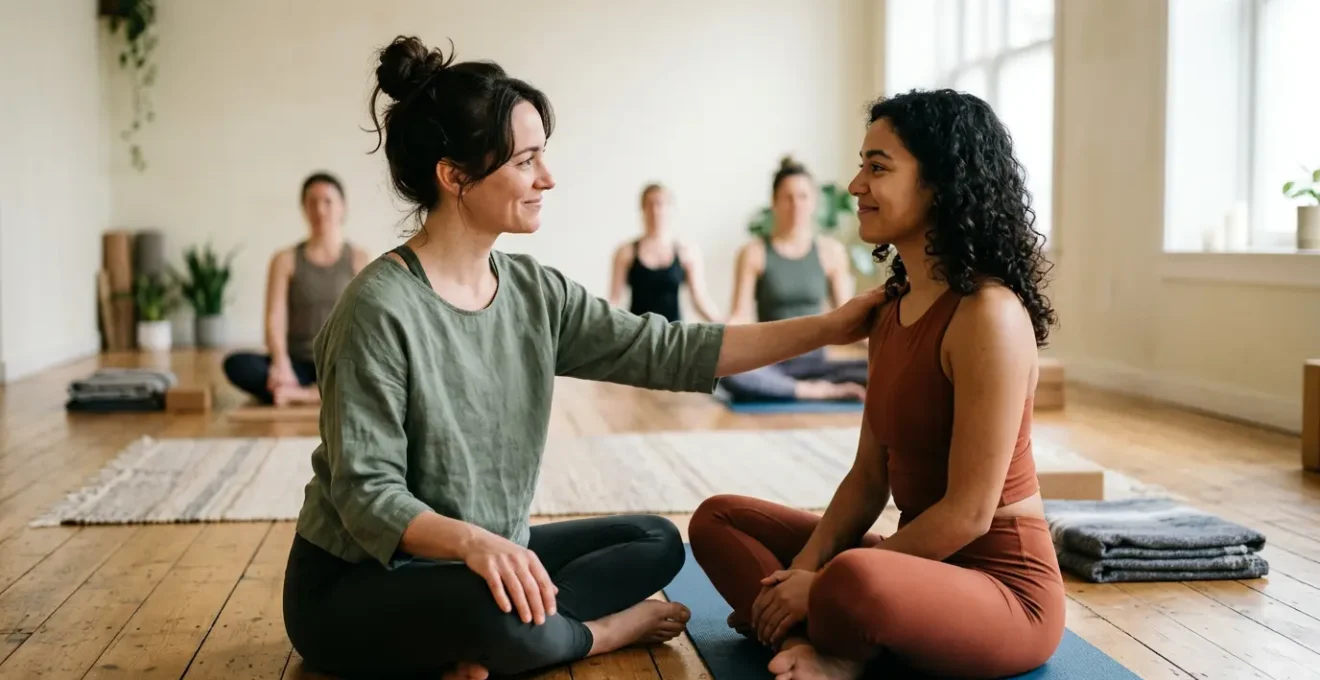
Student retention has less to do with a teacher’s personality and more to do with their mastery of the technical craft of teaching.
- Effective instruction is about creating neurological safety and clarity, allowing students’ brains to follow instructions without cognitive friction.
- The ability to « read the room » is an active, observable skill, not a vague intuition, that allows for real-time adjustments.
Recommendation: Shift your focus from performance (demonstrating the pose) to observation (watching your students’ responses) to transform your teaching effectiveness immediately.
You’ve completed your 200-hour training. You know the poses, you can recite the alignment cues you were taught, and you have a genuine passion for yoga. Yet, you watch as some of your classes thin out, while another teacher in the studio has a packed room week after week. It’s a common and deeply frustrating experience. The conventional wisdom offers familiar advice: « find your authentic voice, » « create a better playlist, » or « just be more confident. » While well-intentioned, this advice misses the fundamental point. It assumes teaching is primarily an art of personality.
This perspective is incomplete. What if the difference between a teacher who struggles and one who thrives isn’t their knowledge or their personality, but their mastery of a specific, learnable set of pedagogical skills? The truth is that teaching yoga is a technical craft. It’s about understanding how the human nervous system learns, how to communicate with precision, and how to create an environment of psychological safety that allows students to truly absorb your instructions. It’s less about being liked and more about being clear, consistent, and responsive.
This article will deconstruct the mechanics behind masterful teaching. We will move beyond the platitudes and dive into the specific techniques that build student trust and loyalty. We will explore the neurological basis of effective cueing, the practical methods for observing and responding to your class in real-time, the critical importance of maintaining your own practice to avoid burnout, and how to choose continuing education that genuinely refines your craft, rather than just adding another certificate to your wall.
Contents: The Craft of Impactful Yoga Teaching
- Why Do Students Follow Some Teachers’ Instructions Instantly While Ignoring Others?
- How Do You Know Mid-Class That Students Are Lost and What Do You Do About It?
- How Do You Maintain Your Own Practice When Teaching 15 Classes Per Week?
- How Long Does It Take to Develop Your Own Teaching Style After Training?
- What Continuing Education Actually Improves Your Teaching Versus Just Adding Credentials?
- Why Group Classes Alone Cannot Refine Your Alignment After the First Year
- What Can You Legally and Ethically Teach After a 200-Hour Certification?
- Why Do Some 200-Hour Trainings Produce Confident Teachers While Others Leave Graduates Lost?
Why Do Students Follow Some Teachers’ Instructions Instantly While Ignoring Others?
The answer lies less in your choice of words and more in the neurological environment you create. When a student feels safe and a teacher’s instructions are clear and embodied, their nervous system can process the cues without resistance. This isn’t magic; it’s biology. The brain contains a « mirror neuron system, » which is fundamental to learning through imitation. As researchers like Rizzolatti have shown, « Observing another’s gestures and movements can activate the mirror neuron system in the learner’s brain to aid in learning through imitation. » When you demonstrate a pose with clarity and confidence, you are literally giving your students’ brains a clear blueprint to follow.
However, this system is highly sensitive to stress. If a student feels confused, rushed, or unsafe, their sympathetic nervous system (the « fight or flight » response) takes over. Cognitive function diminishes, and the ability to learn and follow complex instructions plummets. A masterful teacher understands this intuitively and works to foster a state of calm. This involves more than just a soothing voice; it’s about predictable sequencing, consistent timing, and clear, unambiguous cues. By doing so, you support your students’ ability to self-regulate.
This is where the concept of vagal regulation becomes a powerful tool for a teacher. Effective yoga practice has a measurable impact on the body’s primary calming pathway, the vagus nerve. In fact, research published in Frontiers in Human Neuroscience demonstrates that yoga is correlated with both improved psychological resilience and improved vagal regulation. As a teacher, your clear, calm, and embodied presence acts as an external regulator for the entire room, a process known as co-regulation. When students trust that you are in control and the space is safe, their own systems can relax, making them far more receptive to your guidance.
How Do You Know Mid-Class That Students Are Lost and What Do You Do About It?
The key is to shift from being a performer to being an observer. Many new teachers are so focused on delivering their sequence and remembering their cues that they teach with their eyes closed, either literally or metaphorically. They are demonstrating, not teaching. « Reading the room » is an active, technical skill that involves scanning for specific, observable signs of confusion or struggle. It requires you to be fully present and watchful.
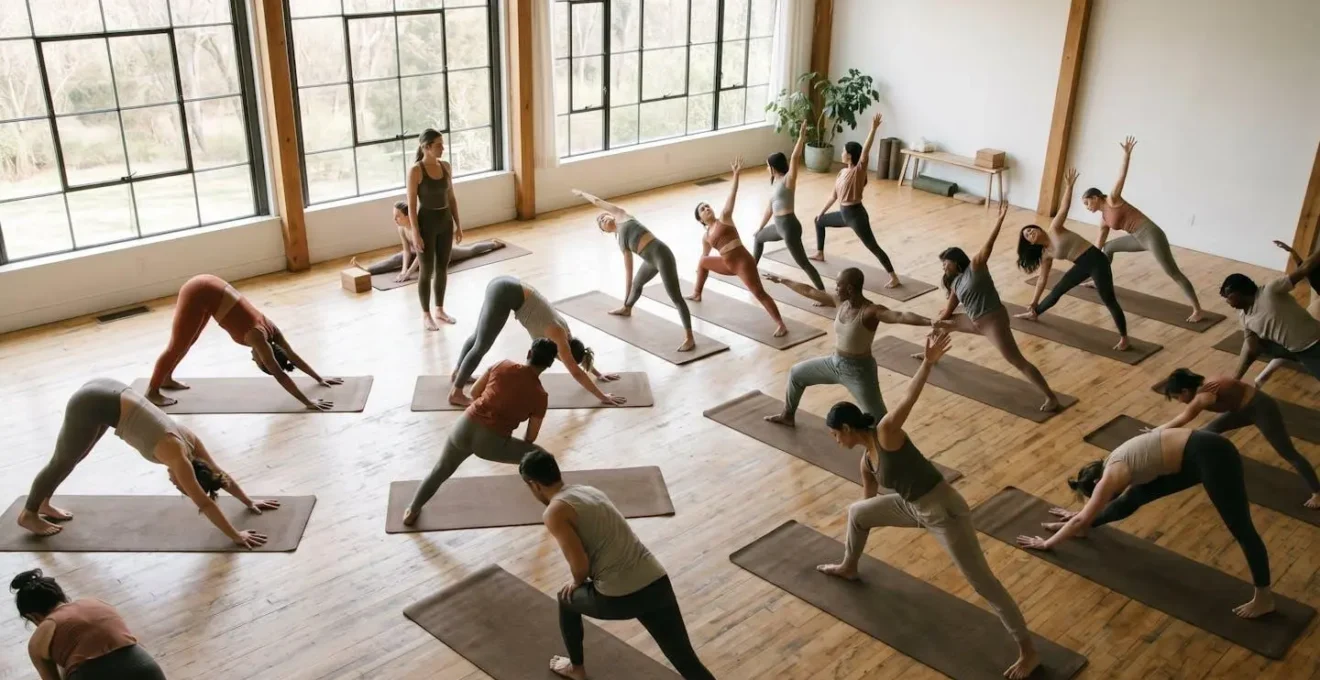
Look for the non-verbal data. Are students’ eyes darting around the room, trying to copy their neighbors? Is there a collective hesitation or a delayed response after you give a cue? Are you seeing widespread misalignment in the same pose, like hyperextended knees in Triangle Pose or rounded lower backs in a forward fold? These are not individual mistakes; they are data points indicating that your instruction was unclear or incomplete. The moment you see a pattern of confusion, pause. Stop the flow. Re-teach the component part. Use a simpler cue, offer a different entry point, or demonstrate from a different angle. Your willingness to interrupt your own plan in service of your students’ understanding is a hallmark of an advanced teacher.
One of the most important shifts that happens in a yoga teacher’s career is when you decide to stop trying to make everyone happy.
– Yoga teacher perspective, Teaching Yoga: Why Do Students Leave, and Why Do They Stay? – YogaUOnline
This is not about pleasing everyone; it’s about being effective. Your job is not to provide a flawless performance but to facilitate a clear learning experience. When you see that a third of the class is lost, it is your responsibility to meet them where they are. This builds immense trust. Students don’t remember the perfect sequence; they remember the teacher who saw they were struggling and took the time to help them understand.
Action Plan: How to Read the Room
- Establish a Scan Pattern: Actively look from front-to-back and side-to-side every 3-4 poses. Note the overall energy and pace.
- Listen for Breathing: Is the breath smooth and steady, or are you hearing held breaths and sharp exhales? This indicates strain or confusion.
- Identify Common Misalignments: Look for one recurring issue across multiple students in a single pose (e.g., collapsed chests in Chaturanga). This is your cue to re-teach.
- Watch for « The Scan »: Notice when multiple students start looking at others for confirmation. This means your verbal cue was not sufficient.
- Pause and Clarify: When you spot a pattern, stop and say, « Let’s pause here. I’m noticing a lot of us are [observation]. Let’s try it this way instead. »
How Do You Maintain Your Own Practice When Teaching 15 Classes Per Week?
The single greatest threat to a yoga teacher’s career is not a lack of students, but burnout. Teaching is an act of giving, and if your own energetic well is dry, you will have nothing left to offer. The gradual erosion of one’s personal practice is the most common path to burnout. You start by sacrificing your morning sadhana to plan a class, then you skip an evening practice because you’re exhausted from teaching three back-to-back sessions. This phenomenon isn’t unique to yoga; it mirrors trends in other teaching professions. For instance, a 2024 RAND survey of K-12 educators found that 60% are burned out, feeling the stress outweighs the rewards.
Your personal practice is not a luxury; it is a non-negotiable professional requirement. It is the source of your energy, your creativity, and your empathy. It is where you work through your own physical and emotional challenges, which in turn makes you a more compassionate and insightful guide for others. Teaching a pose is not the same as practicing it. When you teach, your awareness is external, focused on your students. When you practice, your awareness is internal, focused on your own experience. You cannot effectively guide others into territory you are no longer exploring yourself.
Case Study: The High-Volume Burnout
A full-time yoga teacher documented her experience of teaching 24-28 heated group classes per week, which led to complete physical and emotional burnout. She noted that her personal practice became the first thing to be sacrificed, making it impossible to sustain her energy and passion for teaching. Her recovery involved a drastic reduction in her teaching schedule, finding supplementary income outside of teaching, and, most importantly, treating her personal practice as a fixed, non-negotiable appointment in her calendar. This real-world example underscores that more teaching does not equal a better teacher; sustainable teaching does.
The solution is a radical shift in mindset. Treat your personal practice with the same sanctity as a class you are paid to teach. Schedule it in your calendar and protect that time fiercely. It may mean teaching fewer classes. It may mean accepting that teaching 15-20 classes a week is fundamentally unsustainable for most people in the long term. A teacher with a vibrant personal practice teaching 8 classes a week is infinitely more effective and inspiring than an exhausted teacher going through the motions in 15.
How Long Does It Take to Develop Your Own Teaching Style After Training?
Many new teachers are anxious to « find their style, » believing it’s a personality trait they must discover or invent. This pressure often leads to imitating a beloved teacher or forcing a persona that feels inauthentic. The truth is, your unique teaching style is not found; it is forged over time through consistent practice, dedicated observation, and hundreds of hours of teaching. It is an emergent property of your lived experience in the teaching role.

Your 200-hour training gives you a foundational script. For the first year or two, your primary job is to deliver that script with as much clarity and safety as possible. You are building the basic architecture of your teaching. During this phase, your style is simply « clear and safe. » As you gain more experience, you begin to notice patterns. You see what cues land effectively and which ones cause confusion. You learn which sequences energize a room and which ones ground it. As Allison Ray Jeraci, E-RYT 500, notes, « Your teaching style will forge its own path and will become informed by your students’ learning styles, your preferences for holding space for your students, and the teaching environment you want to cultivate. »
Your style becomes the sum of your solutions to the practical problems of teaching. It’s how you learn to explain Downward-Facing Dog to someone with tight shoulders. It’s the specific prep poses you find work best for Bird of Paradise. It’s the tone you adopt when a student is struggling. This process cannot be rushed. It requires patience and a commitment to the slow craft of refinement. Instead of asking, « What is my style? » ask a better question: « What do my students need right now, and how can I best provide it? » Your style will be the authentic answer to that question, repeated over and over again.
What Continuing Education Actually Improves Your Teaching Versus Just Adding Credentials?
The yoga world is saturated with trainings that promise to expand your skills. While many are valuable, the most impactful continuing education is not about accumulating more knowledge (the « what »), but about refining your delivery of it (the « how »). Adding a certification in a new style of yoga might broaden your offerings, but a training focused on pedagogy, anatomy, or the science of resilience will deepen your effectiveness in every single class you teach, regardless of the style. The goal is to acquire portable skills, not just more credentials.
Look for trainings that focus on the underlying mechanisms of the practice. Instead of a weekend workshop on arm balances, consider an in-depth course on functional anatomy that teaches you the principles of leverage and stability that make *all* arm balances possible. Instead of simply learning a new mantra, seek out education that explains the « why » behind the techniques you already know. This is the difference between collecting recipes and learning how to cook.
A powerful example of this is education that bridges the gap between ancient practice and modern science, making you a more precise and effective teacher.
Case Study: Applied Polyvagal Theory in Yoga
Dr. Arielle Schwartz’s training on applying polyvagal theory to yoga is a prime example of deep, effective continuing education. Instead of teaching new poses, this course teaches the ‘how’ behind creating a healing environment. Teachers learn how specific breathing techniques work with autonomic imbalances, how asana can reduce pain by creating a new relationship with sensation, and how the teacher-student dynamic (co-regulation) is key to a therapeutic experience. This is a portable skill; a teacher who understands these principles can apply them to a Vinyasa class, a Restorative session, or a private client, making their teaching fundamentally more effective across the board.
When evaluating a training, ask yourself: Will this make me better at teaching what I already know? Will it give me a new framework for understanding my students’ experience? Or will it just add another line to my bio? Prioritize depth over breadth. One profound training that changes *how* you teach is worth more than five that just give you more *what* to teach.
Why Group Classes Alone Cannot Refine Your Alignment After the First Year
As a practitioner, group classes are essential for community and energy. But as a teacher looking to refine your own practice and teaching, they have a significant limitation: the feedback is generalized. A teacher leading a class of 30 students simply cannot provide the nuanced, personalized feedback required to break through ingrained movement patterns or subtle misalignments. After the initial learning phase, your progress in a group class environment often plateaus.
To evolve, you need a different kind of input. This is where mentorship, private sessions with a senior teacher, or joining a dedicated peer practice group becomes invaluable. You need an experienced eye focused solely on you. This external perspective is crucial for identifying your blind spots—the habitual ways you move that you can no longer feel. Maybe you consistently shift weight onto one foot in Tadasana, or you initiate twists from your lower back instead of your thoracic spine. These are the details a group class teacher will likely miss, but a mentor will spot immediately.
This need for individualized guidance is a core principle of effective teaching pedagogy. In fact, an analysis of successful teacher training programs demonstrates that programs providing personalized feedback and access to subject matter experts produce significantly more confident graduates. What is true for learning to teach is also true for refining your practice. To grow beyond a certain point, you need specific, actionable feedback on your own body and movement. Investing in a few private sessions with a teacher you admire can provide more growth than months of group classes. It’s a concentrated dose of the very thing you’re trying to provide for your own students: focused, expert attention.
What Can You Legally and Ethically Teach After a 200-Hour Certification?
A 200-hour certification is the foundational starting point for a yoga teacher. Legally, the yoga industry is largely unregulated in most regions, meaning your certification is a credential recognized by studios and insurance companies, not a state-issued license. Ethically, however, your scope of practice is much clearer. Your training has prepared you to guide students through asana (postures), pranayama (breathing exercises), and basic meditation.
Your role is to teach the techniques of yoga. It is not to be a psychotherapist, a nutritionist, or a medical advisor. One of the most significant ethical lines a new teacher can cross is offering advice outside their field of expertise. You may have a student share a personal struggle or a physical ailment. Your job is to listen with compassion and, when appropriate, guide them back to the physical and energetic sensations of their practice on the mat. You can suggest modifications for an injury, but you cannot diagnose it. You can create a space for emotional release, but you cannot offer psychological counseling. There is a well-documented grey area of teachers offering life advice or psychological guidance without credentials, and this can create unhealthy and co-dependent student-teacher dynamics.
The RYT-200 credential is a license to begin your teaching journey, not a declaration of mastery. According to Yoga Alliance standards, the foundational 200-hour training provides a strong base in techniques, philosophy, and anatomy. It qualifies you to teach foundational yoga classes to the general population. It does not qualify you to work with significant trauma, severe injuries, or complex medical conditions without further specialized training. Honoring this scope of practice is not a limitation; it is a sign of professional integrity. It protects your students, and it protects you. Knowing your boundaries is as important as knowing your poses.
Key Takeaways
- Shift from Performer to Observer: Your primary job is not to demonstrate poses perfectly, but to observe your students and respond to what you see.
- Prioritize Clarity Over Complexity: Simple, clear, and well-timed instructions are more effective than poetic but ambiguous cues. Your goal is student understanding.
- Protect Your Personal Practice: Treat your own time on the mat as a non-negotiable professional requirement. It is the source of your energy and insight.
Why Do Some 200-Hour Trainings Produce Confident Teachers While Others Leave Graduates Lost?
The vast difference in outcomes between 200-hour Yoga Teacher Trainings (YTTs) often comes down to one crucial element: the emphasis on the practical application of teaching skills. A training that spends the majority of its time on lectures about philosophy and anatomy while dedicating only a few hours to actual practice-teaching will produce knowledgeable graduates who are terrified to lead a class. Conversely, a training that gets you on your feet, teaching your peers from the first week, builds confidence and competence through direct experience.
Confidence is not a personality trait; it is a byproduct of repeated, successful application of a skill. The best YTTs create a structured, safe environment for this repetition. They understand that teaching is a craft learned by doing. As the Kripalu School of Yoga states about their program, » The practice-teach sessions are the determining factor for whether or not a student will graduate. Being able to successfully and safely deliver a complete yoga class… is a requirement for certification. » This isn’t just a final exam; it’s the central pillar of the learning process.
Furthermore, strong programs focus not just on *what* to teach, but *how* to teach it, often by exposing students to a variety of subject matter experts.
Case Study: YogaRenew’s Pedagogical Model
The YogaRenew 200-hour training provides a clear model for success by de-emphasizing the « guru » model. Instead of one or two lead trainers covering all topics, they bring in dedicated subject matter experts for anatomy, philosophy, sequencing, and the business of yoga. Students get live access to these experts and receive personalized feedback on their practice-teaching. This approach directly addresses the pedagogy gap. It recognizes that knowing anatomy is different from being able to teach anatomy effectively. By providing access to experts in both the subject and its delivery, the training builds true competence and, therefore, genuine confidence.
Ultimately, a 200-hour program is successful if it treats teaching as a skill to be drilled, not just a body of knowledge to be memorized. When choosing a YTT or reflecting on your own, the most important question is: « How much time did I spend actually teaching and receiving specific, constructive feedback? » That answer is the strongest predictor of a graduate’s readiness to step confidently in front of a class.
The journey from a knowledgeable student of yoga to an effective teacher is a shift in focus from self to other, from performance to observation, and from theory to craft. Your value is not in the poses you can do, but in the understanding you can facilitate for others. Begin today by applying these principles. In your very next class, make a conscious choice to watch more than you demonstrate, to prioritize clarity over poetry, and to see your students not as an audience, but as your partners in the practice.